The book is finished. GIBBS: The Forgotten Warrior of the First New York Dragoons, by Garland H. Green Jr. How to order is coming soon; you can reserve a copy now. Reserve a copy →
Alfred GibbsThe research archive
Menu

The evidence behind your reading · San Augustine Springs

Read the records behind this chapter

Follow a letter, report, recollection or family record beyond the passage in the book. Each source below shows where the chapter uses it and what to examine. Open it here, compare its pages, and return without losing your chapter.

Begin with a question: How did Gibbs ask his conduct to be examined?

Go beyond the book · San Augustine Springs

Separate the surrender from accounts of responsibility

San Augustine Springs left officers explaining what they had done and who had ordered it. Gibbs’s reports and request for inquiry let readers examine his account in his own formal words.

New to these records? A little context.

A docket is an office’s summary or filing note; it may be on a wrapper rather than in the letter. An endorsement is another official’s response or forwarding note. Read each voice and date separately. A transcription is a reading of a document, with uncertain words marked where the exhibit provides them.

How did Gibbs ask his conduct to be examined?
Research preview · An invitation into the written account, not a reproduction of an original document.

Read the source exhibit & its explanation

Gibbs’s reports and request for inquiry

The exhibit presents reports and a sworn statement printed in the Official Records. It identifies his charges against Lynde and his later request for a court of inquiry.

What to examine: Read the August report before the later statement and inquiry request. Track which events Gibbs says he saw, which orders he received, and what relief he requested.

Keep this distinction in mind: An officer’s report is evidence of his account, not automatic adjudication of every dispute. Compare it with other witnesses rather than treating its formal format as a verdict.

Follow this question into San Augustine Springs →

Keep your question in view as you explore. The reading tray retains San Augustine Springs. Close it to return to this point, or deliberately choose to explore outside the chapter.

9 distinct source records · Page 2 of 2

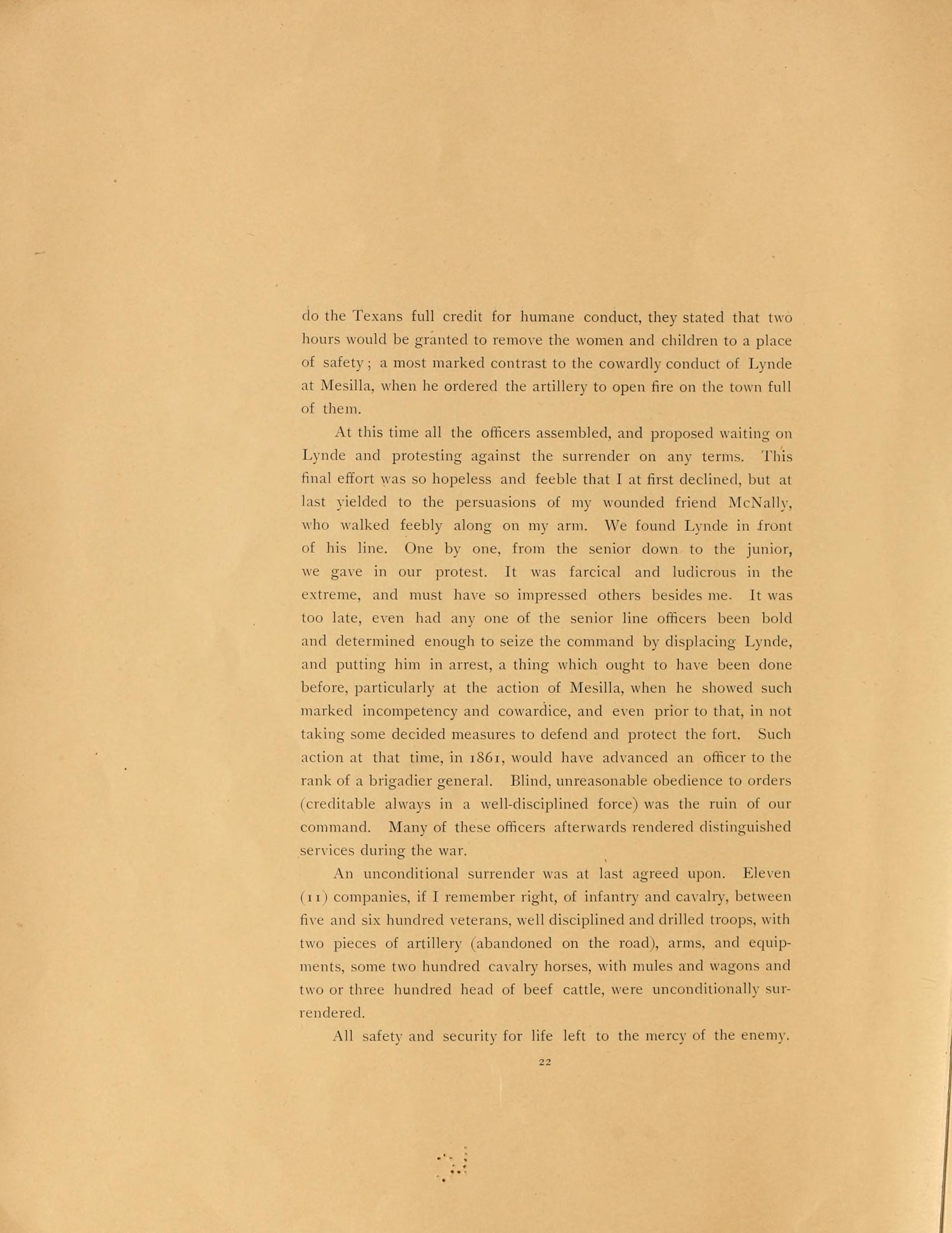
Printed page (archive.org leaf 25) · Internet Archive scan
Printed page (archive.org leaf 25) · Internet Archive scan · Document preview; the quoted page may differ.

Named source

McKee, J. C. (1886). Narrative of the surrender of a command of U.S. forces at Fort Filmore, N.M., in July, A.D. 1861 (3rd ed.). John A. Lowell & Co.

Begin with who made this record, when and for whom. Compare the book’s words with the scan and the surrounding transcription. Distinguish what the writer observed from a request, opinion or later interpretation.

Your passage · San Augustine Springs

farcical and ludicrous in the extreme.

Source identified; page to confirm. Read the surrounding record before drawing a conclusion.

· page to confirm

Where this chapter uses this source · 1 passage

San Augustine Springs

farcical and ludicrous in the extreme.

Source identified; page to confirm

Examine quotation 18-023 →

Open the record and its pages →

2 catalogued pages. Transcription and image availability are shown on the document view.

Citation and source credit

McKee, J. C. (1886). Narrative of the surrender of a command of U.S. forces at Fort Filmore, N.M., in July, A.D. 1861 (3rd ed.). John A. Lowell & Co.

Citation details need review.

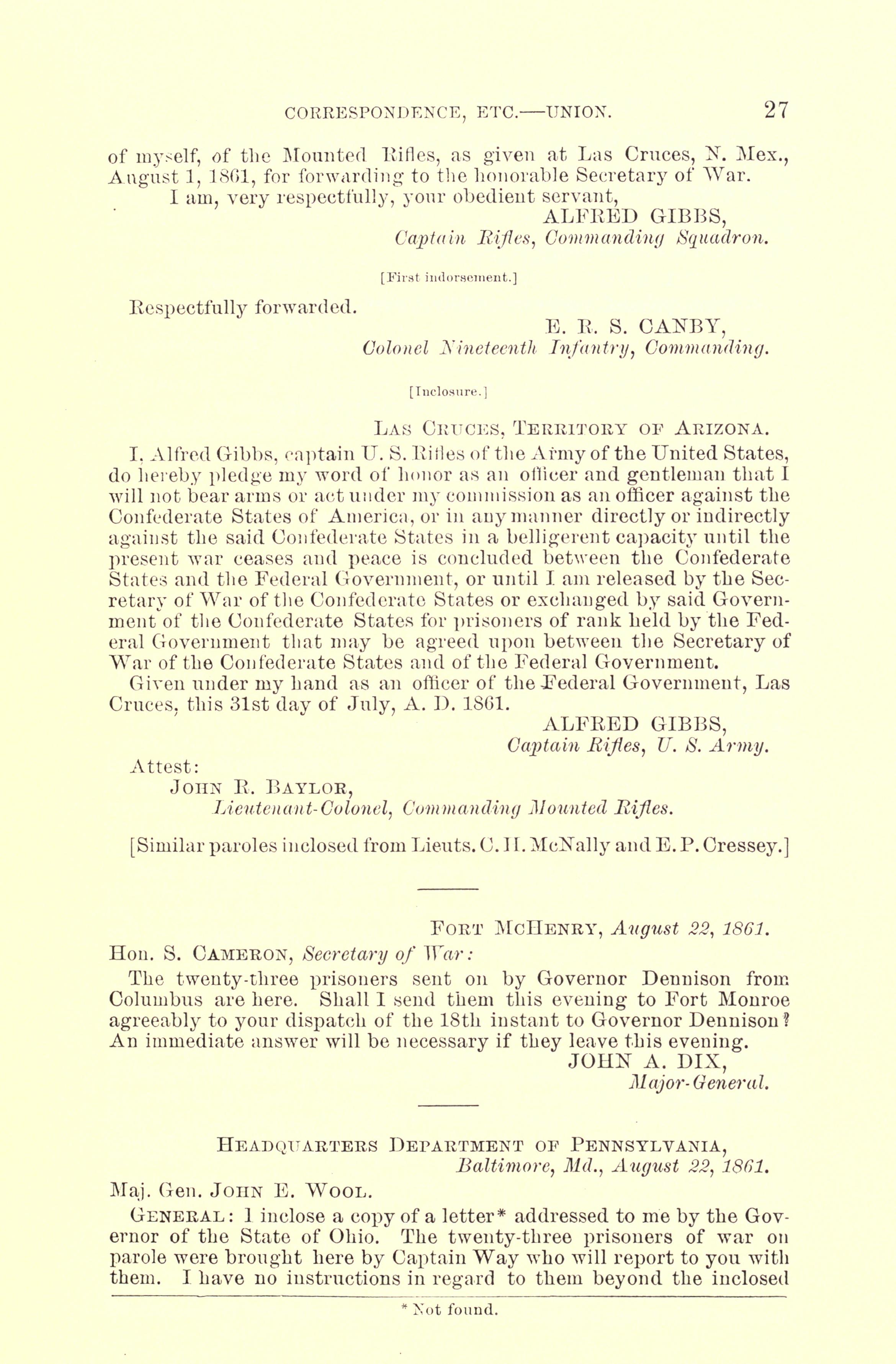
Printed page (archive.org leaf 44) · Internet Archive scan
Printed page (archive.org leaf 44) · Internet Archive scan · Supplied page connection.

Named source

U.S. War Department (1898). The war of the rebellion: Official records of the Union and Confederate armies, Series II, Vol. 3 (Gibbs parole, Fort Wayne and exchange correspondence, 1861-1862)

Begin with who made this record, when and for whom. Compare the book’s words with the scan and the surrounding transcription. Distinguish what the writer observed from a request, opinion or later interpretation.

Your passage · Las Cruces and Fort Craig

I, Alfred Gibbs, captain U. S. Rifles of the Army of the United States, do hereby pledge my word of honor as an officer and gentleman that I will not bear arms or act under my comm…

Source identified; supplied locator: p. 27. Read the surrounding record before drawing a conclusion.

· see page labels

Where this chapter uses this source · 2 passages

Las Cruces and Fort Craig

I, Alfred Gibbs, captain U. S. Rifles of the Army of the United States, do hereby pledge my word of honor as an officer and gentleman that I will not bear arms or act under my commission as an officer…

Source identified; supplied locator: p. 27

Examine quotation 18-027 →

Las Cruces and Fort Craig

Attest; JOHN R. BAYLOR, Lieutenant-Colonel, Commanding Mounted Rifles.

Source identified; supplied locator: p. 27

Examine quotation 18-028 →

Open the record and its pages →

16 catalogued pages. Transcription and image availability are shown on the document view.

Citation and source credit

U.S. War Department. (1898). The war of the rebellion: A compilation of the official records of the Union and Confederate armies (Series II, Vol. 3). Government Printing Office. https://archive.org/details/warofrebellion0203rootrich

Citation details need review.

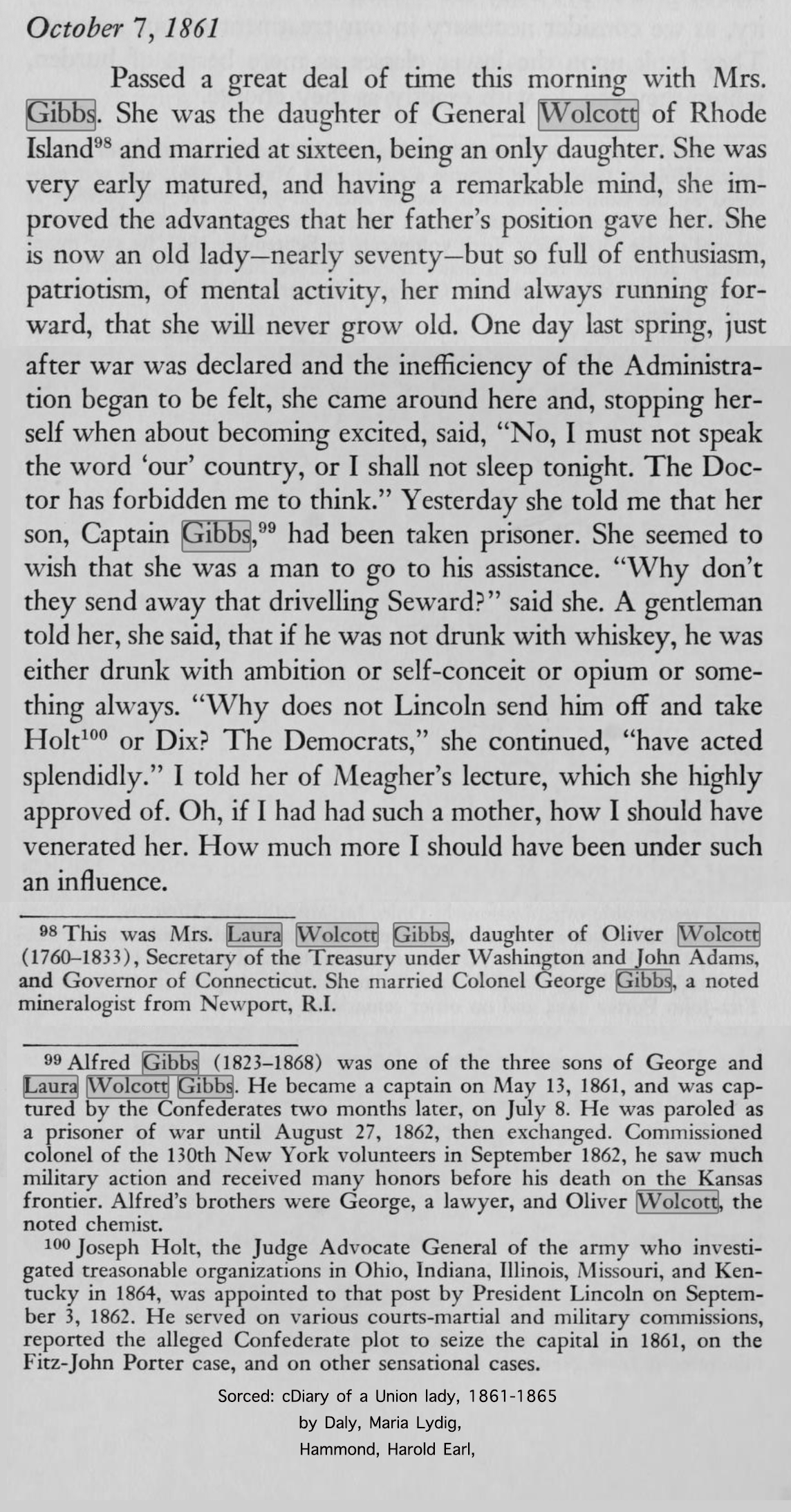
Excerpt (copyrighted book; the passage only, shown under fair use) · screenshot on Garland’s page
Excerpt (copyrighted book; the passage only, shown under fair use) · screenshot on Garland’s page · Supplied page connection.

Modern book (secondary)

Daly, M. L. (1962). Diary entry, October 7, 1861. In H. E. Hammond (Ed.), Diary of a Union lady, 1861-1865. Funk & Wagnalls.

Read the historian’s argument in its published context. This is secondary interpretation, not an original eyewitness record. Copyrighted text is not reproduced here.

Your passage · The other side of the record

Yesterday she told me that her son, Captain Gibbs had been taken, prisoner. She seemed to wish that she was a man to go to his assistance.

Source identified; page to confirm. Read the surrounding record before drawing a conclusion.

· Page references are recorded with each quotation.

Where this chapter uses this source · 1 passage

The other side of the record

Yesterday she told me that her son, Captain Gibbs had been taken, prisoner. She seemed to wish that she was a man to go to his assistance.

Source identified; page to confirm

Examine quotation 18-037 →

Open the record and its pages →

1 catalogued pages. Transcription and image availability are shown on the document view.

Citation and source credit

Daly, M. L. (1962). Diary entry, October 7, 1861. In H. E. Hammond (Ed.), Diary of a Union lady, 1861-1865. Funk & Wagnalls.

Citation details need review.

← Continue your chapter journey · Follow the people in this chapter →

Your chapter stays open
Your book journey · San Augustine SpringsExplore the evidence

Compare the original with its transcription and citation.

Explore outside this journey ↗

This chapter’s source collection as JSON