
There was no grand “Battle of Amelia Court House.” What happened in Amelia County on April 4–5, 1865 was something quieter and, for the Confederacy, more fatal. Falling back from Richmond and Petersburg, Gen. Robert E. Lee concentrated the Army of Northern Virginia at Amelia Court House, on the Richmond & Danville Railroad, counting on rations to be waiting there. They were not. The day Lee lost foraging the countryside for food gave Maj. Gen. Philip H. Sheridan’s cavalry — the First New York Dragoons riding in its ranks — the time they needed to get ahead of the retreat and slam the door at Jetersville, setting the stage for the disaster at Sailor’s Creek two days later.
Lee’s Fatal Halt
When the lines at Petersburg broke on April 2, 1865, Lee ordered his scattered columns to converge on Amelia Court House, where he expected trains of food to meet the army. The supply situation was the whole reason for the concentration. But the rations never arrived; the cars that did reach Amelia carried ammunition the army did not need. Forced to halt and scour the surrounding farms for provisions, Lee burned a full day he could not spare.
That lost day decided the campaign. While the Confederates foraged, the Union cavalry pressed on hard for the Richmond & Danville Railroad below Amelia, reaching Jetersville and throwing a line across Lee’s intended route of escape. When Lee’s army resumed its march on the 5th, it found the road south already blocked and had to swing west — straight toward the catastrophe at Sailor’s Creek on April 6.
The Dragoons in the Pursuit
For the First New York Dragoons these were days of motion, not of set-piece battle. By the spring of 1865 the regiment — still carrying its old infantry designation as the 19th New York — rode under Maj. Howard M. Smith in Col. Charles L. Fitzhugh’s Second Brigade of Brig. Gen. Thomas C. Devin’s First Cavalry Division. Their own historian, James R. Bowen, remembered the relentless pace: during April 2, 3, and 4 the regiment was “almost incessantly on the move,” chasing the retreating enemy and tearing up railroad track, with sharp daily engagements that cost a steady trickle of wounded.
Bowen names the April 4 affair near Amelia Court House Drummond’s Mills, grouping it with Sutherland Station and Deep Creek as “hotly contested engagements” whose particulars he frankly leaves out — each, he says, ending in a victory for the boys in blue. After the fight at Drummond’s Mills the division held its ground until ten at night, then set off on a long, exhausting march over wretched roads, reaching Jetersville the next day. The men, Bowen wrote, had “scarcely enjoyed an hour of undisturbed rest for over a week.”
“Each of these three battles, Sutherland Station, Deep Creek, and Drummond’s Mills (Amelia Courthouse), were hotly contested engagements; the details are omitted. However, each resulted in a splendid victory for the ‘boys in blue.’”— James R. Bowen, Regimental History of the First New York Dragoons (1900), ch. XXI, “Appomattox Campaign — The Final Battles.”
Where Gibbs Was
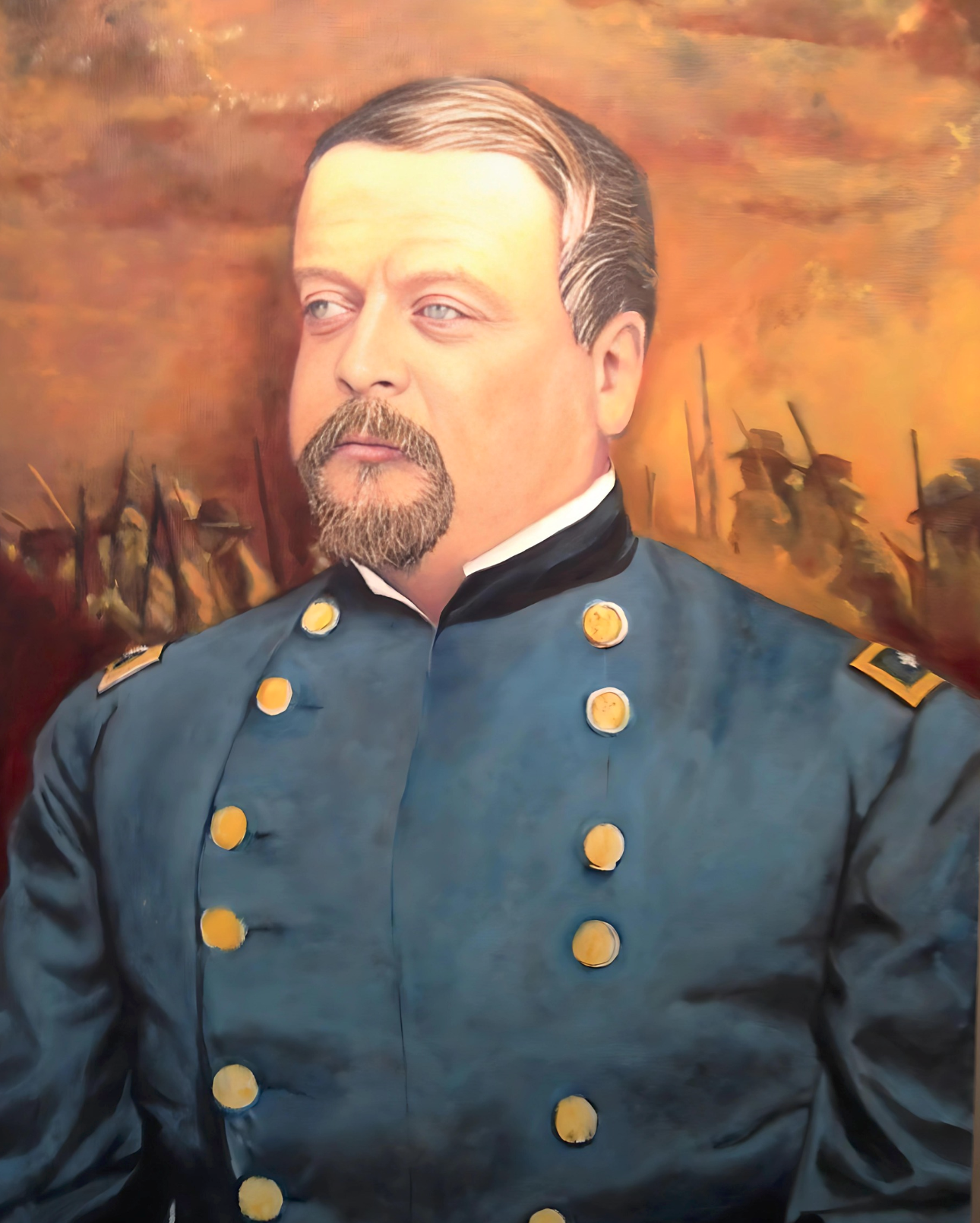
Brevet Major General Alfred Gibbs did not lead the Dragoons in this campaign; in the spring of 1865 he commanded the Third (Reserve) Brigade — the 2nd Massachusetts and 6th Pennsylvania volunteers and the regular 1st, 5th, and 6th U.S. Cavalry — in the same First Division under Devin. The regiment he had so long commanded now rode in the neighboring brigade, but the old Reserve Brigade was never far off in the pursuit that ran Lee’s army to ground.
The Opposing Forces in the Appomattox Campaign
The full order of battle as printed in Bowen’s regimental history. The First New York Dragoons (19th N.Y.) appear in Fitzhugh’s Second Brigade; Gibbs commanded the Third (Reserve) Brigade.
CAVALRY, Maj.-Gen. Philip H. Sheridan.
ARMY OF THE SHENANDOAH, Brig.-Gen. Wesley Merritt.
FIRST DIVISION, Brig.-Gen. Thomas C. Devin.
- First Brigade, Col. Peter Stagg:
- 1st Mich., Lieut.-Col. George R. Maxwell, Capt. Edward L. Negus
- 5th Mich., Lieut.-Col. Smith H. Hastings
- 6th Mich., Lieut.-Col. Harvey H. Vinton
- 7th Mich., Lieut.-Col. George G. Briggs
- Second Brigade, Col. Charles L. Fitzhugh:
- 6th N. Y., Maj. Harrison White
- 9th N. Y., Maj. James R. Dinnin
- 19th N. Y. (1st N. Y. Dragoons), Maj. Howard M. Smith
- 17th Pa., Lieut.-Col. Coe Durland
- 20th Pa., Lieut.-Col. Gabriel Middleton
- Third (Reserve) Brigade, Brig.-Gen. Alfred Gibbs:
- 2d Massachusetts Cavalry Regiment [read a short history]., Col. Casper Crowninshield
- 6th Pa. Cavalry Regiment (6 co’s) [read a short history], Col. Charles I. Leiper.
- 1st U. S. Cavalry Regiment, Capt. Richard S. C. Lord
- 5th U. S Cavalry Regiment [read a short history]., Capt. Thomas Drummond, Lieut. Gustavus Urban
- 6th U. S Cavalry Regiment [read a short history]., Maj. Robert M. Morris
- Artillery : C and E, 4th U. S., Capt. Marcus P. Miller.
THIRD DIVISION, Brig.-Gen. George A. Custer, Col. Alexander C. M. Pennington :
- 1st Conn., Col. Brayton Ives
- 3d N. J., Lieut.-Col. William P. Robeson, Jr.
- 2d N. Y., Col. Alanson M. Randol
- 2d Ohio, Lieut.-Col. A. Bayard Nettleton
Second Brigade, Col. William Wells:
- 8th N. Y., Maj. James Bliss
- 15th N. Y., Col. John J. Coppinger
- 1st Vt., Lieut.-Col. Josiah Hall
Third Brigade, Col. Henry Capehart:
- 1st N. Y., Lieut.-Col. Jenyns C. Battersby
- 1st W. Va., Maj. Shesh B. Howe, Lieut.-Col. Charles E. Capehart
- 2d W. V a., Lieut.-Col. James Allen
- 3d W. Va., Maj. John S. Witcher
SECOND Division (Army of the Potomac), Maj.-Gen. George Crook:
First Brigade, Brig.-Gen. Henry E. Davies:
- 1st N. J., Col. Hugh H. Janeway, Maj. Walter R. Robbins
- 10th N. Y., Col. M. Henry Avery
- 24th N. Y ., Col. Walter C. Newberry, Lieut.-Col. Melzer Richards, Maj. William A. Snyder
- ist Pa. (5 co’s), Maj. Hampton S. Thomas
- A, 2d U. S. Art’y, Lieut. James H. Lord
Second Brigade, Col. J. Irvin Gregg, Capt. Samuel B. M. Young:
- 4th Pa., Lieut.-Col. Alender P. Duncan
- 8th Pa., Lieut.-Col. William A. Corrie
- 16th Pa., Lieut.-Col. John K. Robison, Maj. William H. Fry
- 21st Pa., Col. Oliver B. Knowles
- H and I, 1st U. S. Art’y (detached with Art’y Brigade, 9th Corps), Lieut. Chandler P. Eakin
Third Brigade, Col. Charles H. Smith:
- Fist Me., Lieut.-Col. Jonathan P. Cilley
- 2d N. Y., Mounted Rifles, Maj. Paul Chadbourne, Col. John Fisk
- 6th Ohio, Capt. Matthew H. Cryer, Capt. Frank C. Loveland
- 13th Ohio, Lieut.-Col. Stephen R. Clark
ARMY OF THE JAMES, Maj.-Gen. Edward O. C. Ord:
- Headquarters Guard: D, 3d Pa. Art’y, Capt. Edwin A. Evans; I, 3d Pa. Art’y, Capt: Osbourn Wattson
- Engineers: 1st N. Y., Col. James F. Hall
- Pontoniers: I, 3d Mass. Art’y, Capt. John Pickering, Jr.
- Unattached Cavalry: I, L, and M, 4th Mass., Col. Francis Washburn; 5th Mass. (colored), Col. Charles F. Adams, Jr.; 7th N. Y. (1st Mounted Rifles), Col. Edwin V. Sumner
DEFENSES OF BERMUDA HUNDRED, Maj. Gen. George L. Hartsuff:
INFANTRY Division Brig.-Gen. Edward Ferrero
- First Brig.-Gen. Gilbert H. McKibbin: 41st N. Y., Lieut.-Col. Detleo von Einsiedel; 103d N. Y., Capt. William Redlick; 2d Pa., H. Art’y, Maj. Benjamin F. Winger; 104th Pa., Lieut.-Col. Theophilus Kephart
- Second Brigade, Col. George C. Kibbe: 6th N. Y. H. Art’y, Lieut.-Col. Stephen Baker; 10th N. Y. H. Art’y, Lieut.-Col. G. de Peyster Arden
- Artillery: 33d N. Y., Capt. Alger M. Wheeler
ARTILLERY: A and H, 13th N. Y. Heavy, Capt. Wm. Pendrell; 7th N. Y., Lieut. Martin V McIntyre; E, 3d Pa. Heavy, Capt. Erskine H. Miles; M, 3d Pa. Heavy, Lieut. Sylvester W. Marshall
SEPARATE BRIGADE, Brig.-Gen. Joseph B. Carr:
- FORT POCAHONTAS, Lieut.-Col. Ashbel W. Angel: 38th N. J. (4 co’s), Maj. William H. Tantum; D, 20th N. Y. Cav., Capt. Wayland F. Ford; E, 16th N. Y. H. Art’y, Capt. John W. Hees; H, 16th N. Y. H. Art’y, Capt. Henry C. Thompson; I, 184th N. Y., Capt. George Wetmore
- HARRISON’S LANDING, Col. Wardwell G. Robinson: / 184th N. Y., Lieut.-Col. William P. McKinley; I, 1st U. S. Colored Cav., Lieut. Horace Hudson
- Fort Powhatan, Col. William J. Sewell: 38th N. J. (6 co’s), Col. William J. Sewell; F, 20th N. Y. Cav., Lieut. John C. Pollard; detachment 3d Pa. H. Art’y, Lieut. Frederick Grill; E, 1st U. S. Colored Cav., Capt. Charles W. Emerson
TWENTY-FOURTH ARMY CORPS, Maj.-Gen. John Gibbon:
- Headquarters Guard, Capt. Charles E. Thomas: F, 4th Mass. Cav., Capt. Joseph J. Baker; K, 4th Mass. Capt Capt. Charles E. Thomas
THIRD DIVISION, Brig.-Gen. Charles Devens, Jr:
- First Brigade, Col. Edward H. Ripley: 11th Conn., Maj. Charles Warren; 13th N. H., Lieut.-Col. Normand Smith; 81st N. Y., Capt. Matthew T. Betton; 98th N. Y., Lieut.-Col. William Kreutzer; 139th N. Y., Maj. Theodore Miller; 19th Wis., Maj. Samuel K. Vaughan
- Second Brigade, Col. Michael T. Donohoe: 8th Conn., Maj. William M. Pratt; 5th Md., Lieut.-Col. William W. Bamberger; 10th N. H., Capt. Warren M. Kelley; 12th N. H., Lieut.Col. Thomas E. Barker; 96th N. Y., Capt. George W. Hindes; 118th N. Y., Lieut.-Col. Levi S. Dominy; 9th Vt., Lieut.-Col. Valentine G. Barney
- Third Brigade, Col. Samuel H. Roberts: 21st Conn., Lieut.-Col. James F. Brown; 40th Mass., Lieut.-Col. John Pollack; 2d N. H., Lieut.-Col. Joab N. Patterson; 58th Pa.., Lieut.-Col. Cecil Clay; 188th Pa., Lieut.-Col. George K. Bowen
INDEPENDENT DIVISION, Brig.-Gen. John W. Turner:
- First Brigade, Lieut.-Col. Andrew Potter: 34th Mass., Capt. Frank T. Leach; 116th Ohio, Lieut.-Col. Wilbert B. Teters; 123d Ohio, Lieut.-Col. Horace Kellogg
- Second Brigade, Col. William B. Curtis: 23d Ill., Capt. Patrick M. Ryan; 54th Pa., Lieut: Col. Albert P. Moulton; 12th W. Va., Capt. Erastus G. Bartlett
- Third Brigade, Col. Thomas M. Harris: 10th W. Va., Capt. Marshal W. Coburn; 11th W. Va., Maj. Michael A. Ayers; 15th W. Va., Lieut.-Col. John W. Holliday
ARTILLERY, Maj. Charles C. Abell:
- E, 3d N. Y., Capt. George E. Ashby
- H, 3d N. Y., Capt. Enoch Jones
- K, 3d N. Y., Capt. James R. Angel
- M, 3d N. Y., Capt. John H. Howell
- 17th N. Y., Capt. George T. Anthony
- A, 1st Pa., Capt. William Stitt
- F, 1st R. I., Lieut. Charles E. Guild
- B, 1st U. S., Capt. Samuel S. Elder
- L, 4th U. S., Lieut. Henry C. Hasbrouck
- A, 5th U. S., Lieut. Charles P. Muhlenberg
- F, 5th U. S., Lieut. Henry B. Beecher
TWENTY-FIFTH ARMY CORPS (1), Maj.-Gen. Godfrey Weitzel:
- Provost Guard: E and H, 4th Mass. Cav., Maj. Atherton H. Stevens, Jr.
FIRST DIVISION, Brig.-Gen. August V. Kautz:
- First Brigade, Col. Alonzo G. Draper: 22d U. S., Lieut.Col. Ira C. Terry; 36th U. S., Lieut.-Col. Benjamin F. Pratt; 38th U. S., Col. Robert M. Hall; 118th U. S., Col. John C. Moon
- Second Brigade, Brig.-Gen. Edward A. Wild: 29th Conn., Col. William B. Wooster; 9th U. S., Col. Thomas Bayley; 115th U. S. (detached from 1st Brigade, 2d Division), Col. Robert H. Earnest; 117th U. S., Col. Lewis G. Brown
- Third Brigade, Brig.-Gen.
(1) The infantry was composed entirely of colored troops.
Sources & Further Reading
- Primary James R. Bowen, Regimental History of the First New York Dragoons (originally the 130th N.Y. Vol. Infantry) (1900), ch. XXI, “Appomattox Campaign — The Final Battles,” pp. 282–291 — the regiment’s own eyewitness historian. Full text: archive.org/details/regimentalhistor00bowe.
- Primary U.S. War Dept., The War of the Rebellion: Official Records of the Union and Confederate Armies, Series I, Vol. 46 (the reports and correspondence of the Appomattox Campaign, including Sheridan’s and Meade’s movements about Amelia Court House and Jetersville).
- American Battlefield Trust — the Appomattox Campaign and Lee’s retreat: battlefields.org/learn/civil-war/battles/appomattox-court-house.
- National Park Service / Civil War Sites Advisory Commission (CWSAC) battle summaries for the Appomattox Campaign — Amelia Springs and Jetersville (April 5, 1865) and Sailor’s Creek (April 6, 1865): nps.gov/abpp/battles.
Views: 50
Explore the evidence
View this article’s connected sources and media →
About this page
This article was brought over from AlfredGibbs.com. Its preserved text, media and citations remain available for comparison.