
In late December 1864, the First New York Dragoons rode with Brigadier General Alfred T. A. Torbert’s cavalry on a raid toward the Virginia Central Railroad at Gordonsville and Charlottesville. The expedition is remembered less for its fighting than for the brutal winter weather that punished men and horses. Its one clear success — the capture of two guns at Liberty Mills on December 22 — was won in part by the Dragoons, but the column failed to break the railroad and withdrew to Winchester by December 28.
Background
By December 1864, Philip H. Sheridan’s army had cleared organized Confederate forces from the lower Shenandoah Valley after the victories at Fisher’s Hill and Cedar Creek. General Grant wanted the Virginia Central Railroad — the line linking the Valley to Richmond through Gordonsville and Charlottesville — broken up. Despite the season, Sheridan ordered a mounted raid. Bowen records the regiment’s understanding of the plan: “General Torbert, with about eight thousand cavalry, was directed to strike the railroad at Charlottesville, and follow it up to Lynchburg, destroying everything of use to the enemy.” (Bowen, Regimental History of the First New York Dragoons (1900). Other accounts based on the Official Records put Torbert’s force nearer 5,000.)
The March
The column moved out from Winchester on December 19, 1864, passing through Front Royal and Chester Gap. The pleasant weather did not last. As Bowen put it, “The weather, at first pleasant, changed within thirty-six hours, first to a drizzling rain, then to a wretchedly disagreeable sleet” (Bowen, 1900). The temperature then fell so fast that the men’s soaked clothing froze stiff, and they could only keep from freezing by dismounting and leading their horses on foot. One night’s snow buried the sleeping men eight inches deep. Many on picket were frostbitten and permanently injured.
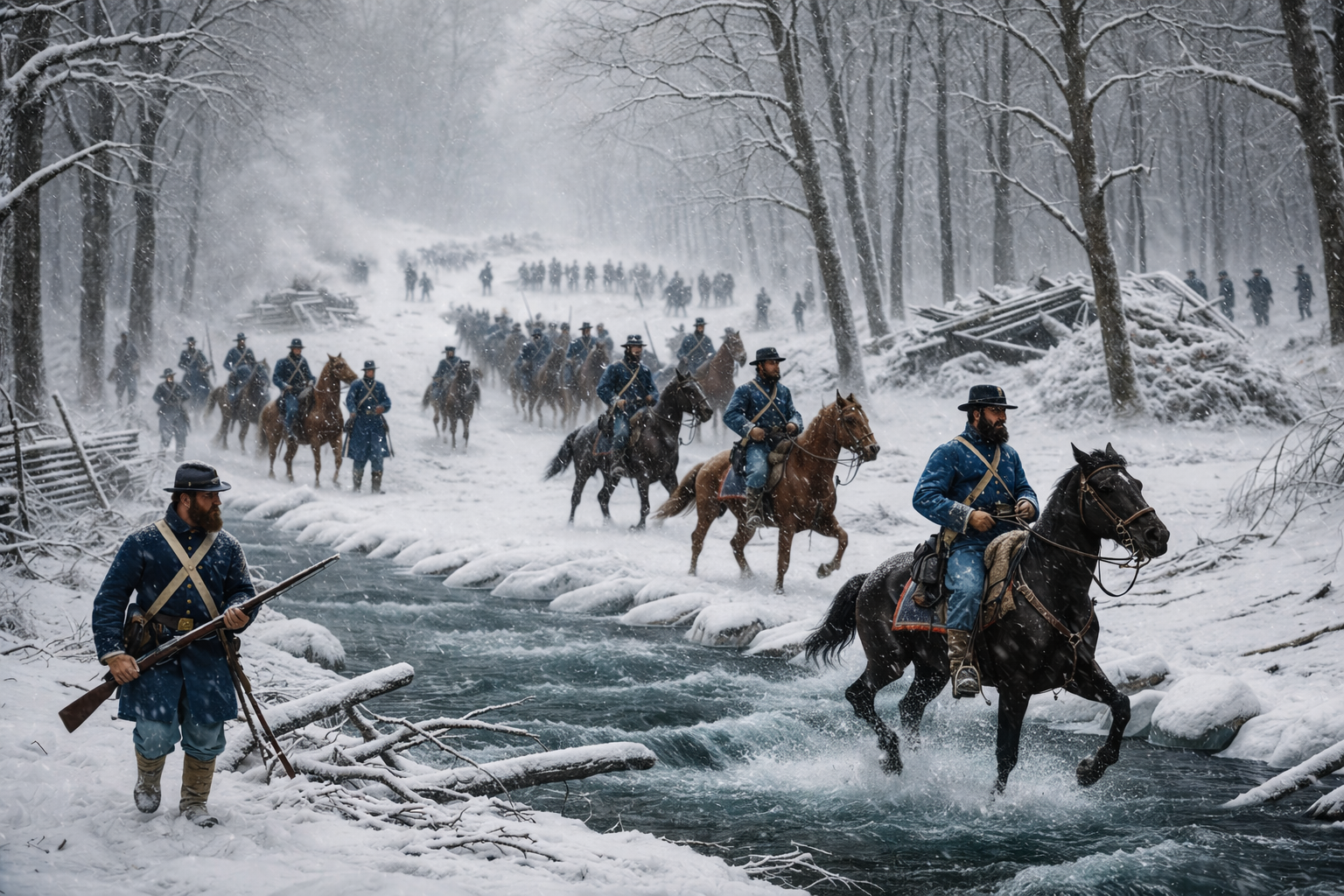
The Action at Liberty Mills
On December 22, climbing a spur of the Blue Ridge, the advance found a Confederate force holding the plateau ahead. A charge cleared them from their camps. This was the fight at Liberty Mills, on the Rapidan River, where the opposing cavalry — the brigades of Jackson and McCausland under General Lunsford L. Lomax — were driven across the river. Of the Dragoons’ part Bowen states plainly: “In this engagement, known as Liberty Mills, our regiment captured two pieces of artillery” (Bowen, 1900). During the following day there were several minor skirmishes, but, in Bowen’s words, “nothing of special importance was accomplished except the capture of a few prisoners near Gordonsville.” When Confederate infantry reinforcements reached the Gordonsville defenses, Torbert judged that breaking the railroad was no longer possible and turned back.
The First New York Dragoons
The Dragoons were commanded on the raid by Major Rufus Scott. Beyond the capture of the two guns at Liberty Mills — the one achievement Sheridan singled out in his official report — the regiment shared in the column’s hard marching and suffering, and in its small adventures: the night capture of a Confederate general’s pack train and surgeon, and the seizure of a young rebel major found hidden in a feather bed on the eve of his wedding. The men returned by way of Culpeper, Warrenton, and Ashby’s Gap, harassed at times by guerrillas.
Casualties
Bowen records no battle roll of killed or wounded for this raid. The regiment’s losses came chiefly from the weather: “we lost men and horses, with many men injured for life” (Bowen, 1900), a reference to the frostbite and exposure that left numerous troopers permanently disabled.
Aftermath
The column reached its camps near Winchester on December 28, 1864. Bowen’s verdict on the expedition was bleak: “December 28, with horses and men jaded, we reached our home camp near Winchester. It was a ten-days’ raid of hard tramping and suffering, in which we lost men and horses, with many men injured for life; and no one has ever been able to point to even one compensating result” (Bowen, 1900). He blamed the failure on the commander — “The expedition, under a competent leader, might have been a success; but under Torbert proved a failure” — and Torbert, having lost Sheridan’s confidence, went on extended leave; Wesley Merritt became Sheridan’s chief of cavalry for the next campaign.
“December 28, with horses and men jaded, we reached our home camp near Winchester. It was a ten-days’ raid of hard tramping and suffering, in which we lost men and horses, with many men injured for life; and no one has ever been able to point to even one compensating result.”— James R. Bowen, Regimental History of the First New York Dragoons (1900), ch. XIX, “The Gordonsville Raid,” p. 274.
Sources & Further Reading
- Primary James R. Bowen, Regimental History of the First New York Dragoons (originally the 130th N.Y. Vol. Infantry) (1900), ch. XIX, “The Gordonsville Raid,” pp. 269–274 — the regiment’s own historian and an eyewitness; the source of the verbatim quotations here (command by Major Scott, the frozen march, the two guns at Liberty Mills, and the final verdict). Full text: archive.org/details/regimentalhistor00bowe.
- Primary U.S. War Dept., The War of the Rebellion: Official Records of the Union and Confederate Armies, Series I, Vol. 43 — the reports of Sheridan and Torbert on the December 1864 raid toward Gordonsville and Charlottesville (in which Sheridan credited the expedition chiefly with the Dragoons’ capture of two guns).
- Primary Philip H. Sheridan, Personal Memoirs of P. H. Sheridan (1888) — Sheridan’s account of the raid and of replacing Torbert with Merritt as chief of cavalry, cited by Bowen.
- “Sheridan’s Christmas Raid of Gordonsville, Virginia,” Civil War Traveler: civilwartraveler.blog (secondary background on the raid).
- “A Christmas Raid – Gordonsville, 1864,” Regular Cavalry in the Civil War: regularcavalryincivilwar.com (secondary background on the raid).
- Note: The December 1864 Gordonsville raid is not one of the CWSAC/NPS or American Battlefield Trust principal-battle summaries, so no ABT or NPS battle page is cited here; the fighting near Gordonsville and at Liberty Mills was a raiding action rather than a listed engagement.
Trevilian Station · The Shenandoah Valley Campaign · The Audiobook
Views: 56
Explore the evidence
View this article’s connected sources and media →
About this page
This article was brought over from AlfredGibbs.com. Its preserved text, media and citations remain available for comparison.