
On the afternoon of May 31, 1864, the First New York Dragoons rode into one of the proudest hours in their history. Fighting as part of the Reserve Brigade — Col. Alfred Gibbs commanding, the regiment under Lt. Col. Thomas J. Thorp — in Brig. Gen. Wesley Merritt’s First Cavalry Division of Sheridan’s Cavalry Corps, the Dragoons led the advance on the Cold Harbor crossroads, stormed a strong line of breastworks with their seven-shot Spencer carbines, and took the junction both Grant and Lee were determined to hold. It was, in Merritt’s words, “a success by cavalry which has no parallel in this war.”
The Bone of Contention
By late May 1864 the crossroads at Cold Harbor had become, in Bowen’s phrase, the “bone of contention” between Grant and Lee — a strategic junction “both were determined to secure… at all hazards.” Lee had already concentrated his cavalry there, with infantry pushing forward to support it. On May 30 the Dragoons had fought at Old Church on Matadequin Creek, driving the Confederate cavalry back toward Cold Harbor. On the afternoon of May 31 Sheridan’s troopers advanced on the crossroads itself, the Reserve Brigade taking the lead on the direct road while Custer’s Michigan brigade deployed on its left and the Sixth Pennsylvania Cavalry formed on the left of the regiment.
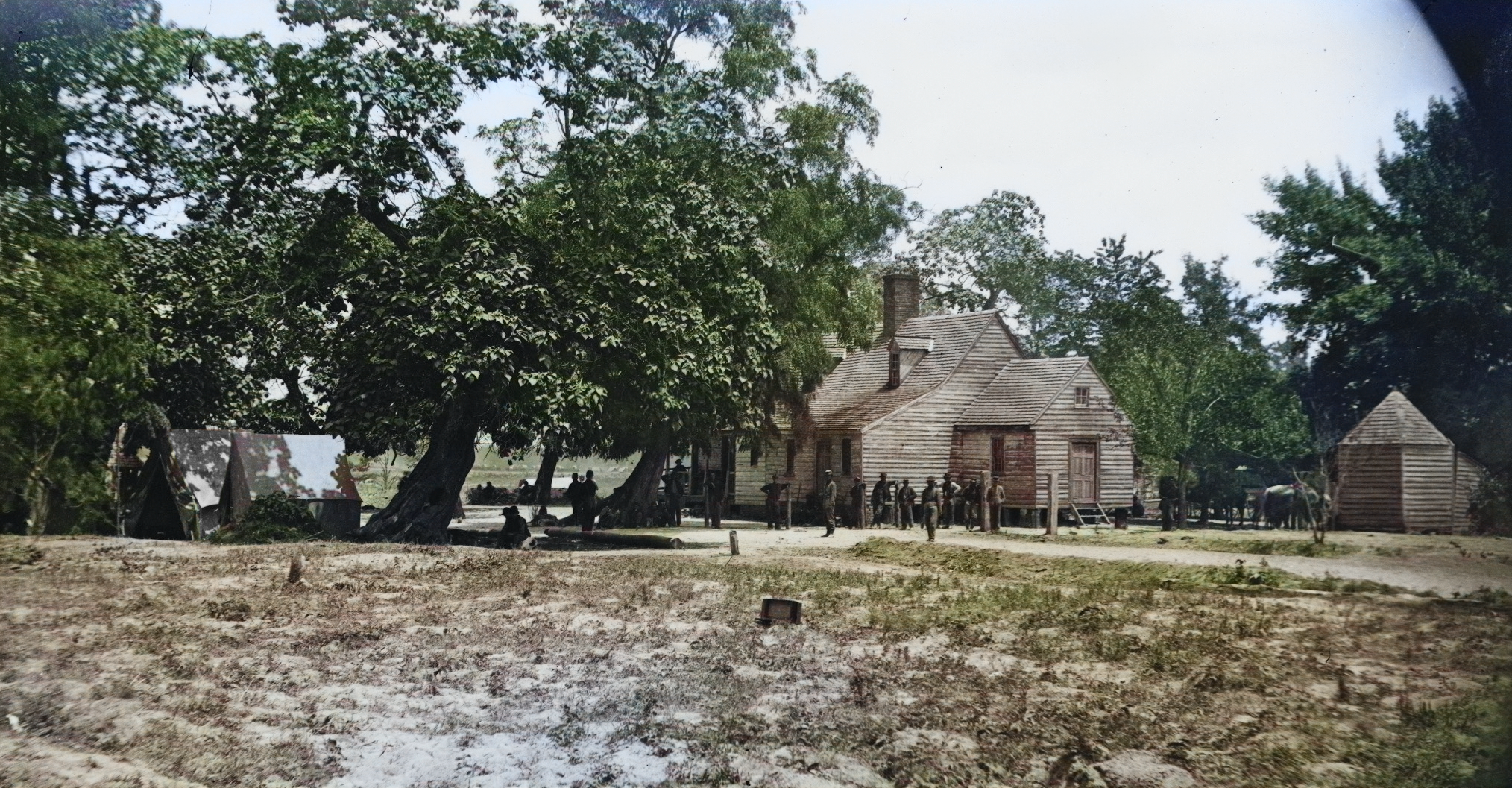
Storming the Crossroads
The advancing brigade struck the enemy in force within half a mile and pressed them back to a strong line of breastworks — a heavy rail fence reinforced with logs and earth — crowning the hill directly in front of the Dragoons. The Confederates “could shoot us down like turkeys in a pen,” Bowen wrote, and nothing but a desperate charge could dislodge them. The First and Second U.S. Cavalry were sent through the woods to turn the enemy’s left flank while the First New York Dragoons and Sixth Pennsylvania held their attention in front. Then Colonel Thorp and Major Scott — who, Bowen remembered, “never said ‘Go!’ but ‘Come on, boys!’” — led the advance. Armed with their seven-shot Spencer repeaters, the dismounted troopers went up the hill and over the works, fighting hand to hand as they crossed the fence, and routed the defenders. The regiment alone captured sixty-one prisoners, including several officers.
“These works were too strong to be taken without great loss, if at all… here was accomplished a work of which everyone connected with the brigade is justly proud; a success by cavalry which has no parallel in this war — a single brigade contending with and taking from an enemy at least three times its numbers, and one-third infantry, a naturally strong position, and made doubly strong by artificial means.”— Brig. Gen. Wesley Merritt, commanding the First Cavalry Division, in his report of Cold Harbor, quoted in Bowen’s regimental history.
“Hold It at All Hazard”
Sheridan now held the crossroads — but stood, by his own account, “about nine miles from our nearest infantry,” and the isolation made him uneasy. Prisoners told him the balance of Hoke’s division was en route for Cold Harbor and that Kershaw was near at hand. He notified General Meade that he had taken the position but could not hold it, and gave directions to withdraw — only to receive a dispatch from Meade ordering him to hold Cold Harbor “at all hazard,” with word that the Sixth Corps had been dispatched to his aid. Through the night the weary troopers — eighteen consecutive hours marching and fighting — reversed the captured redoubts to face the other way and piled cartridges at hand. Before dawn on June 1 the Confederate infantry came on; the Dragoons, holding the center of the Union line with their repeating carbines, broke charge after charge until the Sixth Corps marched up about nine o’clock and relieved them. That all-night and dawn defense is the subject of the companion page, Cold Harbor, June 1, 1864.
A Cavalry Fight — Not the June 3 Assault
The Dragoons’ battle at Cold Harbor was a cavalry action of May 31–June 1: seizing the crossroads, storming the breastworks, and — relying on the firepower of their Spencers — holding the line against Confederate infantry until the Sixth Corps arrived. They were then withdrawn from the front. They took no part in the massed Union infantry assault of June 3, in which the Army of the Potomac suffered thousands of casualties in a frontal attack on Lee’s entrenchments. The two events share a name and a field, but are distinct and should not be conflated.
Aftermath
Relieved by the Sixth Corps on June 1, the Dragoons were spared the costly infantry assaults that followed. The larger Battle of Cold Harbor ground on through June 3 and cost the Union army many thousands more before Grant disengaged to cross the James River. Within days the regiment was again in the saddle, riding south with Sheridan on the Trevilian raid.
Roll of Loss — Cold Harbor, May 31–June 1, 1864
Named casualties of the First New York Dragoons in the action, compiled from the regimental records.
Killed
| Name | Rank | Company |
|---|---|---|
| John S. Anderson | Sergeant | Co. B |
| Warren W. Atherton | Private | Co. F |
| Martin V. Babcock | Private | Co. F |
| John Jones | Private | Co. D |
| Lawson B. Leddick | Private | Co. A |
| George B. Putman | Private | Co. B |
Wounded
| Name | Rank | Company |
|---|---|---|
| Andrew J. Leach | Captain | Co. K |
| Scott | Major (acting) | — |
| A. K. Thorp | Captain | — |
| Thomas J. Burr | 2nd Lieutenant | Co. A |
| David B. Abbey | Private | Co. G |
| Oliver Barnard | Private | Co. F |
| Martin L. Blackman | Private | Co. A |
| William H. Burdick | Private | Co. G |
| Robert T. Charles | Corporal | Co. G |
| Walter Curtis | Private | Co. D |
| Charles G. Davis | Private | Co. G |
| Morris J. Griffith | Private | Co. A |
| Cullen Halsted | Private | Co. A |
| Charles H. Hinman | Sergeant | Co. B |
| Frederick E. Howard | Sergeant | Co. A |
| Alexander Kinghorn | Private | Co. G |
| Shedrick L. Pealer | Private | Co. K |
| Corydon C. Weaver | Private | Co. D |
Note: Capt. Andrew J. Leach (Co. K) was once listed here as killed in action; that is incorrect. Bowen records Leach among the officers wounded at Cold Harbor — “Major Scott, Captains Thorp and Leach, Lieutenants Burr and Burlison.” Leach was also wounded earlier at Deserted Farm and later at Five Forks, mustered out with his company on June 30, 1865, survived the war, and afterward contributed to the regimental history.
Sources & Further Reading
- Primary James R. Bowen, Regimental History of the First New York Dragoons (1900), ch. XI, “Five Days of Awful Fighting (May 28 to June 1),” pp. ~176–181 — the regiment’s own historian and an eyewitness, who quotes the reports of Merritt and Sheridan and supplies the casualty roll. Full text: archive.org/details/regimentalhistor00bowe.
- Primary U.S. War Dept., The War of the Rebellion: Official Records of the Union and Confederate Armies, Series I, Vol. 36 (Sheridan’s, Torbert’s, and Merritt’s reports of the operations about Cold Harbor, May–June 1864).
- American Battlefield Trust — Battle of Cold Harbor: battlefields.org/learn/civil-war/battles/cold-harbor.
- National Park Service / CWSAC Battle Summary, Cold Harbor (VA062): nps.gov/abpp/battles/va062.htm.
Cold Harbor — June 1, 1864 · Trevilian Station · The Shenandoah Valley Campaign · The Audiobook
Views: 27
Explore the evidence
View this article’s connected sources and media →
About this page
This article was brought over from AlfredGibbs.com. Its preserved text, media and citations remain available for comparison.