
The Battle of Haw’s Shop — also spelled Hawe’s Shop, and known as well by the name of Enon Church — was fought on May 28, 1864, in Hanover County, Virginia, during Grant’s Overland Campaign. It was one of the most stubborn cavalry fights of the war: for some seven hours the troopers of both armies fought mostly on foot, behind hasty breastworks of logs and fence-rails, in a tangle of swampy creeks and dense woods that left no room for the old mounted charge. The First New York Dragoons, riding in Merritt’s Reserve Brigade, dismounted and charged through a deep ravine on the Union right, drove the enemy with their repeating carbines, and came off lightly — while a few hundred yards to the left other regiments were cut to pieces around an old country church.
An All-Night Ride to Battle
The Dragoons had only just come in from Sheridan’s first great raid — nearly three hundred miles in the saddle and several pitched battles, by the army’s own reckoning — and the men “sincerely hoped for a few days of rest, for all were tired, worn, and sleepy.” They got none. As Bowen tells it, the next day, “as we were trying to get a little sleep, or answer our home letters, the clarion notes of the division bugle were heard sounding ‘boots and saddles.’” The jaded horses were saddled and the regiment rode off for an all-night ride — into what Major Smith remembered as “those awful days of fighting at Hawe’s Shop, Old Church, and Cold Harbor, which are stamped upon our memories as with fire.”
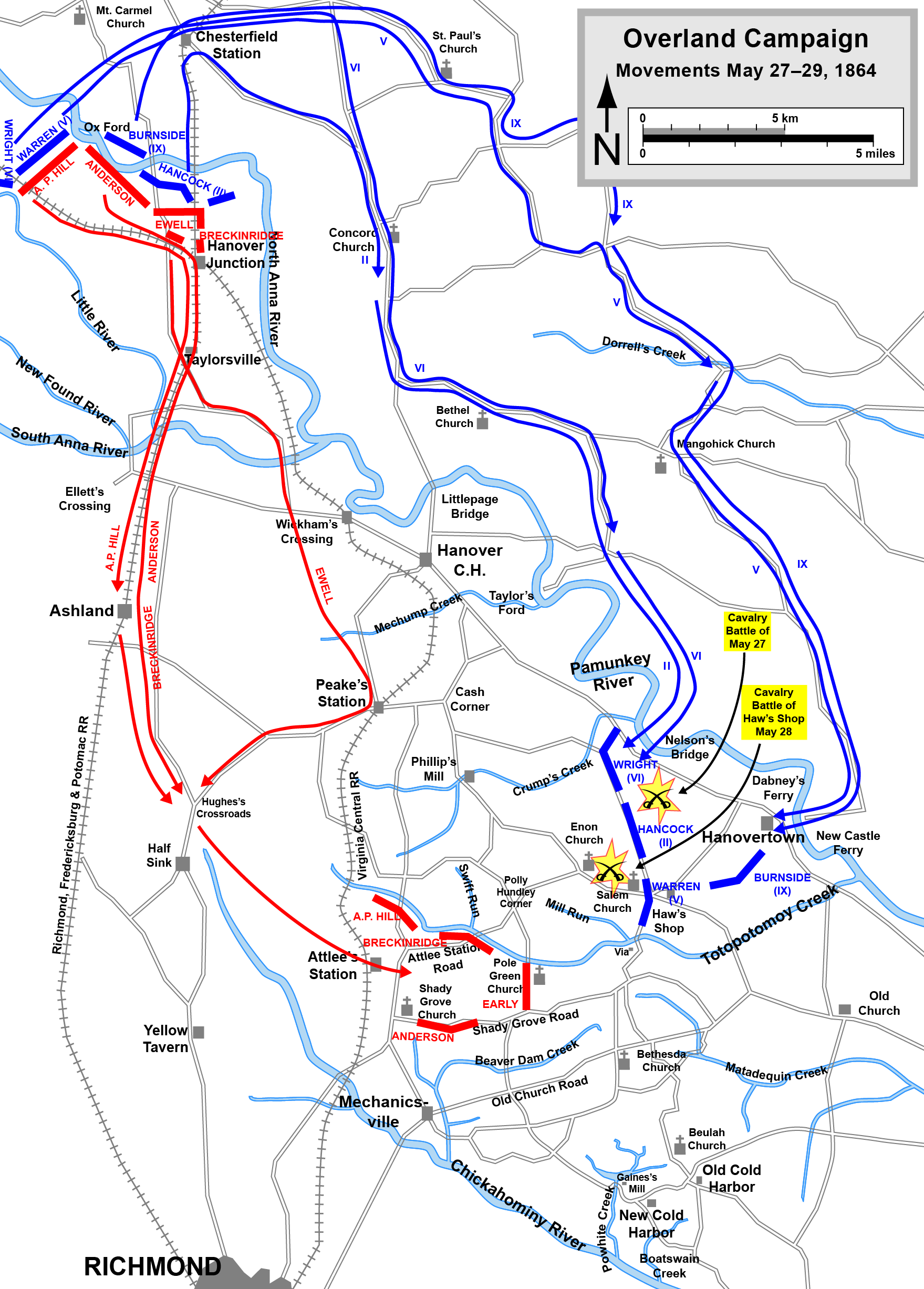
Grant, by Bowen’s account, “was mystified regarding Lee’s movements,” and threw his cavalry across the Pamunkey to seize the river fords and reconnoiter toward Richmond and Hanover Courthouse. On the night of the 27th the squadron to which Bowen belonged picketed the Richmond road, with its reserves posted at an old country church — which Bowen thought was Salem Church, and on whose wall, behind the pulpit, he chalked a great spread eagle and the line, “Compliments of First New York Dragoons.” At about nine the next morning the Dragoons were relieved by a squadron of the 10th New York Cavalry — and had “scarcely moved out” when the rebel yell rose and Hampton’s horsemen came dashing in on three roads. The men who had taken the Dragoons’ place were shot down where they stood; passing back over the field, Bowen’s comrade saw them lying “in heaps about the old church.”
Where the Dragoons Stood
A point of command needs to be set straight, because the older version of this page got it wrong. Colonel Alfred Gibbs had commanded the Reserve Brigade since the opening of the spring campaign — but, as Bowen records, on the eve of Haw’s Shop he “had just been returned to his regiment, and Merritt to the brigade.” So at Haw’s Shop, Gibbs was leading the regiment — the First New York Dragoons — inside Brig. Gen. Wesley Merritt’s Reserve Brigade of Brig. Gen. Alfred T. A. Torbert’s First Cavalry Division. Gibbs was still a colonel in May 1864; he would not be made a brigadier general until December of that year. The eyewitness who wrote the account Bowen reproduces speaks of “Colonel Gibbs” estimating the day’s losses — the regiment’s commander, not a brigade or division chief.
Behind the Breastworks
The battle opened near Enon Church, in country that punished attackers: swampy tributaries, thick woods, and rolling fields that closed off any chance of a flanking maneuver and forced both sides into frontal fighting. Hampton’s troopers threw up makeshift breastworks of logs and rails and settled in to hold. Many of his men carried long-range Enfield rifles, and against Union horsemen armed mostly with shorter carbines they had the reach; the first Federal attacks, by Brig. Gen. David McM. Gregg’s division, broke down under heavy fire. For hours the fight settled into a dismounted infantry-style struggle — a foretaste of how cavalry would be used through the rest of the war.
“Only a few minutes later the Colonel called out, ‘Orderly bugler, sound the charge!’ and away we went. … We were dismounted, and charged down into a deep ravine. As we came up on the other side, we ran almost into the rebel line. They must have been greatly surprised, for, as we rushed out of the thick bushes, they gave us a volley at short range, but did no damage. Our boys rushed upon them, pouring the lead into their ranks from the seven-shooters at such a lively rate that they broke and ran in confusion, leaving lots of their dead and wounded behind them.”— An eye-witness of the First New York Dragoons, in an account “written the next morning,” quoted in J. R. Bowen, Regimental History of the First New York Dragoons, ch. XI.
The Dragoons’ Charge
When the order came, the regiment went in on foot. They charged down into a deep ravine and came up the far side almost on top of the Confederate line, which loosed a close volley that “did no damage” before the Dragoons’ repeating carbines — the “seven-shooters” — broke the rebels and sent them running. “Fortune favored us on the right,” the eyewitness wrote, “and our regiment suffered but little.” The men on the left had no such luck: there, facing not only cavalry but a brigade of infantry, the Union regiments “suffered terribly.” Colonel Gibbs, the writer noted, “does not know just what the loss on our side is, but thinks it can not be less than five hundred, and the rebel loss must have been as great.” About nine that night the infantry came up and relieved the cavalry, and the Dragoons drew off toward New Castle.
Custer and the Confederate Withdrawal
The turning point came with reinforcements from Torbert’s division, including Brig. Gen. George A. Custer’s Michigan brigade. Custer stayed mounted and conspicuous while pushing his dismounted troopers forward in a double-ranked line; their Spencer repeating carbines, capable of fast, sustained fire, gave the Federals a decisive edge — one Pennsylvania regiment was said to have fired some 18,000 rounds in the action. Under the mounting pressure, and misled by a report that the dismounted Union troopers were infantry, Hampton concluded he was outnumbered and ordered a withdrawal, leaving the field to the Union late in the day. Sheridan claimed the victory, but later critics faulted him for spending men on costly frontal assaults rather than throwing in his whole corps to crush Hampton’s isolated command.
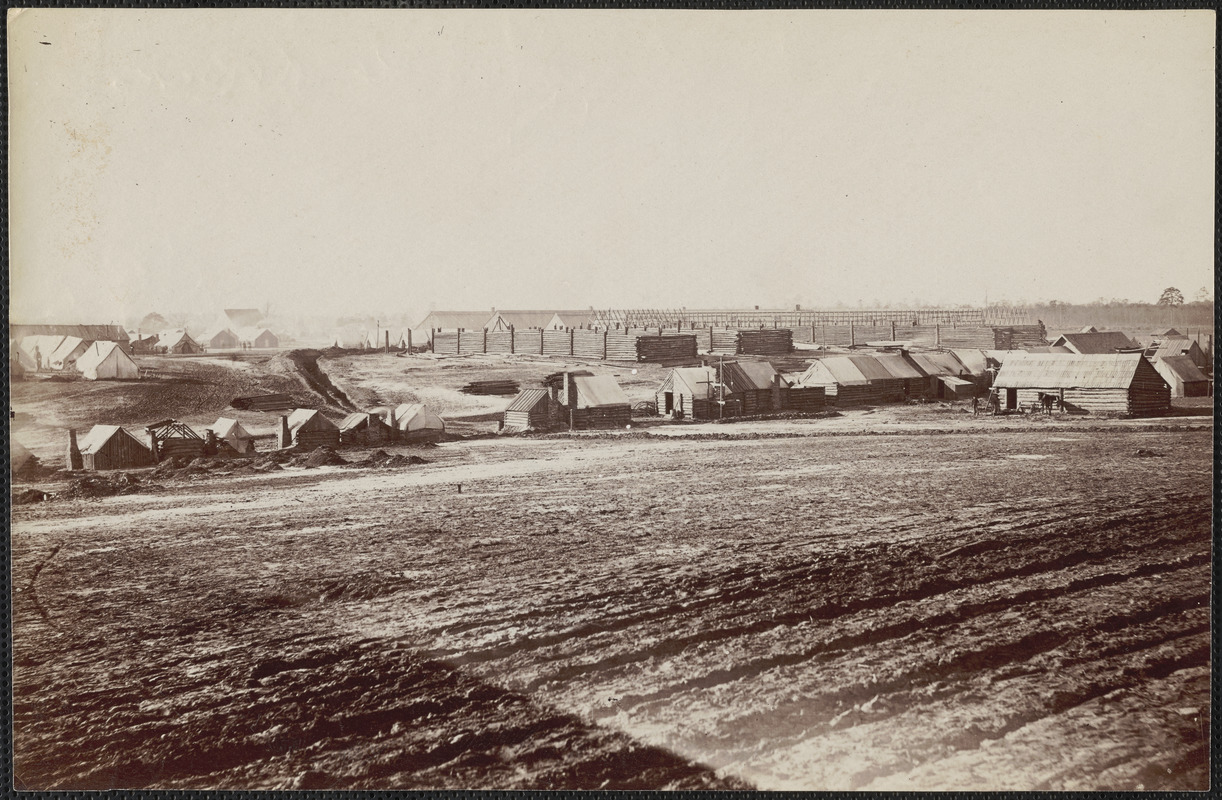
There is a historical irony in the fact that the Battle of Haw’s Shop centered on a landmark called Enon Church in Hanover County, while just forty miles south, in Chesterfield County, another Enon Baptist Church was being systematically dismantled by Union engineers. As Colonel Alfred Gibbs and his troopers used the swampy tributaries and dense woods around the Hanover Enon Church for cover, Maj. Gen. Benjamin Butler’s forces were prying the very boards off the Chesterfield Enon Church to build the Point of Rocks Hospital.
It is the “total war” of 1864 in miniature. The timber harvested from the Chesterfield church was turned into the surgical wards and recovery bays that would house casualties flowing from clashes like Haw’s Shop — a grim, recycled landscape in which cavalry fought behind breastworks of logs and rails in the morning and the wounded were treated in wards built of church lumber by evening.
A Tactical Draw with Strategic Weight
Both sides claimed Haw’s Shop, and in truth it was a draw. The Federals held the ground and took prisoners — including some eighty South Carolinians — and the burial parties counted heavy Confederate dead. But Hampton had won what he came for: time. The seven-hour stand let Lee fortify a strong line along Totopotomoy Creek, and the reconnaissance pinpointed Union corps for him, helping shape the bloody days that followed at Old Church and Cold Harbor. For the First New York Dragoons it was the first of those “five days of awful fighting” — a day they came through, on the right of the line, more fortunate than most.
Sources & Further Reading
- Primary James R. Bowen, Regimental History of the First New York Dragoons (1900), ch. XI, “Five Days of Awful Fighting (May 28 to June 1),” pp. 168–172 — the regiment’s own bugler-historian, reproducing an eyewitness account written the morning after the battle and recording Col. Gibbs’s return to the regiment. Full text: archive.org/details/regimentalhistor00bowe.
- Primary U.S. War Dept., The War of the Rebellion: Official Records of the Union and Confederate Armies, Series I, Vol. 36 (the reports of Sheridan and Torbert for the cavalry operations on the Pamunkey, May 1864 — the source confirming Merritt’s Reserve Brigade in Torbert’s First Division).
- American Battlefield Trust — Battle of Haw’s Shop (Enon Church): battlefields.org/learn/civil-war/battles/haws-shop.
- National Park Service / Civil War Sites Advisory Commission (CWSAC) Battle Summary, Haw’s Shop / Enon Church (VA061): nps.gov/abpp/battles/va061.htm.
Trevilian Station · The Shenandoah Valley Campaign · The Audiobook
Views: 57
Explore the evidence
View this article’s connected sources and media →
About this page
This article was brought over from AlfredGibbs.com. Its preserved text, media and citations remain available for comparison.