
On the afternoon of May 7, 1864, in the tangled woods south of the Wilderness, the First New York Dragoons were thrown into their first severe action of the spring campaign. It was, in the words of the regiment’s own historian, “of the most sanguinary character, the First New York Dragoons sustaining the heaviest loss of any cavalry regiment, in any one engagement during the entire war.” Sent in dismounted against Confederate cavalry dug in behind log breastworks along the Brock Road, the regiment lost close to a hundred men in a few desperate hours — and earned the praise of Sheridan’s own staff for fighting “like demons.”
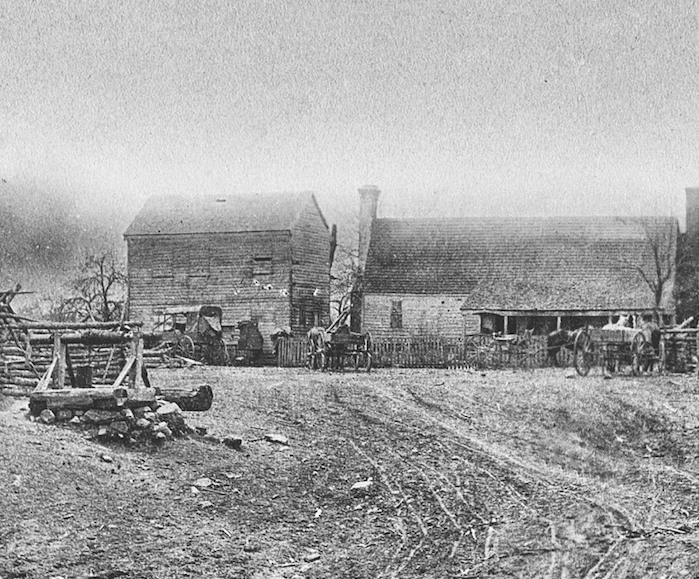
The Spring Campaign Opens
Through the winter of 1863–64 the Dragoons had picketed the Rapidan from their camp at Mitchell’s Station. In April the cavalry corps was reorganized under its new chief, Maj. Gen. Philip H. Sheridan; the regiment turned in its unreliable Joslyn carbines for the rapid-firing Spencer seven-shooter, “thus increasing our effectiveness sevenfold.” The Dragoons belonged to the Reserve Brigade of the First Cavalry Division — the brigade Colonel Alfred Gibbs had long led, and would lead again in this fight, with the regiment itself under Lt. Col. Thomas J. Thorp.
Early on Wednesday, May 4, 1864, the army struck its tents and moved out upon the “spring campaign.” The Dragoons crossed the Rapidan at Ely’s Ford on the 5th and camped near the old Chancellorsville battlefield. For the first two days Torbert’s division guarded the great trains of the army while the infantry and two cavalry divisions fought the savage two-day battle of the Wilderness. “On the 7th,” Bowen wrote, “we were pushed to the front.”
A Fight at the Crossroads
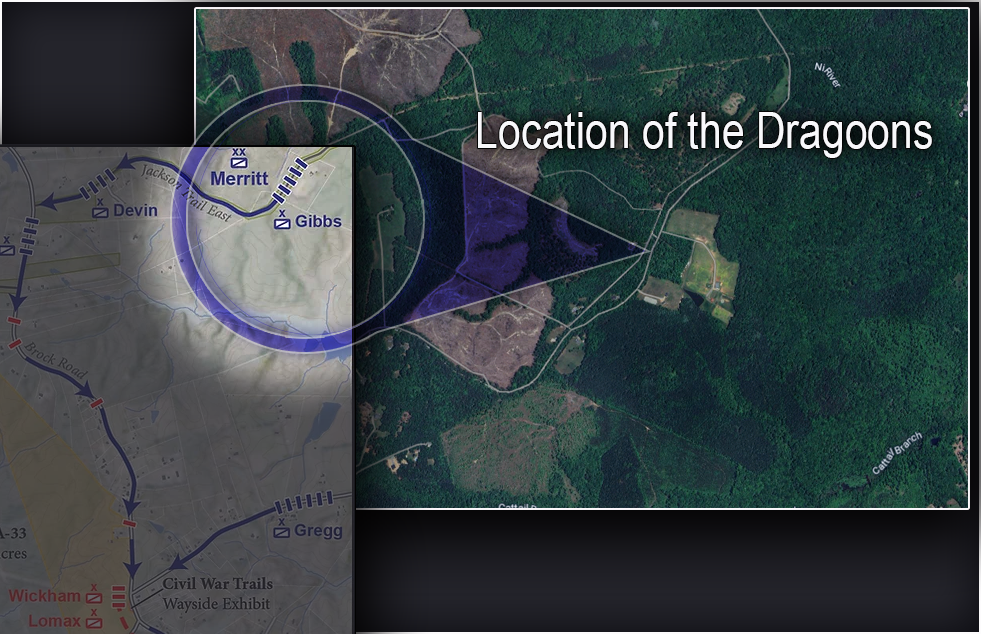
Todd’s Tavern stood at a vital crossing of the Brock and Catharpin Roads — the very route by which Grant meant to slip past Lee’s right and seize Spotsylvania Court House. Sheridan’s troopers were ordered to clear the road and screen the army’s flank, and J.E.B. Stuart’s cavalry, the divisions of Fitzhugh Lee and Wade Hampton, were determined to hold them. Fitz Lee’s men dismounted and fought from behind hastily built log barricades astride the Brock Road, while Hampton stood to the west at Corbin’s Bridge. It was against Fitz Lee’s works that the Reserve Brigade was thrown.
Lt. Daniel Flint’s little regimental history captured the moment the Dragoons went in: “At 3 p.m. the regiment is dismounted and moved across the country for more than a mile at the ‘double quick,’ when the enemy are met. With a terrible yell the Dragoons go to work, loading and firing their carbines with the utmost rapidity and with deadly effect. … For a while the issue is doubtful, for support comes up tardily; but still the desperate, though unequal, conflict is kept up with unabated fury.”
“The Men Fought Like Demons”
The Dragoons charged clear up to the burning breastworks, poking their carbine barrels between the logs and firing at point-blank range until the works themselves caught fire. But the dismounted regiment had been pushed in near nightfall, in the face of Sheridan’s protest, against Confederate numbers far larger and without proper support. When the flames revealed how thin the attacking line was, the Confederates swarmed around both flanks and captured what the firing had not already cut down. Companies I and F suffered worst — Company I alone lost twenty-four men, killed, wounded, and prisoners.
An aide-de-camp who watched the assault turned to Sheridan and said, “I never saw men fight with such desperate valor as did the First New York Dragoons; the men fought like demons.” Colonel Fox’s classic study of Union casualties, Three Hundred Fighting Regiments, would later rank the regiment’s loss at Todd’s Tavern as the heaviest sustained by any cavalry regiment in any single engagement of the entire war. On the morning of the 8th the fight was renewed, the enemy dislodged from his first line of works and driven back toward Spotsylvania.
Thorp’s Report to Gibbs
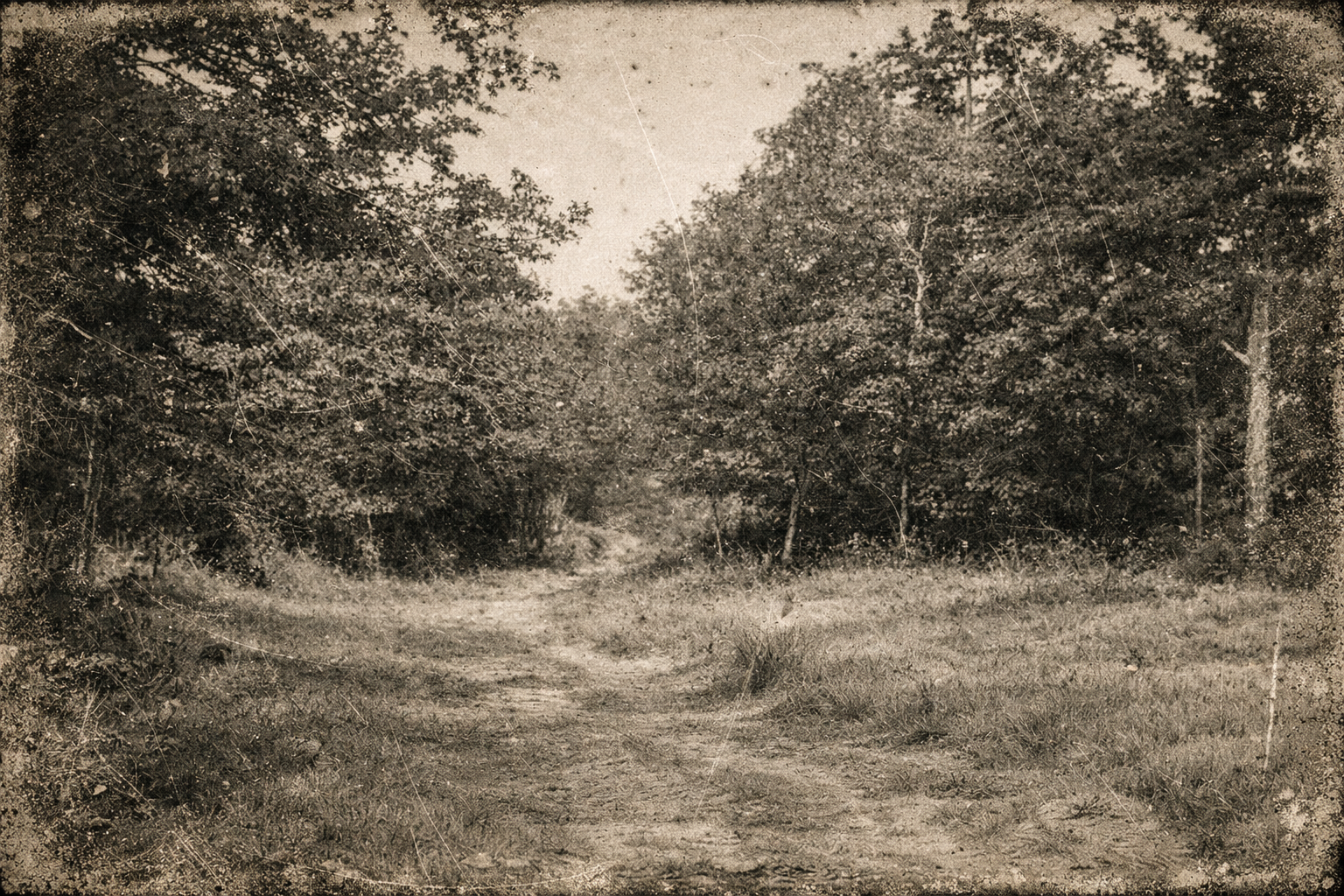
The cost was learned at first light. Lt. Flint overheard Lt. Col. Thorp make his verbal report to Colonel Gibbs, then commanding the brigade — a brief exchange that says more about the bond between the regiment and its old colonel than any casualty return could. A message Gibbs sent to the regimental surgeon on the night of the 8th put the killed and wounded at eighty-six; Thorp reckoned the whole loss at “nearly a hundred.” Among the captured were Lieutenants Britton, Lewis, West, and Abbott; many of the prisoners, including Josiah H. Flint and Hiram J. Woodward, would die in unknown graves at Andersonville.
“Colonel, it is a sore task for me to tell you that your regiment has been badly cut to pieces; that we have lost nearly a hundred — killed, wounded, or captured.” … Colonel Gibbs, deeply affected, and hardly able to control his voice, inquired whether any of his men ran. On being assured in the negative, he replied, “I knew they wouldn’t.”— Lt. Col. Thomas J. Thorp reporting to Col. Alfred Gibbs, as recalled by Lt. Daniel Flint and printed in J. R. Bowen’s regimental history of the First New York Dragoons.
Roll of Loss — a Sample of the Named Casualties
A representative list of men of the First New York Dragoons recorded as captured, wounded, or killed in the spring fighting at Charlottesville (March 5, 1864) and Todd’s Tavern (May 7, 1864). It is only a fraction of the regiment’s roughly ninety casualties at the tavern.
| Type | Name | Company | Rank |
|---|---|---|---|
| Captured | Romanzo Wells | E | Private |
| Killed | Lyman Z. Whiting | H | Corporal |
| Wounded | Prosper B. Annis | B | Private |
| Killed | William Black | I | Private |
| Wounded | Martin V. Barber | H | Private |
Sources & Further Reading
- Primary James R. Bowen, Regimental History of the First New York Dragoons (originally the 130th N.Y. Vol. Infantry) (1900), ch. IX, “The Spring Campaign,” pp. 142–145 — the regiment’s own historian, quoting Lt. Flint’s account and the Thorp–Gibbs exchange, and the surgeon’s recollections (ch. XXIII). Full text: archive.org/details/regimentalhistor00bowe.
- Primary U.S. War Dept., The War of the Rebellion: Official Records of the Union and Confederate Armies, Series I, Vol. 36, Pt. 1 (Sheridan’s cavalry operations, May 7–8, 1864).
- William F. Fox, Regimental Losses in the American Civil War (“Three Hundred Fighting Regiments”) (1889) — the source, cited by Bowen, for the regiment’s standing as the heaviest single-engagement cavalry loss of the war.
- Gordon C. Rhea, The Battles for Spotsylvania Court House and the Road to Yellow Tavern, May 7–12, 1864 (Baton Rouge: Louisiana State University Press, 2002) — the standard modern account of the action.
- American Battlefield Trust — Battle of Todd’s Tavern: battlefields.org/learn/civil-war/battles/todds-tavern.
- National Park Service / CWSAC Battle Summary, Todd’s Tavern (VA047): nps.gov/abpp/battles/va047.htm.
Trevilian Station · The Shenandoah Valley Campaign · The Audiobook
Views: 72
Explore the evidence
View this article’s connected sources and media →
About this page
This article was brought over from AlfredGibbs.com. Its preserved text, media and citations remain available for comparison.