
In the last week of February 1864 the First New York Dragoons lay in winter quarters at Mitchell’s Station, in the country between the Rapidan and the Rappahannock. From that camp a detachment rode out to join “the raid of General Custer to Charlottesville” — an operation Bowen’s account states plainly “was intended as a diversion in favor of Kilpatrick’s famous raid to Richmond.” The little town of Stannardsville, in Greene County, sat squarely on the road Custer took, and it was there that the column drove in the enemy’s pickets going out and fought a running rear-guard action coming back.
A Diversion for the Richmond Raid
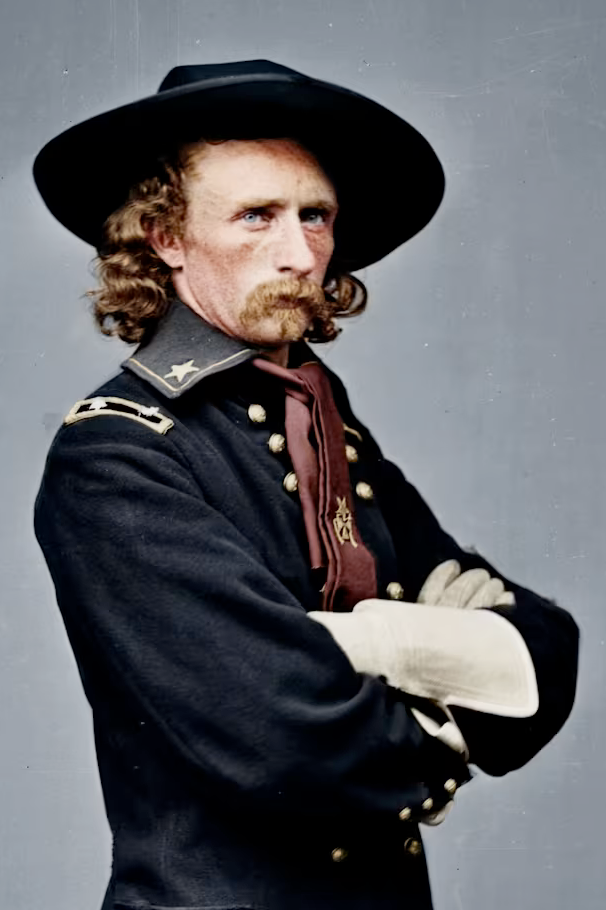
The raid was one move in a larger design. In late February 1864 the Union high command set in motion a mounted strike at Richmond under Brig. Gen. Hugh Judson Kilpatrick and Col. Ulric Dahlgren, meant to break into the lightly held capital and free the Federal prisoners there. To draw Confederate cavalry away to the west while that column slipped south, General Custer was sent toward Charlottesville. His command, Bowen’s account records, “was made up of a body of picked men from the First New York Dragoons, Sixth Pennsylvania Cavalry, First New Jersey Cavalry, and First, Second, Fifth, and Sixth United States Cavalry.” From the Dragoons went one hundred and fifty men and four officers — Captain Hakes of Company E, Captain Britton of Company H, Lieutenant Morey of Company D, and Lieutenant Schlick of Company K. Colonel Gibbs, who commanded the regiment, did not ride with the detail; his men went out under Captain Hakes as their senior officer.
Through Stannardsville to Charlottesville
The column left Pony Mountain on Sunday, February 28, at two in the afternoon and reached Madison Courthouse by six. Reveille sounded at one the next morning and “to horse” at two, and the march went on down the road to Stannardsville, which was reached about eight o’clock. There the raiders met a cavalry picket and drove it in; from prisoners they learned that Fitzhugh Lee’s division of cavalry was encamped near Charlottesville. Pressing on, the command crossed the Rivanna River about three in the afternoon and drove the enemy back some two miles beyond it, to within three miles of Charlottesville.
There the raid reached its limit. The Confederates opened with a battery of twenty guns that raked the road where the Federal troopers were formed. Captain Ash of the Fifth United States Cavalry was sent to the left to reconnoiter, charged into the enemy’s artillery camp, and carried off six caissons and two forges, burning the camp equipage. But the sound of trains told of a division of Confederate infantry coming into the place, and when that large force appeared Custer withdrew, the whole command retiring on the Stannardsville road and bivouacking for the night sixteen miles from Charlottesville.
The Fighting Retreat
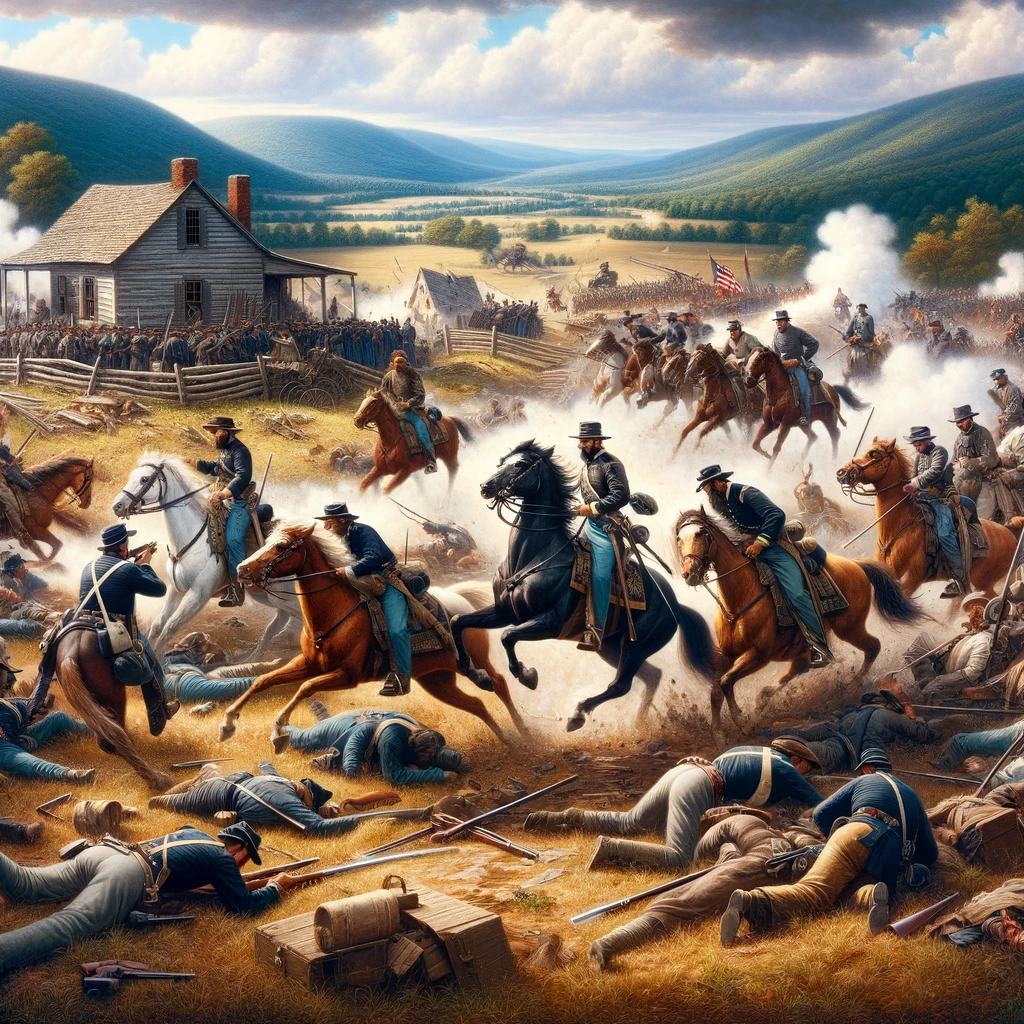
At daylight on March 1 the retreat continued to Stannardsville, where a quantity of government stores was destroyed. By then a brigade of Confederate cavalry under General Stuart had worked into the raiders’ rear and was trying to cut off their escape. North of Stannardsville the road forked — one branch toward Burton’s ford, the other toward Bank’s ford — and there the enemy charged Custer’s advance. A countercharge threw them back on the Burton’s ford road, where Stuart drew up in a strong position to bar the way. Custer made an ostentatious display as if to force the crossing; while the enemy stood waiting to meet it, he quietly slipped his command onto the other road and crossed at Bank’s ford without opposition.
Outwitted, Stuart sent a force to follow up the retreat — and here the First New York Dragoons had their sharpest work of the raid, for they formed the rear of the whole column. Lieutenant Morey commanded the rear squadron and Lieutenant Schlick the detached rear guard. About dark Schlick’s guard was fired upon; Morey faced his squadron about and, with drawn sabers and yells, charged down the dark road at an enemy he could not even see. The startled rebels fired a single volley and fled. The squadron pursued about half a mile, rejoined the regiment, and the column marched on through Madison Courthouse, reaching camp about one o’clock on the morning of March 2.
“The First New York Dragoons formed the rear of the column. … With drawn sabers and terrific yells the squadron charged down the dark road, not knowing what they might meet. The rebels not knowing what was coming, discharged a volley and fled in confusion. They were pursued for about half a mile, when the squadron rejoined the regiment.”— From the eyewitness account “furnished by an officer present,” in J. R. Bowen, Regimental History of the First New York Dragoons (1900), of the retreat from the Charlottesville raid.
A Complete Success
In a little over two days and a half the regiment had marched one hundred and fifty miles. The whole expedition, Bowen’s account concludes, “was regarded as a complete success” — the raiders had destroyed the bridge over the Rivanna and burned three large flouring mills full of grain, and brought off six caissons, a standard bearing the arms of Virginia, more than fifty prisoners, some five hundred horses, and over a hundred contrabands. From the cavalry corps commander Custer received a message expressing “entire satisfaction at the result of the expedition.” Just as important to the larger plan, the movement had drawn Confederate cavalry westward while Kilpatrick and Dahlgren rode for Richmond.
The Dragoons’ loss was light. The one man Bowen singles out is Myron Tanner, whose horse gave out within a mile of the Union lines; a citizen reported him cut down by a rebel trooper’s saber, though men of his company believed instead that he was taken prisoner and died in Libby.
Sources & Further Reading
- Primary James R. Bowen, Regimental History of the First New York Dragoons (originally the 130th N.Y. Vol. Infantry) (1900), “Winter Quarters at Mitchell’s Station,” the account of “The Charlottesville Raid, Feb. 28 to March 1, 1864,” furnished by an officer present, pp. 120–123; the engagement “Stannardsville, Va., Feb. 23, 1864” is listed in the regiment’s roll of engagements. Full text: archive.org/details/regimentalhistor00bowe.
- Primary U.S. War Dept., The War of the Rebellion: Official Records of the Union and Confederate Armies, Series I, Vol. 33 (operations in Virginia, Jan.–Apr. 1864, including the reports of Custer’s expedition toward Charlottesville, Feb. 28–March 1, 1864).
- American Battlefield Trust — on the Kilpatrick–Dahlgren Raid (Feb. 28–March 4, 1864), the strike at Richmond that Custer’s movement was meant to screen: battlefields.org/learn/articles/kilpatrick-dahlgren-raid.
Trevilian Station · The Shenandoah Valley Campaign · The Audiobook
Views: 46
Explore the evidence
View this article’s connected sources and media →
About this page
This article was brought over from AlfredGibbs.com. Its preserved text, media and citations remain available for comparison.