
For most of the winter of 1863–64 the First New York Dragoons lay in “palatial huts” at Mitchell’s Station, taking their “severe turns of picket service on the Rapidan,” where men on both banks traded coffee for tobacco across the ice. On February 6, 1864, that quiet broke: Meade ordered a forward movement along the river, and the Dragoons — the regiment of Col. Alfred Gibbs — were sent across the water to feel for the enemy.
One Wing of a Winter Demonstration
The Dragoons had gone into permanent winter quarters at Mitchell’s Station, on the Orange & Alexandria Railroad, in late December, building comfortable log “burrows to crawl into when returning, cold and wet, from our severe turns of picket service on the Rapidan.” Their picket line ran some ten miles along the river, from Cedar Mountain past Raccoon Ford, most of it in plain sight of the enemy’s pickets across the stream.
On February 6, 1864, this routine gave way to a “forward movement of the army.” The Dragoons crossed the Robertson River at Moot’s Ford, where the Confederate cavalry pickets guarding the crossing “were met and driven in.” It was the far right wing of a two-day demonstration whose main weight fell downstream at Morton’s Ford.
A Sharp Artillery Duel, Then Mud
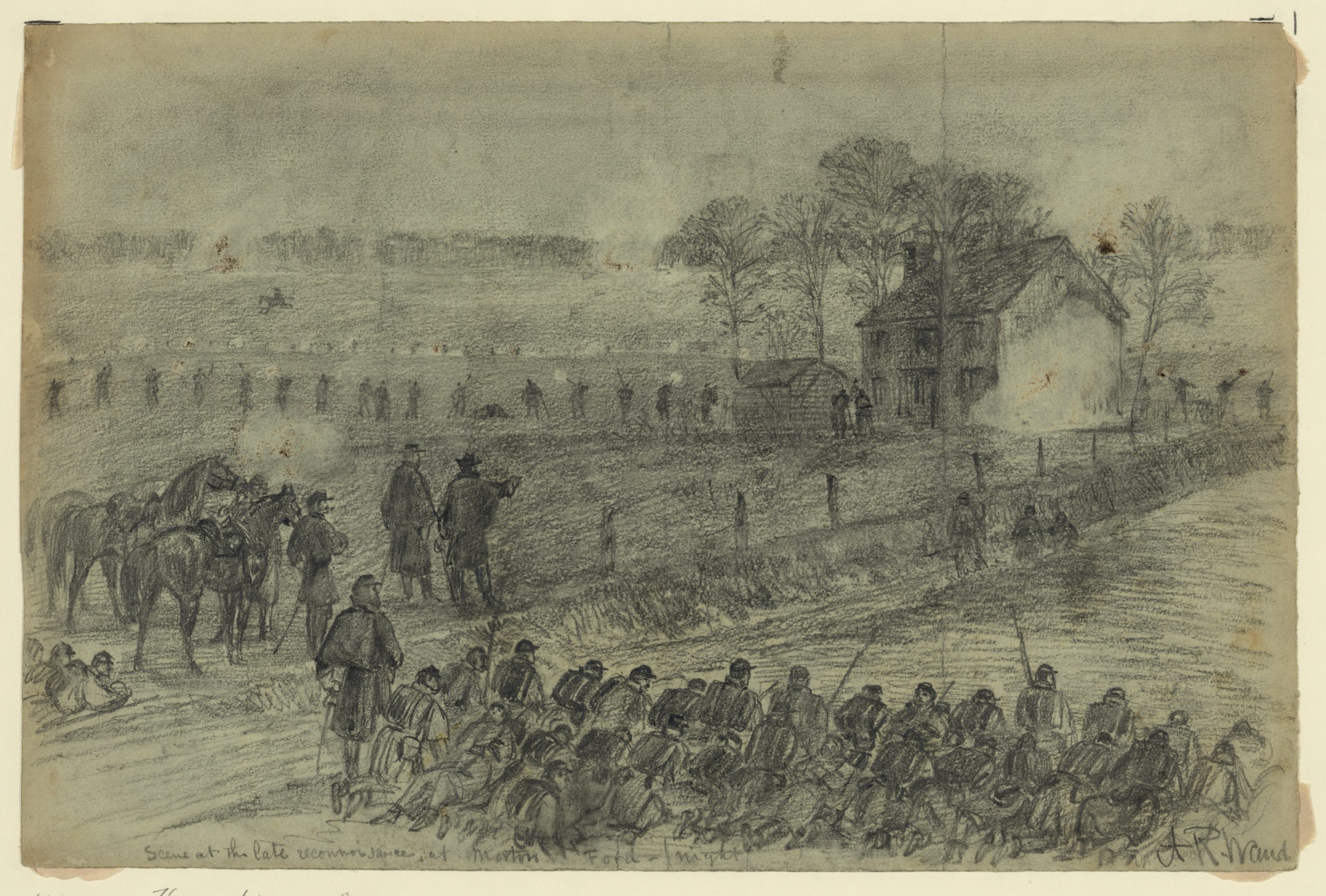
Beyond the ford the action settled into “a sharp artillery duel,” followed by “a brush… with a brigade of infantry.” The regiment lost three men killed and eight wounded; the supporting Union infantry, in heavier fighting, lost some three hundred. Then the weather and the ground had the last word. As the regiment’s historian put it, “after floundering around in the deep mud, we returned to camp, the whole affair, like most of Meade’s later movements, proving a failure.” He records no more of the fight than that — and, honestly, neither can we.
“February 6 and 7 a forward movement of the army occurred. The dragoons crossed Robertson River at Moot’s Ford, where the enemy’s cavalry pickets were met and driven in. The principal fighting, however, was a sharp artillery duel, and a brush we had with a brigade of infantry, in which we lost three killed and eight wounded. Our infantry had some sharp fighting, sustaining a loss of three hundred men. After floundering around in the deep mud, we returned to camp, the whole affair, like most of Meade’s later movements, proving a failure.”— James R. Bowen, Regimental History of the First New York Dragoons (1900), ch. VIII, “Winter Quarters at Mitchell’s Station,” pp. 118–119.
Sources & Further Reading
- Primary James R. Bowen, Regimental History of the First New York Dragoons (originally the 130th N.Y. Vol. Infantry) (1900), ch. VIII, “Winter Quarters at Mitchell’s Station,” pp. 118–119 — the regiment’s own historian and eyewitness; the sole narrative source for the Dragoons’ part in this action. Full text: archive.org/details/regimentalhistor00bowe.
- Primary U.S. War Dept., The War of the Rebellion: Official Records of the Union and Confederate Armies, Series I, Vol. 33 — reports of the demonstration on the Rapidan, February 6–7, 1864.
- National Park Service / CWSAC Battle Summary, Morton’s Ford (VA054) — the larger February 6–7, 1864 demonstration to which this cavalry crossing belonged: nps.gov/abpp/battles/va054.htm.
Trevilian Station · The Shenandoah Valley Campaign · The Audiobook
Views: 692
Explore the evidence
View this article’s connected sources and media →
About this page
This article was brought over from AlfredGibbs.com. Its preserved text, media and citations remain available for comparison.