
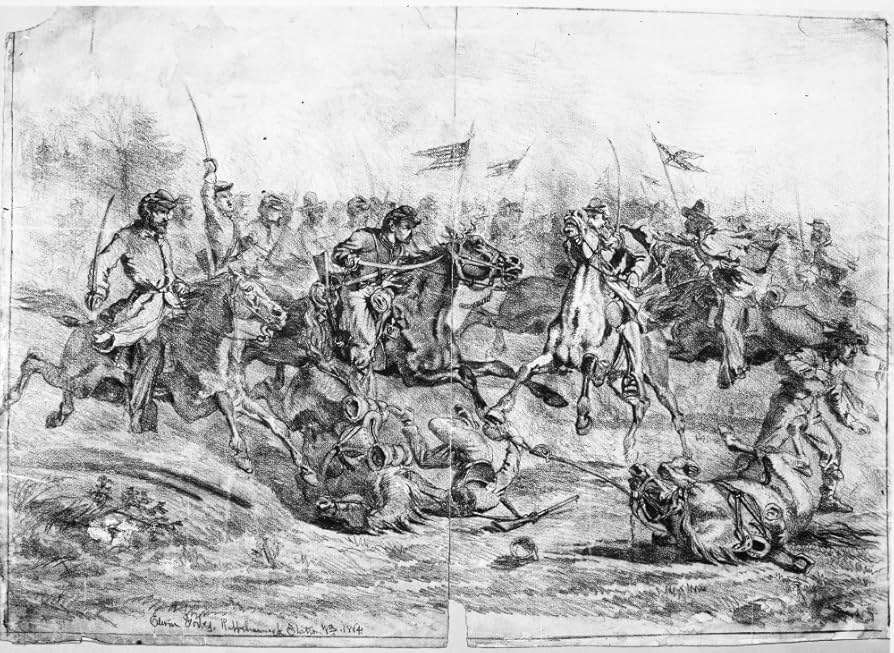
On November 20, 1863, the First New York Dragoons — still carrying their new designation as the 19th New York Cavalry — were in action at Culpeper Court House, Virginia. The fight falls in the restless interval between the Bristoe Campaign of October and Maj. Gen. George G. Meade’s Mine Run offensive at the end of November, a season in which the mounted arm of the Army of the Potomac sparred almost daily with the enemy across the worn Piedmont around Culpeper and Brandy Station. Barely four months earlier the regiment had been foot soldiers; now, under Col. Alfred Gibbs, it rode as cavalry in Brig. Gen. John Buford’s command.
From Infantry to Dragoons
On July 28, 1863, the 130th New York Volunteer Infantry was transferred to the cavalry service and re-designated the Nineteenth New York Cavalry — the regiment soon to be famous as the First New York Dragoons. Its colonel, Alfred Gibbs, a West Pointer with some twenty years in the mounted service, was in his element. Camped at Manassas Junction from August into October, the regiment set to “the work of drilling in cavalry tactics,” and, Bowen wrote, “Colonel Gibbs was now in his element. … his ambition was to make it equally proficient as a cavalry organization, and to this end he bent all his energies.” His men, lately foot soldiers, spent those weeks learning to fight from the saddle.

Cavalry Work Around Culpeper
The regiment rejoined the Army of the Potomac on October 13 and fought its first mounted action four days later at Manassas Plains. It then followed the army south into the country around Culpeper. In mid-November, marching with Brig. Gen. John Buford’s three brigades of cavalry, the Dragoons came up against the enemy near the town. “Nearing Culpepper we found the enemy, who retired before our advance,” one trooper wrote home; “suddenly we were startled by heavy volleys of small arms and the roar of artillery.” They were shelled but, that day, not seriously engaged.
On November 20 the regiment was again in action at Culpeper Court House — the engagement this page commemorates — one more clash in the ceaseless sparring of the outpost line. When Meade opened his Mine Run offensive on November 26, the Dragoons marched toward Ely’s Ford, held their horses through a night so cold the men “could only keep from freezing by drumming our feet upon the frozen ground,” and crossed the Rapidan on the 28th. The campaign came to nothing; the cavalry recrossed the river on December 2 and returned to Culpeper for weeks of grinding picket and scout duty before going into winter quarters at Mitchell’s Station on December 26.
“Nearing Culpepper we found the enemy, who retired before our advance. Suddenly we were startled by heavy volleys of small arms and the roar of artillery. Our advance was attacked, and we were ordered forward at a gallop to their support. We were not engaged, but sat upon our horses in plain view of the enemy, who commenced pouring the shells about us, cutting trees and tearing up the ground near by.”— A soldier of the First New York Dragoons, in a letter dated Culpepper, Va., November 12, 1863, reproduced in J. R. Bowen’s Regimental History, ch. VII, “Manassas to Mitchell’s Station.”
Sources & Further Reading
- Primary James R. Bowen, Regimental History of the First New York Dragoons (originally the 130th N.Y. Vol. Infantry) (1900), ch. VII, “Manassas to Mitchell’s Station,” pp. 96–108 — the regiment’s own historian and an eyewitness; the engagement is also entered in the regiment’s official list of battles and in its chronology (“November 20, engagement at Culpepper C. H.”). Full text: archive.org/details/regimentalhistor00bowe.
- Primary U.S. War Dept., The War of the Rebellion: Official Records of the Union and Confederate Armies, Series I, Vol. 29 — operations in central Virginia, August–December 1863 (the Bristoe and Mine Run campaigns), the context for the Federal cavalry’s work around Culpeper.
- Editorial note: Neither the National Park Service / CWSAC battle-summary series nor the American Battlefield Trust catalogues a separate battle at Culpeper Court House on November 20, 1863; it survives in the record as a minor cavalry affair listed among the regiment’s engagements, and is documented here from Bowen and the Official Records rather than from those reference works.
Trevilian Station · The Shenandoah Valley Campaign · The Audiobook
Views: 2927
Explore the evidence
View this article’s connected sources and media →
About this page
This article was brought over from AlfredGibbs.com. Its preserved text, media and citations remain available for comparison.