
The longest letter in this correspondence file is George Gibbs at his most exposed. Word that President Fillmore had appointed him Collector of Astoria – unsolicited, “on being satisfied that the report of my intemperate habits was incorrect” – reached him in the Klamath mines by rumor, weeks late, with famine closing over the northern camps and the Columbia freezing at Vancouver. What follows runs the whole register of a brother’s honesty: the frank temperance history, renewed to Alfred “on my word of honor”; the $50,000 bond he cannot raise in Oregon; the Whig’s cold-eyed refusal to beg the incoming administration (“I shall blame no one, nor complain, but go my way rejoicing that it is no worse”); Stoneman’s fuller account of Secretary Conrad’s and Gen. Scott’s conduct toward Alfred (“I did think better of Scott”); Hitchcock’s neglect of the Klamath murders; and the embrace of the army world – “D—n it but it does one good to meet an army man… Stoneman too is a glorious good fellow… very much attached to you.” For Alfred there are two gifts: the promise that runs straight to this archive’s Mounted Riflemen file – “finish copying my journal of the Rifle Regiment tour, which if I remain here I will do this winter & send to you” – and the warning of a man schooled by his own debts: “I am afraid that you live far too extravagantly at Sonoma… For God’s sake Alfred be prudent & keep within bounds.”
❦The Letter
Page 1 (scan 1473)
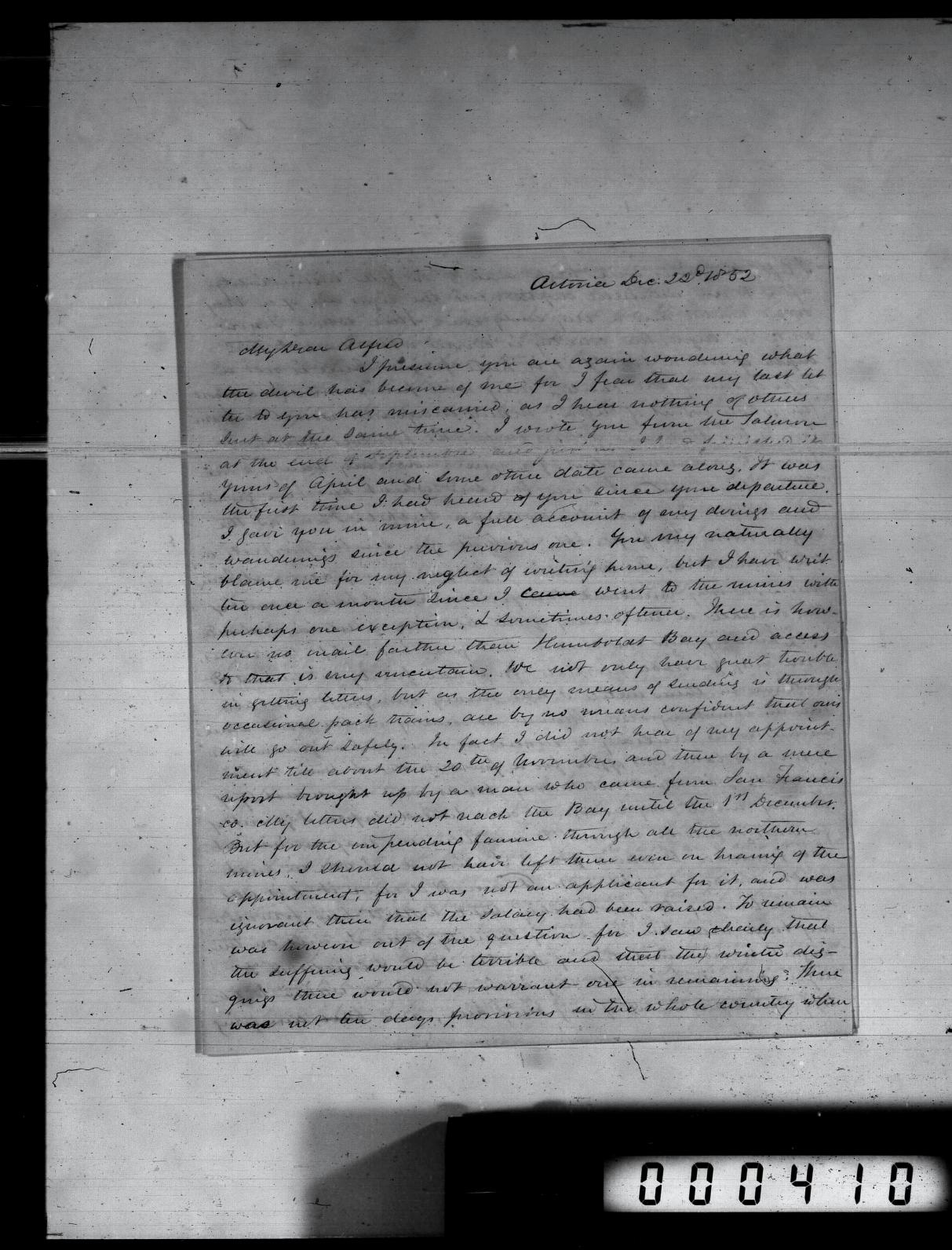
(Reading order: page 1 of 9. Microfilm frame counter 000410.)
Astoria Dec. 22d 1852
My dear Alfred
I presume you are again wondering what the devil has become of me for I fear that my last letter to you has miscarried, as I hear nothing of others sent at the same time. I wrote you from the Salmon at the end of September and [line blurred at film fold: several words illegible] yours of April and some other date came along. It was the first time I had heard of you since your departure. I gave you in mine, a full account of my doings and wanderings since the previous one. You may naturally blame me for my neglect of writing home, but I have written once a month since I [came – struck through] went to the mines with perhaps one exception, & sometimes oftener. There is however no mail farther than Humboldt Bay and access to that is very uncertain. We not only have great trouble in getting letters, but as the only means of sending is through occasional pack trains, are by no means confident that ours will go out safely. In fact I did not hear of my appointment till about the 20th of November, and then by a mere report brought up by a man who came from San Francisco. My letters did not reach the Bay until the 1st December. But for the impending famine through all the northern mines, I should not have left there even on hearing of the appointment, for I was not an applicant for it, and was ignorant then that the salary had been raised. To remain was however out of the question for I saw clearly that the suffering would be terrible and that the winter diggings there would not warrant one in remaining. There was not ten days provisions in the whole country when
Page 2 (scan 1474)
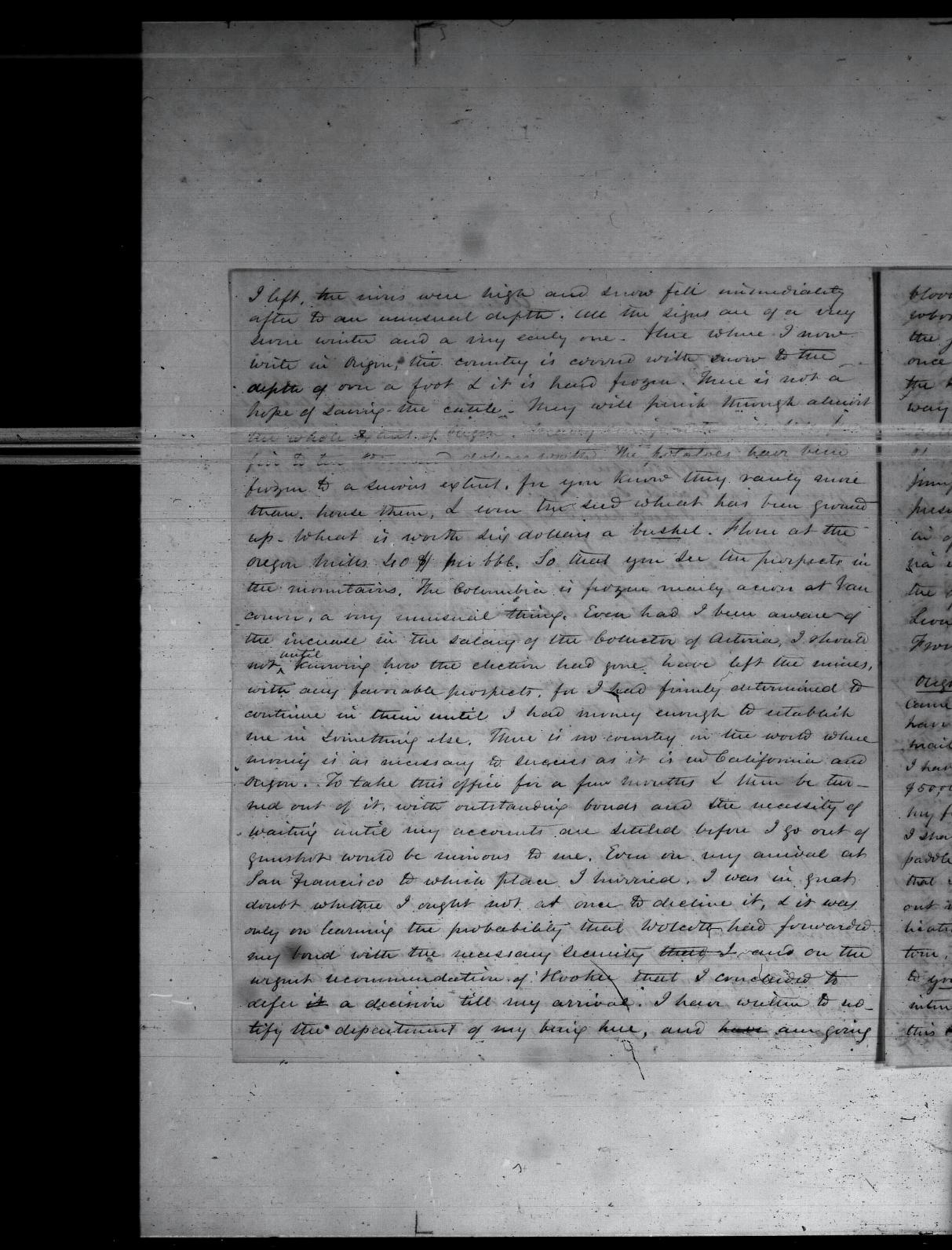
(Reading order: page 2 of 9.)
I left, the rains were high and snow fell immediately after to an unusual depth. All the signs are of a very severe winter and a very early one. Here where I now write in Oregon, the country is covered with snow to the [depth – struck through] depth of over a foot & it is hard frozen. There is not a hope of saving the cattle. They will perish through almost the whole [west?] of Oregon. [line blurred at fold: several words illegible] [illegible] unless watered[?]. The potatoes have been frozen to a serious extent, for you know they rarely more than house them, & even the seed wheat has been ground up. Wheat is worth six dollars a bushel. Flour at the Oregon Mills 40 $ per bbl. So that you see the prospects in the mountains. The Columbia is frozen nearly across at Vancouver, a very unusual thing. Even had I been aware of the increase in the salary of the Collector of Astoria, I should not, until knowing how the election had gone, have left the mines, with any favorable prospects, for I had firmly determined to continue in them until I had money enough to establish me in Something else. There is no country in the world where money is as necessary to success as it is in California and Oregon. To take this office for a few months & then be turned out of it, with outstanding bonds and the necessity of waiting until my accounts are settled before I go out of gunshot would be ruinous to me. Even on my arrival at San Francisco to which place I hurried, I was in great doubt whether I ought not at once to decline it, & it was only on learning the probability that Wolcott had forwarded my bond with the necessary security [that – struck through] I, and on the urgent recommendation of Hooker that I concluded to defer [it – struck through] a decision till my arrival. I have written to notify the department of my being here, and [have – struck through] am going
Page 3 (scan 1480)
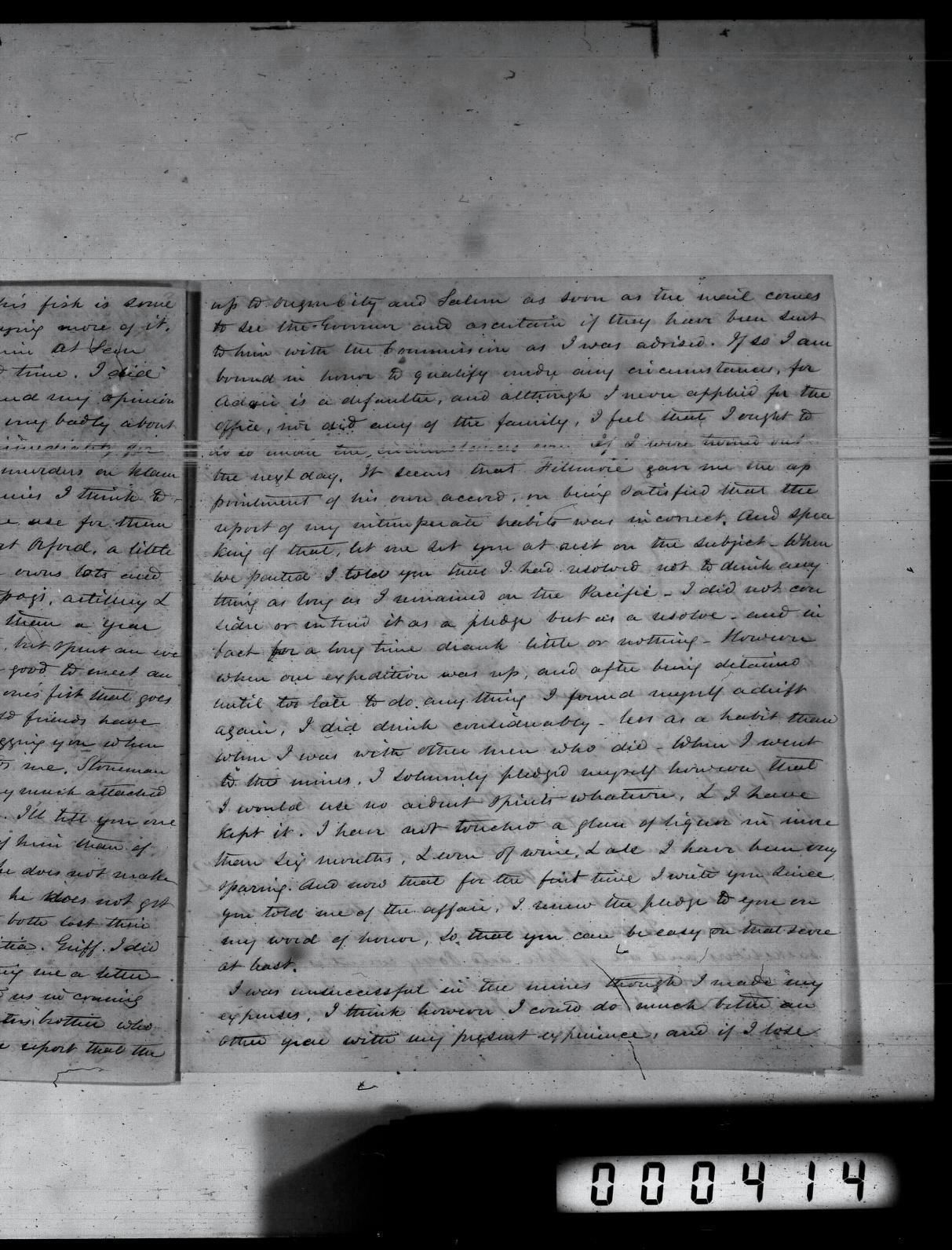
(Reading order: page 3 of 9. Microfilm frame counter 000414. Continues from scan 1474, “…and am going”.)
up to Oregon City and Salem as soon as the mail comes to see the Governor and ascertain if they have been sent to him with the Commission as I was advised. If so I am bound in honor to qualify under any circumstances, for Adair is a defaulter, and although I never applied for the office, nor did any of the family, I feel that I ought to [line blurred at fold: do so under the circumstances[?] even] if I were turned out[?] the next day. It seems that Fillmore gave me the appointment of his own accord, on being satisfied that the report of my intemperate habits was incorrect. And speaking of that, let me set you at rest on the subject. When we parted I told you that I had resolved not to drink any thing as long as I remained on the Pacific – I did not consider or intend it as a pledge but as a resolve – and in fact [for – struck through] for a long time drank little or nothing – However when our expedition was up, and after being detained until too late to do any thing, I found myself adrift again, I did drink considerably – less as a habit than when I was with other men who did – When I went to the mines, I solemnly pledged myself however that I would use no ardent spirits whatever, & I have kept it. I have not touched a glass of liquor in more than six months, & even of wine, & ale I have been very sparing. And now that for the first time I write you since you told me of the affair, I renew the pledge to you on my word of honor, So that you can be easy on that score at least.
I was unsuccessful in the mines though[?] I made my expenses, I think however I could do much better another year with my present experience, and if I lose
Page 4 (scan 1481)
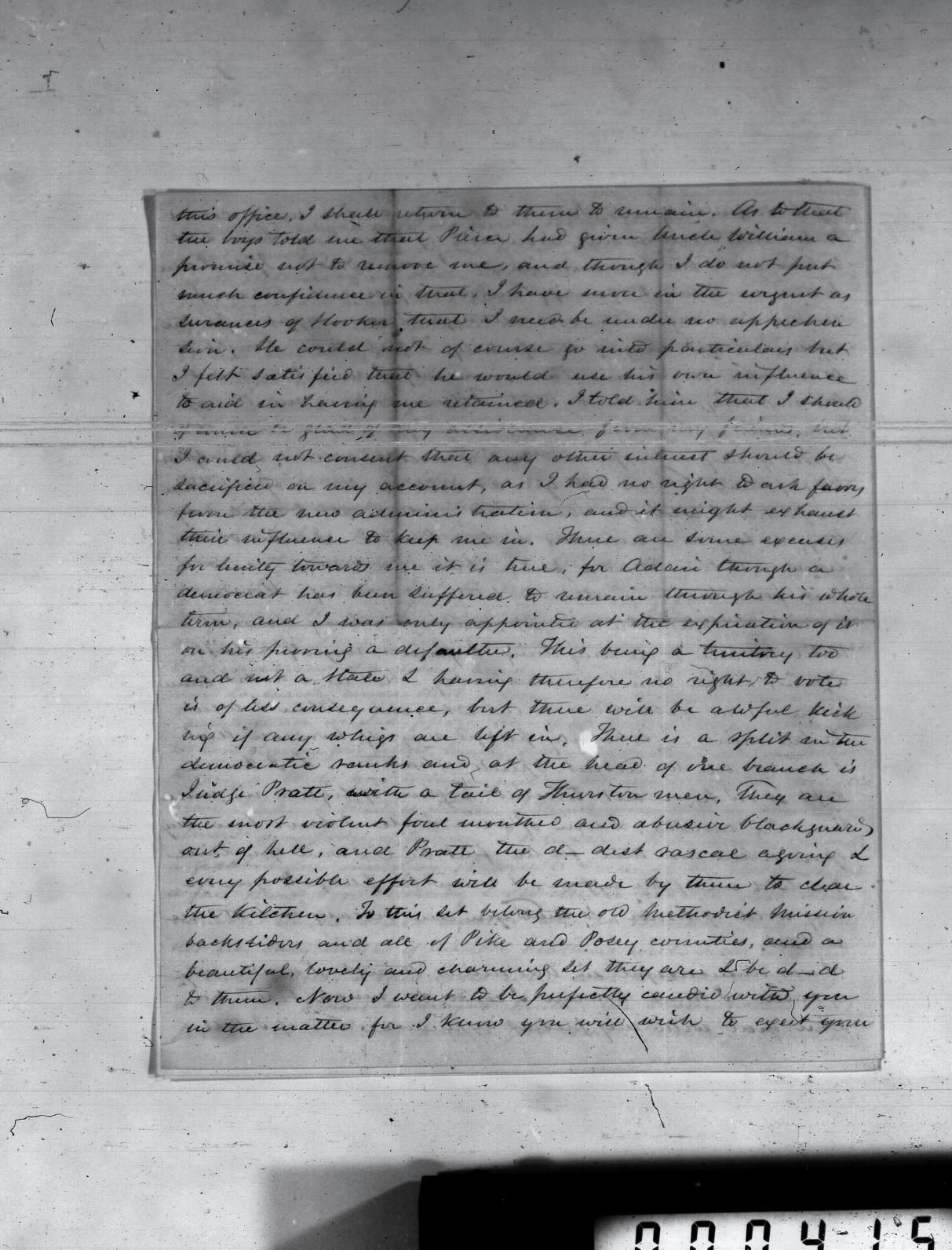
(Reading order: page 4 of 9. Microfilm frame counter 000415. Continues from scan 1480, “…and if I lose”.)
this office, I shall return to them to remain. As to that the boys told me that Pierce had given Uncle William a promise not to remove me, and though I do not put much confidence in that, I have more in the urgent assurances of Hooker, that I need be under no apprehension. He could not of course go into particulars but I felt satisfied that he would use his own influence to aid in having me retained. I told him that I should [line blurred at fold: be willing[?] to accept[?] any assistance from my friends[?], but] I could not consent that any other interest should be sacrificed on my account, as I had no right to ask favors from the new administration, and it might exhaust their influence to keep me in. There are some excuses for lenity towards me it is true, for Adair though a democrat has been suffered to remain through his whole term, and I was only appointed at the expiration of it on his proving a defaulter. This being a territory too and not a state & having therefore no right to vote is of less consequence, but there will be awful kicking if any whigs are left in. There is a split in the democratic ranks and, at the head of one branch is Judge Pratt, [with – struck through] with a tail of Thurston men. They are the most violent foul mouthed and abusive blackguards out of hell, and Pratt the d---dest rascal agoing & every possible effort will be made by them to clear the kitchen. To this set belong the old Methodist Mission backsliders and all of Pike and Posey counties, and a beautiful, lovely and charming set they are & be d---d to them. Now I want to be perfectly candid with you in the matter for I know you will wish to exert your
Page 5 (scan 1477)
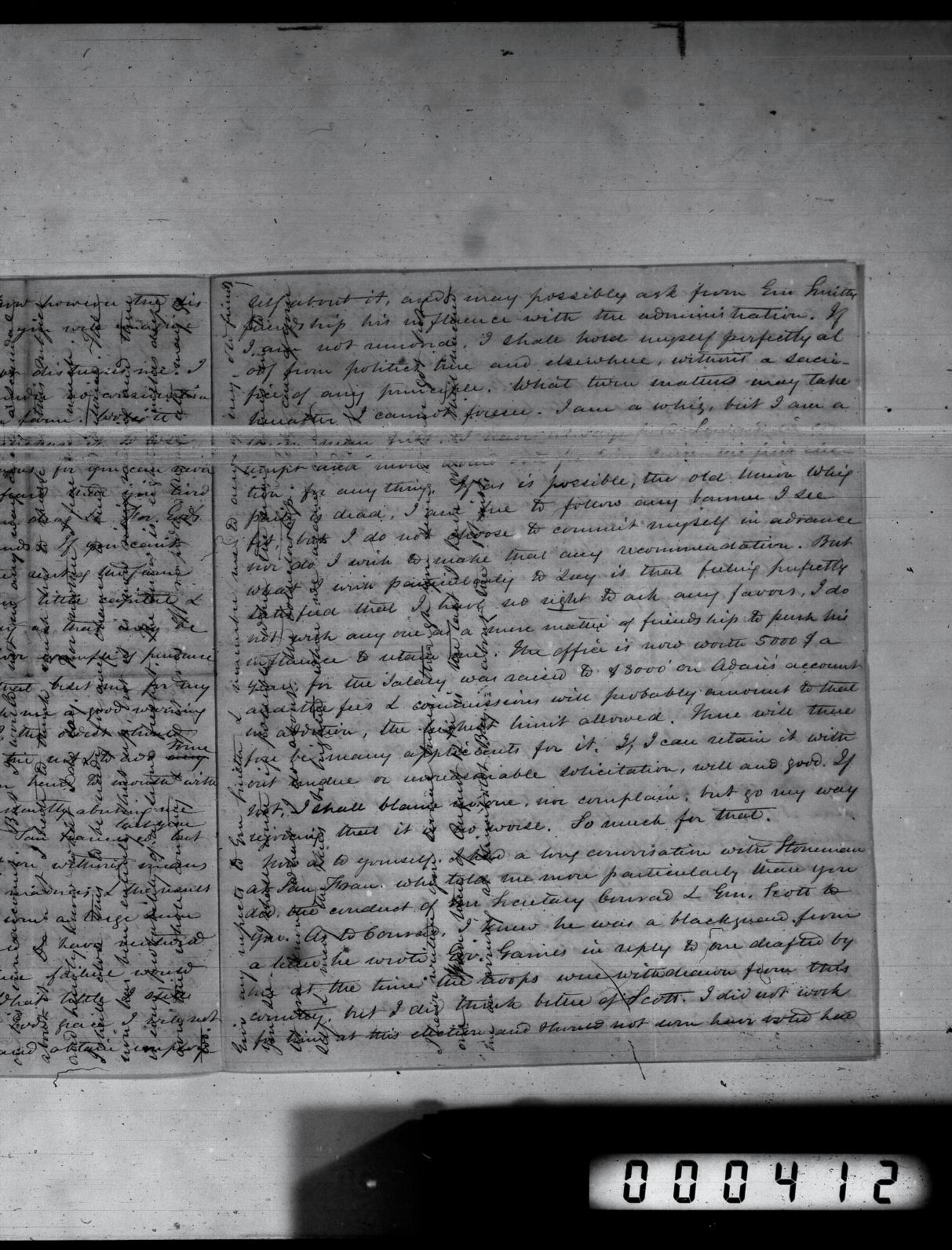
(Reading order: page 5 of 9. Microfilm frame counter 000412. Continues from scan 1481, “…wish to exert your”.)
self about it, and I may possibly ask from Gen Smith’s friendship his influence with the administration. If I am not removed, I shall hold myself perfectly aloof from politics here and elsewhere, without a sacrifice of any principles. What turn matters may take hereafter I cannot foresee. I am a whig, but I am a [line blurred at fold: several words illegible] [second line partially blurred: several words illegible]-tion for any thing. If as is possible, the old Union Whig party is dead, I am free to follow any banner I see fit, but I do not choose to commit myself in advance nor do I wish to make that any recommendation. But what I wish particularly to say is that feeling perfectly satisfied that I have no right to ask any favors, I do not wish any one as a mere matter of friendship to push his influence to retain me. The office is now worth 5000 $ a year, for the salary was raised to $3000 on Adair’s account and the fees & commissions will probably amount to that in addition, the highest limit allowed. There will therefore be many applicants for it. If I can retain it without undue or unreasonable solicitation, well and good. If not, I shall blame no one, nor complain, but go my way rejoicing that it is no worse. So much for that.
Now as to yourself. I had a long conversation with Stoneman at San Fran. who told me more particularly than you did, the conduct of our Secretary Conrad & Gen. Scott to you. As to Conrad, I knew he was a blackguard from a letter he wrote Gov. Gaines in reply to one drafted by me at the time the troops were withdrawn from this country, but I did think better of Scott. I did not work for him at this[?] election and should not even have voted had
Page 6 (scan 1479)
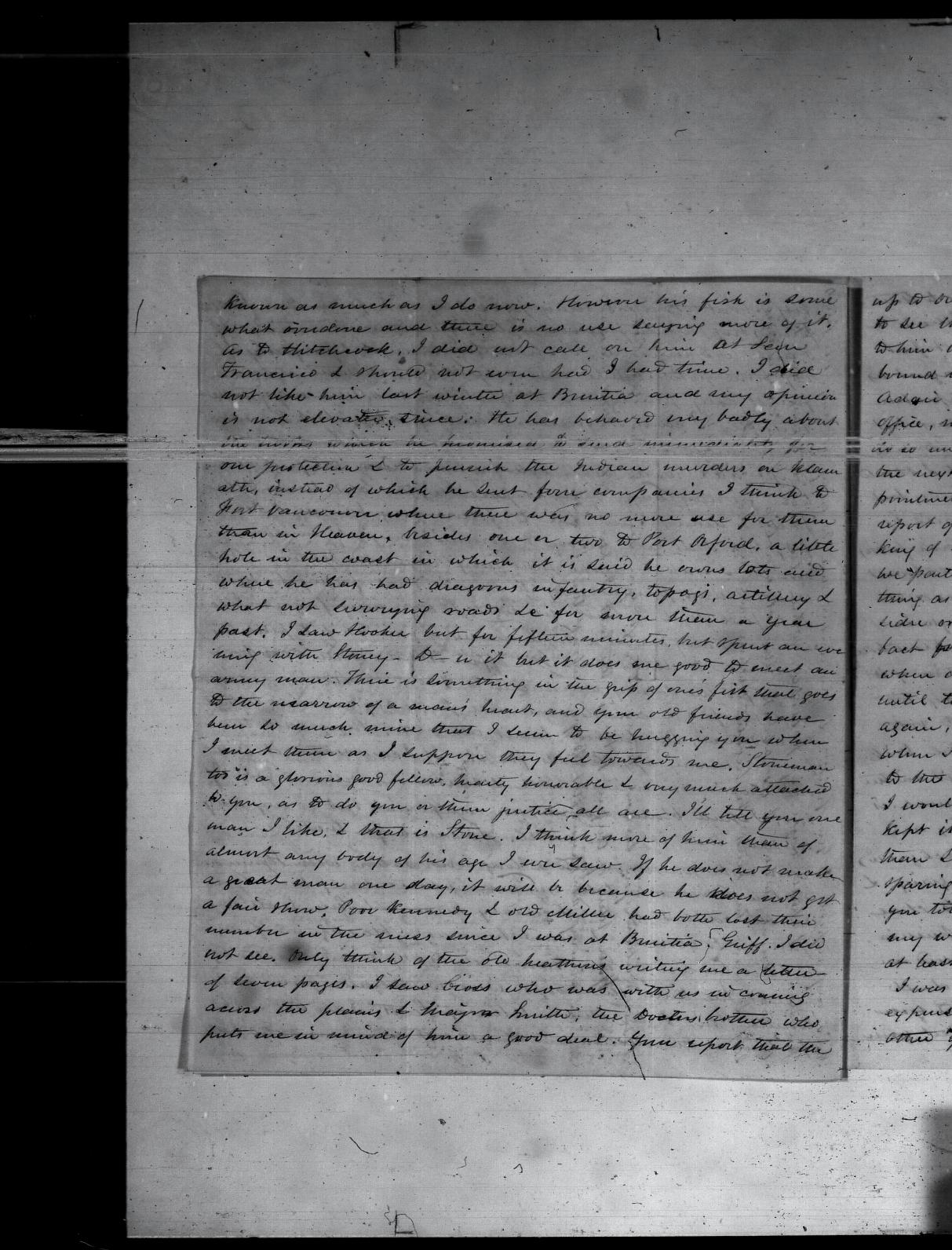
(Reading order: page 6 of 9. Continues from scan 1477, “…should not even have voted had”.)
known as much as I do now. However his fish is somewhat overdone and there is no use saying more of it. As to Hitchcock, I did not call on him at San Francisco & should not even had I had time. I did not like him last winter at Benicia and my opinion is not elevated since. He has behaved very badly about [line blurred at fold: the murders[?] which he promised to [punish?] immediately, for our protection[?]] & to punish the Indian murders on Klamath, instead of which he sent four companies I think to Fort Vancouver where there was no more use for them than in Heaven, besides one or two to Port Orford, a little hole in the coast in which it is said he owns lots and where he has had dragoons infantry, topogs, artillery & what not surveying roads &c for more than a year past. I saw Hooker but for fifteen minutes, but spent an evening with Stoney – D---n it but it does one good to meet an army man. There is something in the grip of one’s fist that goes to the marrow of a man’s heart, and your old friends have been so much mine that I seem to be hugging you when I meet them as I suppose they feel towards me. Stoneman too is a glorious good fellow, hearty honorable & very much attached to you, as to do you or them justice, all are. I’ll tell you one man I like, & that is Stone. I think more of him than of almost any body of his age I ever saw. If he does not make a great man one day, it will be because he does not get a fair show. Poor Kennedy & old Miller had both lost their number in the mess since I was at Benicia. Griff. I did not see. Only think of the old heathens writing me a letter of seven pages. I saw Cross[?] who was with us in coming across the plains & Major Smith, the Doctor’s brother who puts me in mind of him a good deal. You[r?] report that the
Page 7, with the Dec. 26 continuation (scan 1475)
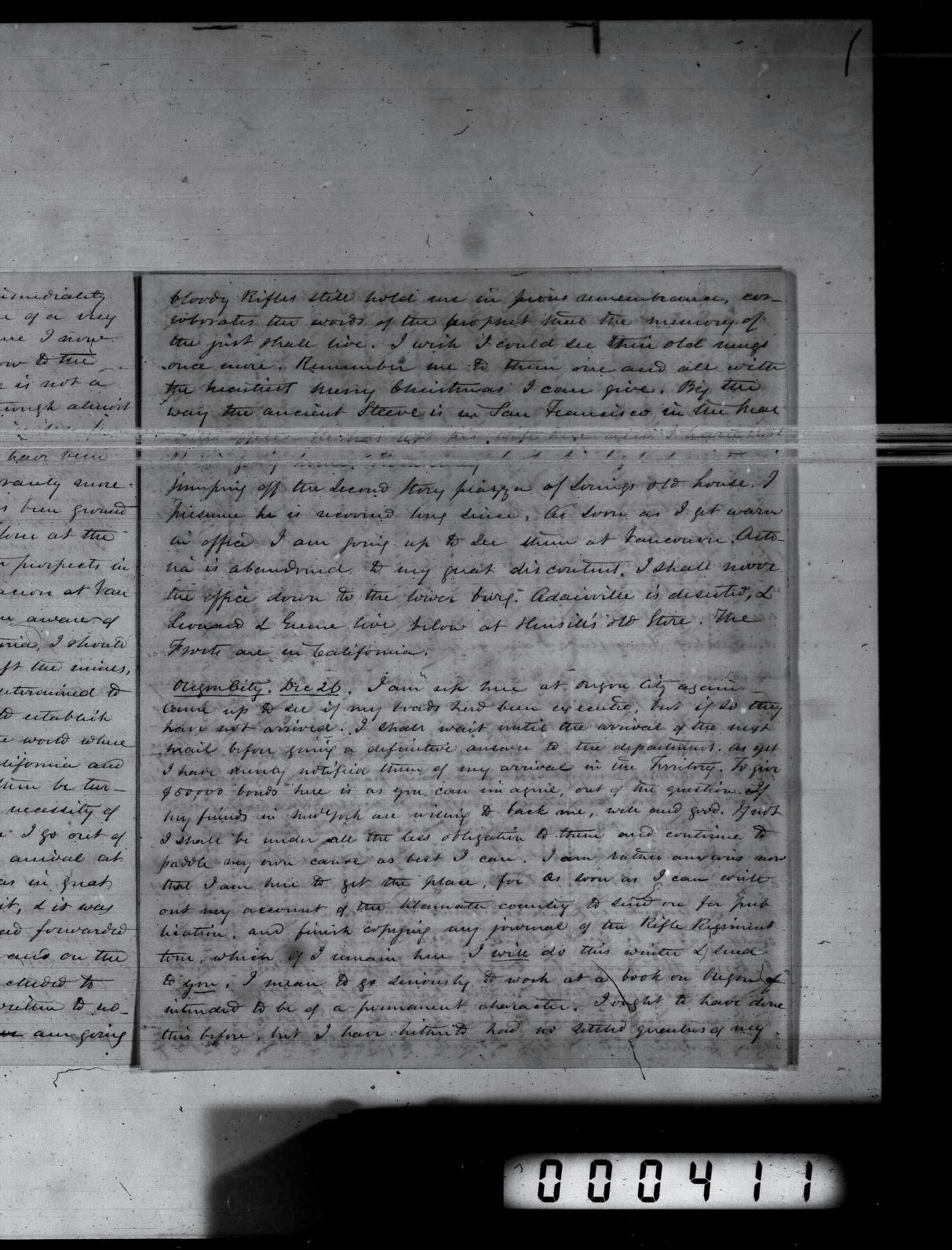
(Reading order: page 7 of 9. Microfilm frame counter 000411. Continues from scan 1479, “You[r] report that the”.)
bloody Rifles still hold me in kind[?] remembrance, corroborates the words of the prophet that the memory of the just shall live. I wish I could see those old mugs[?] once more. Remember me to them one and all with the heartiest merry Christmas I can give. By the way the ancient Steve[?] is in San Francisco in the hea[?]- [two lines blurred at fold: several words illegible; “…office… Rifles here…” discernible] [illegible] jumping off the second story piazza of Loring’s old house. I presume he is recovered long since. As soon as I get warm in office I am going up to see them at Vancouver. Astoria is abandoned to my great discontent. I shall move the office down to the lower burg. Adairville is deserted, & Leonard & Greene live below at Hensill’s[?] old store. The Frosts are in California.
Oregon City. Dec 26. I am up here at Oregon City again – came up to see if my bonds had been executed, but if so they have not arrived. I shall wait until the arrival of the next mail before giving a definite answer to the department. As yet I have simply notified them of my arrival in the Territory. To give $50,000 bonds here is as you can imagine, out of the question. If my friends in New York are willing to back me, well and good. If not I shall be under all the less obligation to them and continue to paddle my own canoe as best I can. I am rather anxious now that I am here to get the place, for as soon as I can write out my account of the Klamath country to send on for publication, and finish copying my journal of the Rifle Regiment tour, which if I remain here I will do this winter & send to you, I mean to go seriously to work at a book on Oregon [of – struck through] intended to be of a permanent character. I ought to have done this before, but I have hitherto had no settled quarters of my
Page 8 (scan 1476)
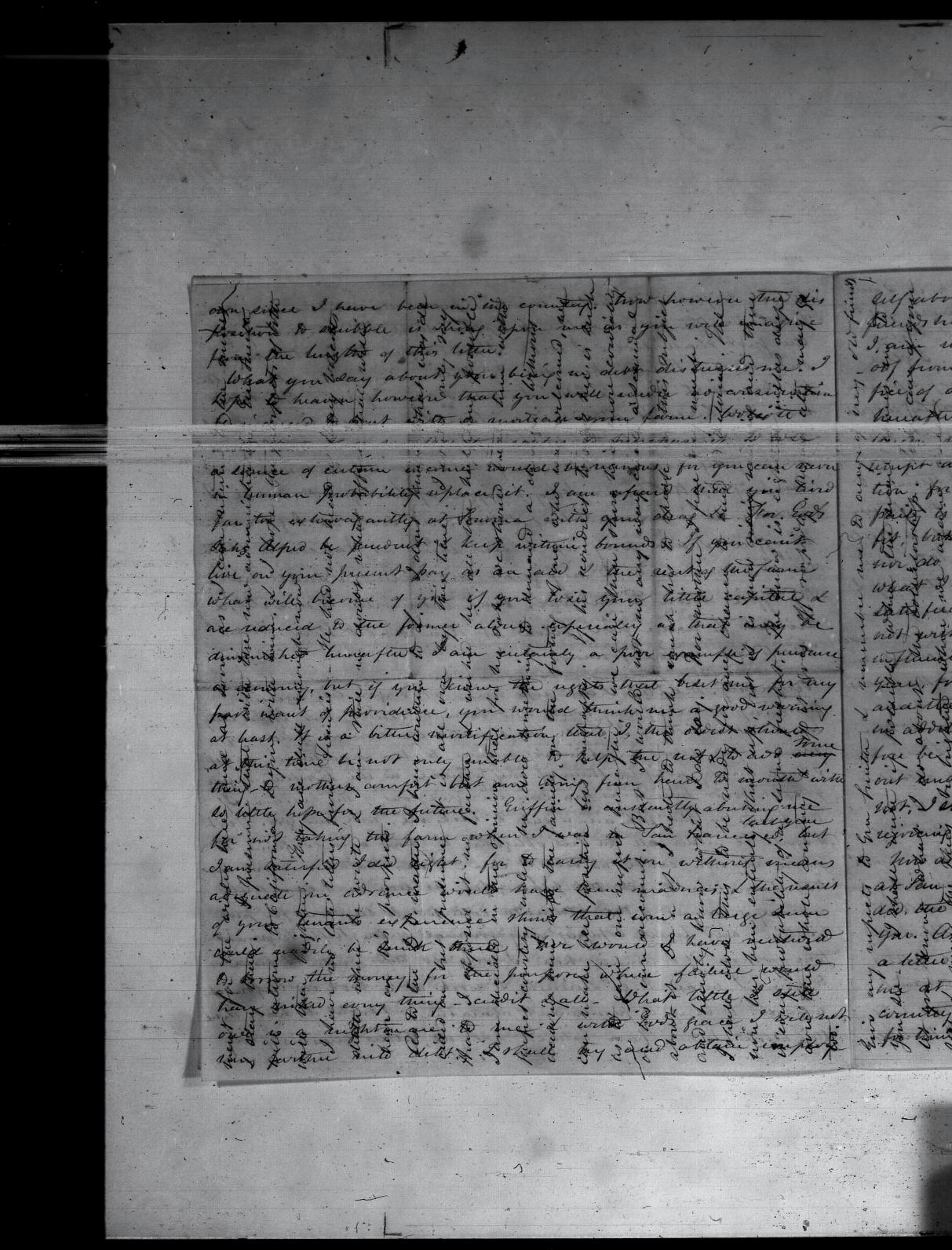
(Reading order: page 8 of 9. The worst-preserved page of the letter: a light exposure with heavy show-through from the conjugate leaf giving a cross-hatched look; see NOTES.)
own, since I have been in the country. Now however the disposition to scribble is strong upon me as you will imagine from the lengths of this letter.
What you say about your being in debt disturbed me. I hope to heaven however that you will make[?] no arrangement[?] [several words illegible] to mortgage your farm. [Were it?] [line largely illegible] as[?] lease[?] of certain income would be [ruinous?] for you can never[?] in human probability replace it. I am afraid that you live far too extravagantly at Sonoma [several words illegible] my dear A[?]. For God’s sake Alfred be prudent & keep within bounds. If you cannot live on your present pay as an aid & the rents[?] of the farm what will become of you if you lose your little capital & are reduced to the former alone, especially as that may be diminished hereafter. I am certainly a poor example of prudence & economy, but if you knew the agonies[?] that beset me for my past want of providence, you would think me a good warning at least. It is a bitter mortification that I, the oldest should at this time be not only unable to help the rest & to do any thing[?] to mother’s[?] comfort but am living[?] from hand to mouth with as little hope for the future. Griffin is constantly abusing me for not taking the farm when I was in San Francisco but I am satisfied I did right, for to carry it on without means and[?] capital[?] in advance would have been madness[?]. The chances[?] of your own[?] unquiet[?] experience show[?] that even a large sum could easily be sunk there. Nor[?] would I have ventured to borrow the money for the purpose whose failure would have risked every thing – credit & all. What little I owe now[?] is a nightmare to me & with God’s grace I will not[?] run further into debt. I shall try[?] and obtain[?] employ[ment?]
Page 9 and closing (scan 1478)
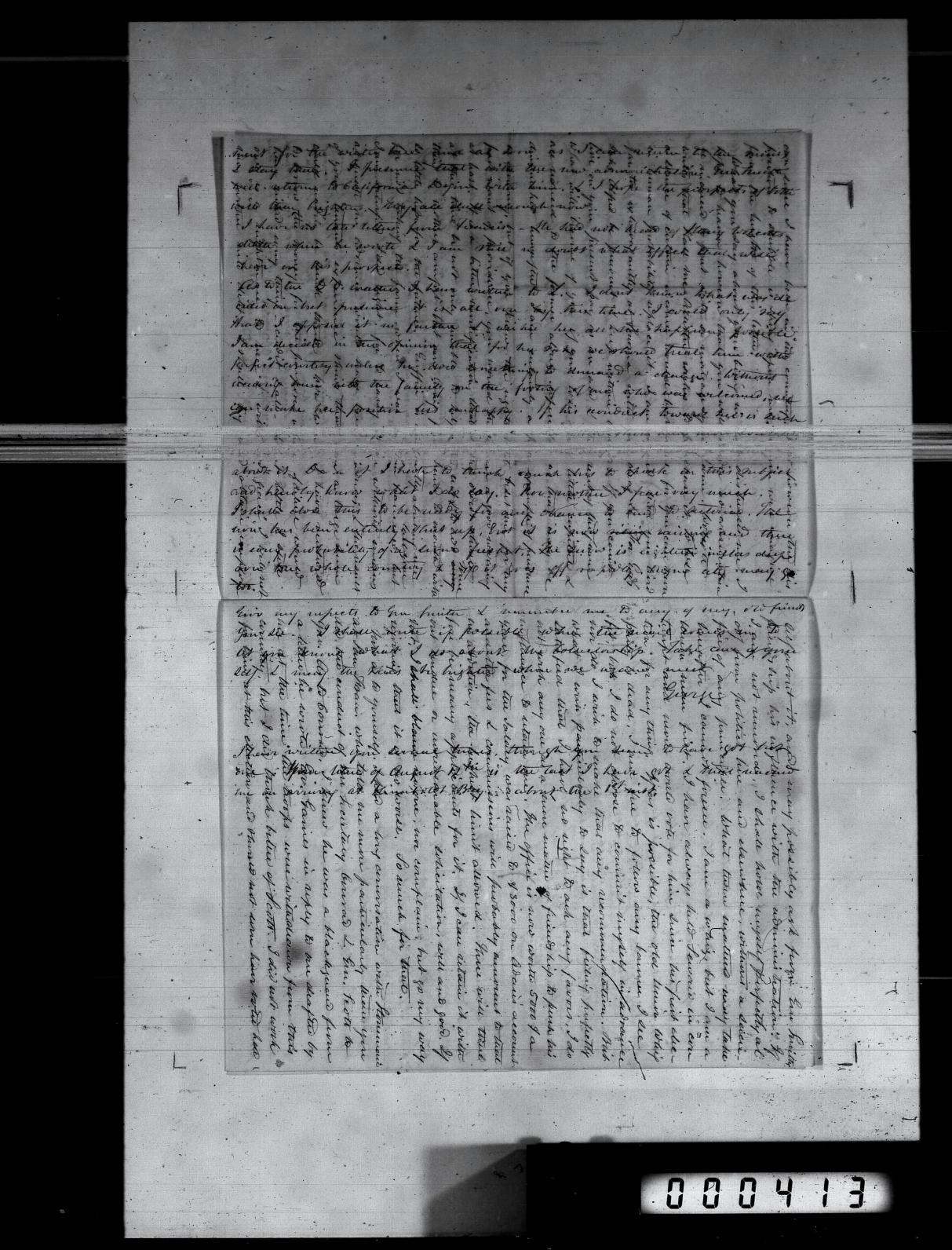
(Reading order: page 9 of 9, plus closing. Microfilm frame counter 000413. VERY light exposure throughout; three text zones are on this frame – see NOTES.)
[Zone 1 – top of the final page, continuing scan 1476’s “I shall try and obtain employ-“:]
-ment[?] [several words illegible] this winter[?] [several words illegible] I[?] return[?] to the mines[?] if[?] I stay there. I presume that[?] with[?] the[?] increased[?] salary[?] [several words illegible] will return to California before[?] winter[?] here[?], & I hope the prospects of Bill[?] will turn brighter. [Hoppin?] shall[?] be remembered[?].
I have had two[?] letters from Vancouver[?] – She[?] had not heard of Harry[?] Wolcott’s[?] death[?] when she[?] wrote & I am here[?] in doubt what effect that[?] will[?] have[?] upon[?] her[?] [several words illegible] hopes[?] on his[?] prospects.
As[?] to the P.O.[?] changes[?], I[?] have[?] written[?] to[?] [several words illegible] I should[?] think[?] it would[?] tell[?] [several words illegible] one[?] way[?] or[?] the[?] other[?]. I[?] would only[?] say[?] that I opposed it in future[?] & we are[?] here[?] all[?] now[?] on[?] the happiest[?] possible[?] footing[?]. I am decided in my opinion that if he goes[?] [several words illegible] we should treat him with[?] respect & courtesy unless he does something to demand a change [several words illegible] certainly[?] done[?] with[?] the family in[?] the footing[?] of one who was welcomed, and[?] [several words illegible] here[?] certain[?] his[?] unhappy[?] [illegible]. If his conduct towards her is such
[Zone 2 – continuation and weather passage:]
abroad. Or as[?] I[?] should[?] choose[?] to think, [several words illegible] he is to choose on this subject and thereby[?] knows[?] it all. I do[?] say[?], [several words illegible] I feel very much. I hardly[?] know[?] this[?] to be ready for any change & such a distance. The[?] [several words illegible] have been entirely[?] [several words illegible]. Rain[?] is now falling [steadily?] and there is every[?] possibility of a large freshet. The snow is a foot in places[?] deep over this whole country & if it goes off rapidly there[?] they[?] may go too.
[Zone 3 – closing lines and signature:]
Give my respects to Gen Smith & remember me to many[?] of my old friends. Jany 2d[?]. I shall wind up finally[?] when[?] the[?] mail[?] comes[?], [several words illegible] all[?] I[?] know[?] about the collectorship. Take[?] care[?] of[?] your[?] [several words illegible] the[?] blues[?] [several words illegible] brighter[?] [several words illegible]
[several words illegible] Good[?] bye[?] [illegible]
George[?]
[Also legible in the lower half of the frame, upright over a doubled exposure:] I[?] have written you several times, though from you I have[?] received[?] only [several words illegible] your[?] letter[?] of August 18th[?] [which?] is the last I have [received?] [several words illegible] arriving[?] at Klamath[?] [several words illegible] the 13[th?] inst[?]
1. CORRECTION TO THE RECORD: the microfilm frames do not follow the reading order. The true sequence, proven by catchwords at every page junction (e.g. “and am going / up to Oregon City,” “ins-” breaks aside), is 1473, 1474, 1480, 1481, 1477, 1479, 1475, 1476, 1478 – and the plates below are presented in that reading order, with each plate’s scan number stated. The reel index records the letter correctly as one nine-page item.
2. The “bloody Rifles” passage and the Rifle Regiment journal promise document George’s 1849 overland journey with Alfred’s regiment – the journal that later fed his published account; this letter shows him planning to copy it for his brother, and “a book on Oregon of a permanent character.”
3. The Sonoma economy passage is the other side of Alfred’s own August 1852 letter (“I am economical, and I expect to be above water in a year”) – two brothers auditing each other across two thousand miles.
4. Pages 8 and 9 (scans 1476, 1478) are the worst exposures of the letter; readings there are conjectural at about one word in six and are marked [?] rather than smoothed. The dashes in “D—n” and “d—d” are George’s own.
Archival citation
Gibbs Family Papers, 1763-1918. U.S. Mss Y; Micro 1117; Photo Lots 3696-3697. Wisconsin Historical Society, Division of Library, Archives, and Museum Collections, Madison, Wis. Digitized research copy (Green collection), Reel 2. Scans 1473-1481 (microfilm frames 000410-000415; presented in reading order 1473, 1474, 1480, 1481, 1477, 1479, 1475, 1476, 1478); microfilm frames 000410-000415. Every page of the letter is shown above; duplicate microfilm exposures are noted in the reel index.
Suggested citation (Chicago): George Gibbs to Alfred Gibbs, December 22-26, 1852 (closed ca. January 2, 1853). Gibbs Family Papers, 1763-1918, U.S. Mss Y, Micro 1117, reel 2. Wisconsin Historical Society, Madison, WI. Accessed via AlfredGibbs.com.
Related in the Record
References
Gibbs, G.. (1852, December 22-26). [Letter to Alfred Gibbs]. Gibbs Family Papers, 1763-1918 (U.S. Mss Y, Micro 1117, reel 2) [Manuscript]. Wisconsin Historical Society, Madison, WI.
Gibbs family. (1763-1918). Gibbs Family Papers (U.S. Mss Y; Micro 1117; Photo Lots 3696-3697) [Manuscript collection]. Wisconsin Historical Society, Madison, WI.
Accuracy review: transcription checked against the full-resolution scans, July 11, 2026. Original spelling and punctuation are preserved; editorial matter appears in square brackets and uncertain readings are marked [?] rather than guessed. Corrections are made openly; this page will be updated, never silently, if better readings are established.
Views: 6
Explore the evidence
View this article’s connected sources and media →
About this page
This article was brought over from AlfredGibbs.com. Its preserved text, media and citations remain available for comparison.