
This is the earliest surviving letter in Alfred Gibbs’s own hand in this archive, and it closes the California chapter in his own words. The Sonoma post is broken up and his world scattered – Col. Hooker (Joseph Hooker, the future army commander) “on leave… the only officer left you knew,” farming six hundred acres of barley by the creek; Stoneman at Fort Orford; Dr. Griffin at Benicia. “General Smith has offered his estate for sale, for which I am very sorry, but I shall hold on to mine at present” – the Sonoma farm, leased three years at $1,800 a year. He is hard run: the government owes him a thousand dollars for getting to his post, and his entire three-year outfit – books, guns, fishing tackle – went down in the steamer wreck at Indianola harbor. His answer is the discipline that runs through his whole career: “I am economical, and I expect to be above water in a year. Meanwhile I have quit drinking, and [smoking,] both probably for ever.” Around the ledger stands the man: the masked ball at Commodore Stevens’, New York having “got about three years ahead of me in everything; from dancing down to scandal”; the older brother’s praise, carefully rationed, for Frank’s improving letters; and the sportsman’s lament for Texas – “the trout by nature is too much of a gentleman ever to have emigrated to Texas.” The direction line closes the Sonoma chain in his own hand: “direct to me here, care of Gen. P. F. Smith. U.S.A.”
❦The Letter
Page 1 (scan 1446)
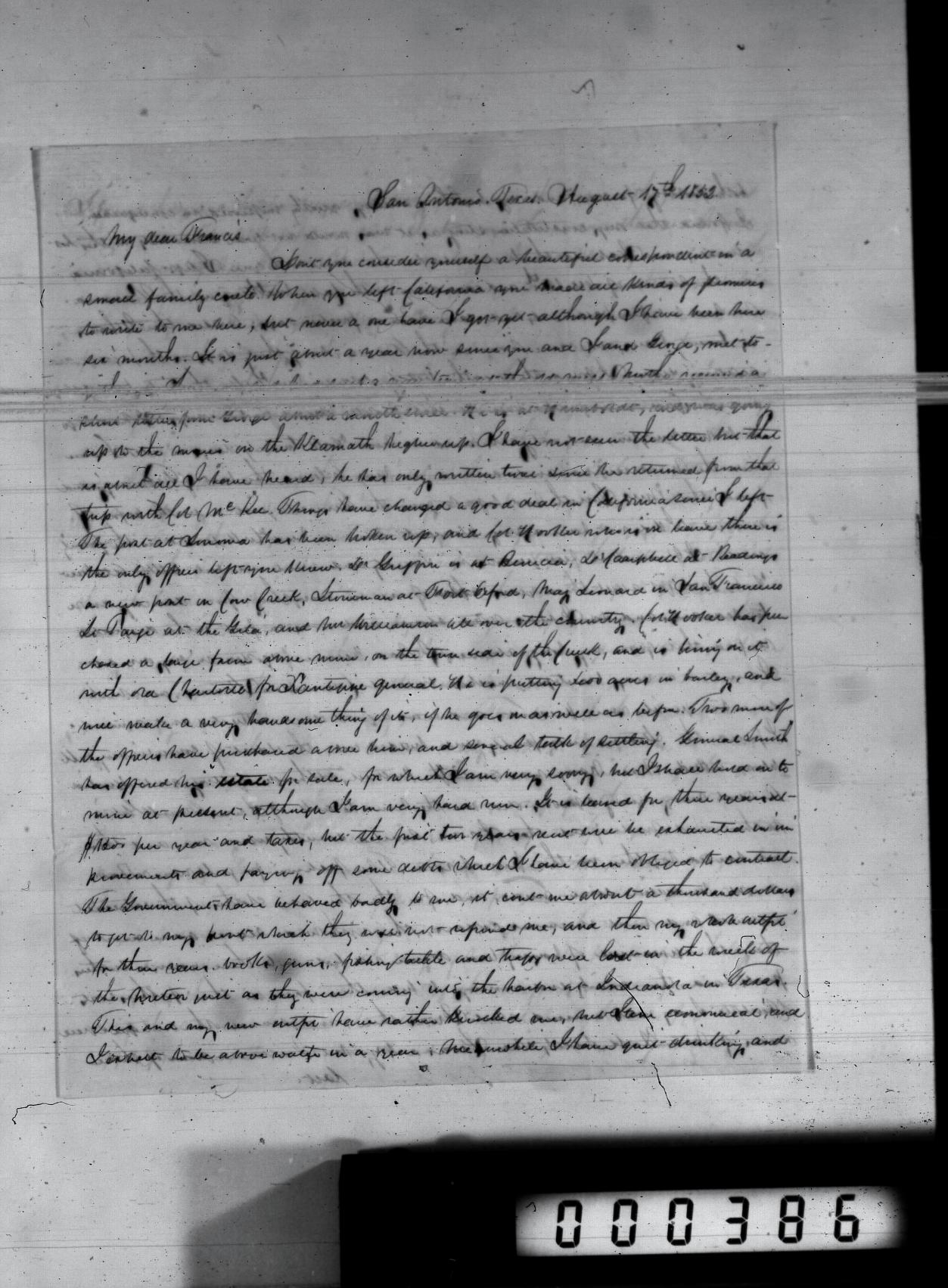
San Antonio. Texas. August 17th 1852
My dear Francis
Dont you consider yourself a beautiful correspondent in a small family circle. When you left California you made all kinds of promises to write to me here; but never a one have I got yet although I have been here six months. It is just about a year now since you and I and George, met to-gether [about one line lost in a horizontal fold/scratch across the film; visible fragments: “at … .”] Mother received a short letter from George about a month since. He is at Humboldt, and was going up to the mines on the Klamath region[?]. I have not seen the letter but that is about all I have heard; he has only written twice since he returned from that trip with Col McKee. Things have changed a good deal in California since I left. The post at Sonoma has been broken up, and Col Hooker who is on leave[?] there is the only officer left you knew. Dr Griffin is at Benicia, Dr Campbell at Readings a new post on Cow Creek, Stoneman at Fort Orford, Maj Leonard in San Francisco Lt Paige[?] at the Gila, and Mr Williamson[?] all over the country. Col Hooker has purchased a place from some man[?], on the town side of the creek, and is living on it with old Charlotte for Lieutenant[?] general. He is putting 600[?] acres in barley, and will make a very handsome thing of it, if he goes on as well as before[?]. Two more of the officers have purchased near him[?], and several talk of settling. General Smith has offered his estate for sale, for which I am very sorry, but I shall hold on to mine at present, although I am very hard run. It is leased for three years[?] at $1800[?] per year and taxes, but the first two years rent will be exhausted in improvements and paying off some debts which I have been obliged to contract. The Government have behaved badly to me, it cost me about a thousand dollars to get to my post which they will not repay[?] me, and then my whole outfit for three years, books, guns, fishing tackle and traps were lost in the wreck of the Meteor just as they were coming into the harbor at Indianola in Texas. That and my new outfit have rather knocked me over[?], but I am economical, and I expect to be above water in a year. Meanwhile I have quit drinking, and
Page 2 (scan 1447)
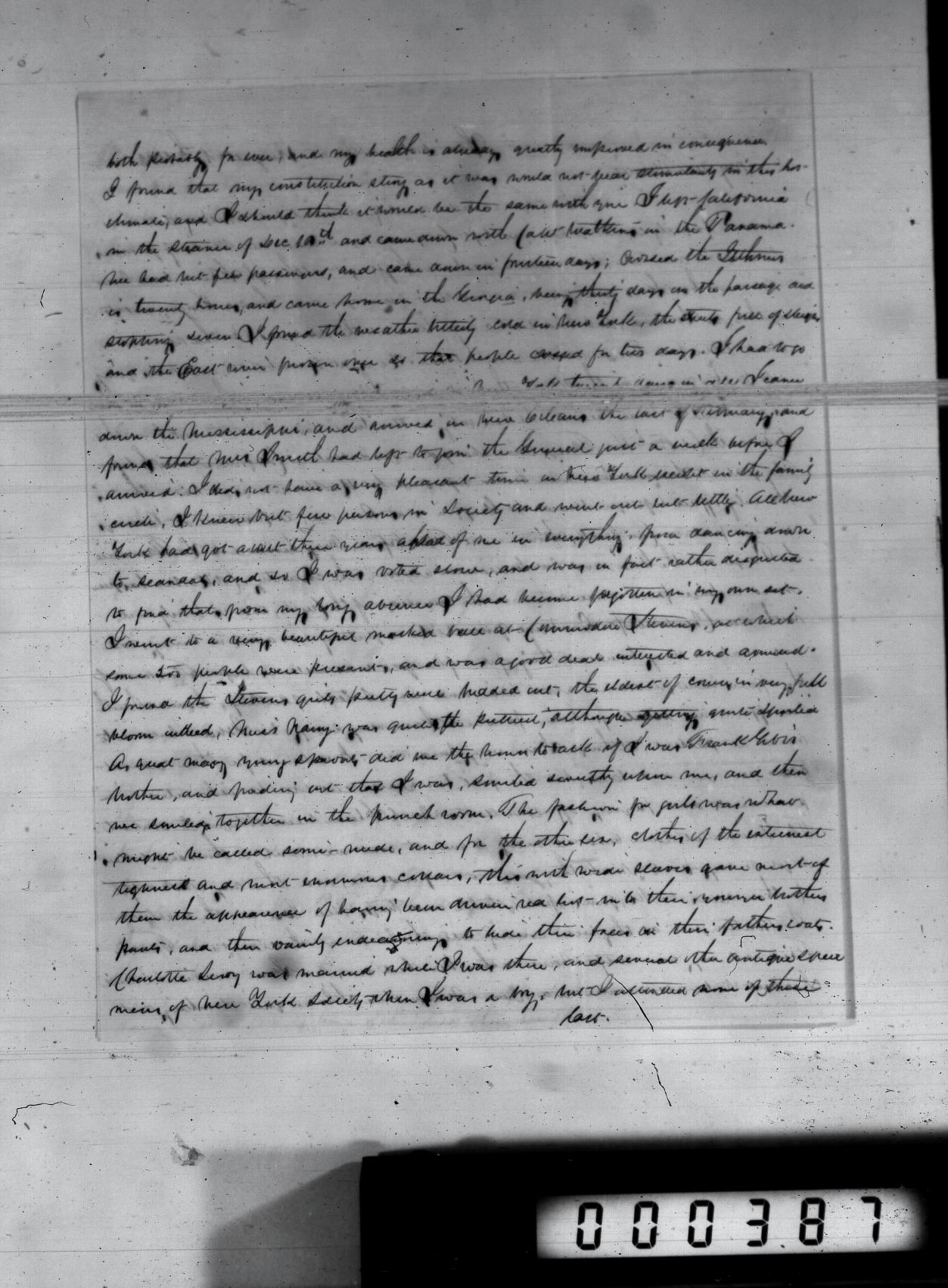
both probably[?] for ever, and my health is already greatly improved in consequence. I found that my constitution being[?] as it was would not bear stimulants in this hot climate, and I should think it would be the same with you. I left California in the steamer of Dec 10th and came down with Carr[?] Watkins in the Panama. We had but few passengers, and came down in fourteen days; crossed the Isthmus in twenty hours, and came home in the Georgia, being thirty days on the passage and stopping seven. I found the weather bitterly cold in New York, the streets full of sleighs and the East river frozen over so that people crossed for two days. I had to go [about one line largely lost in a horizontal fold/scratch; visible fragments: “… left twentieth[?] January[?] in the …”] I came down the Mississippi, and arrived in New Orleans the last of February, and found that Mrs Smith had left to join the General just a week before I arrived. I did not have a very pleasant time in New York except in the family circle, I knew but few persons in Society and went out but little. All New York had got about three years ahead of me in everything; from dancing down to scandal, and so I was voted slow, and was in fact rather disgusted to find that from my long absence I had become forgotten in my own set. I went to a very beautiful masked ball at Commodore Stevens, at which[?] some 400[?] people were present, and was a good deal interested and amused. I found the Stevens girls pretty much faded out, the eldest of course in very full bloom indeed, Miss Nancy was quite the prettiest, although getting quite spoiled. A great many young sprouts did me the honor to ask if I was Frank Gibbs brother, and finding out that I was, smiled sweetly upon me, and then we smiled together in the punch room. The fashion for girls was what might be called semi-nude, and for the other sex, clothes of the extremest tightness and most enormous collars, this with wide[?] sleeves[?] gave most of them the appearance of having been driven red hot into their younger[?] brothers[?] pants, and then vainly endeavouring to hide their faces in their fathers coats. Charlotte Leroy was married while I was there, and several other antique specimens of New York Society when I was a boy, but I attended[?] none of these last.
Page 3 (scan 1448)
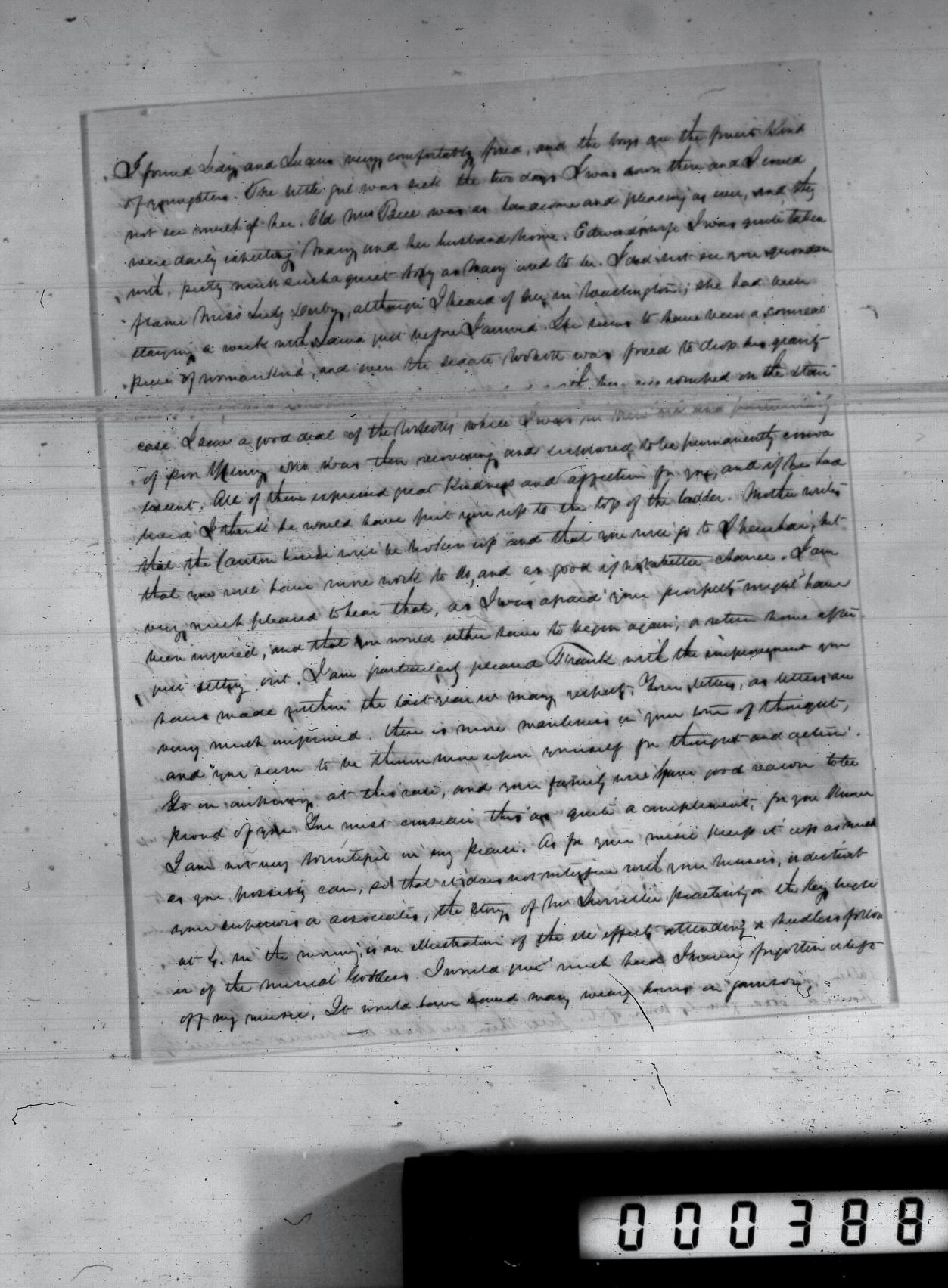
I found Eliza[?] and Susan very comfortably fixed, and the boys are the finest kind of youngsters. The little girl was sick the two days I was down there and I could not see much of her. Old Mrs Buel[?] was as handsome and pleasing as ever, and they were daily expecting Mary and her husband home. Edwards wife I was quite taken with, pretty much such a quiet body as Mary used to be. I did not see my quondam flame Miss Lidy Derby, although I heard of her in Washington; she had been staying a week with Laura just before I arrived. She seems to have been a comical piece of womankind, and even the sedate Wolcott was forced to drop his gravity [about one line partly lost in a horizontal fold/scratch; visible at its end: “… with[?] her, and romped on the stair”] case. I saw a good deal of the Wolcotts while I was in New York and particularly of poor Henry who was then recovering and expected[?] to be permanently cured. All of them expressed great kindness and affection for you, and if he had lived[?] I think he would have put you up to the top of the ladder. Mother writes that the Canton house will be broken up and that you will go to Shanghai, but that you will have more work to do, and as good if not a better chance. I am very much pleased to hear that, as I was afraid your prospects might have been injured, and that you would either have come[?] home to begin again; a return home after your first[?] setting out. I am particularly pleased Frank with the improvement you have made within the last year in many respects. Your letters, as letters are very much improved, there is more manliness in your tone of thought, and you seem to be thrown more upon yourself for thought and action. Go on improving at this rate, and your family will have good reason to be proud of you. You must consider this as quite a compliment, for you know I am not very bountiful[?] in my praise. As for your music keep it up as much as you possibly can, so that it does not interfere with your business, or disturb[?] your superiors & associates; the story of the traveller practising on the key bugle at 4 in the morning, is an illustration of the ill effects attending a heedless[?] pursuit[?] of the musical goddess. I would give much had I not[?] forgotten a little[?] of my music; It would have saved many weary hours in garrison.
Page 4 (scan 1449)
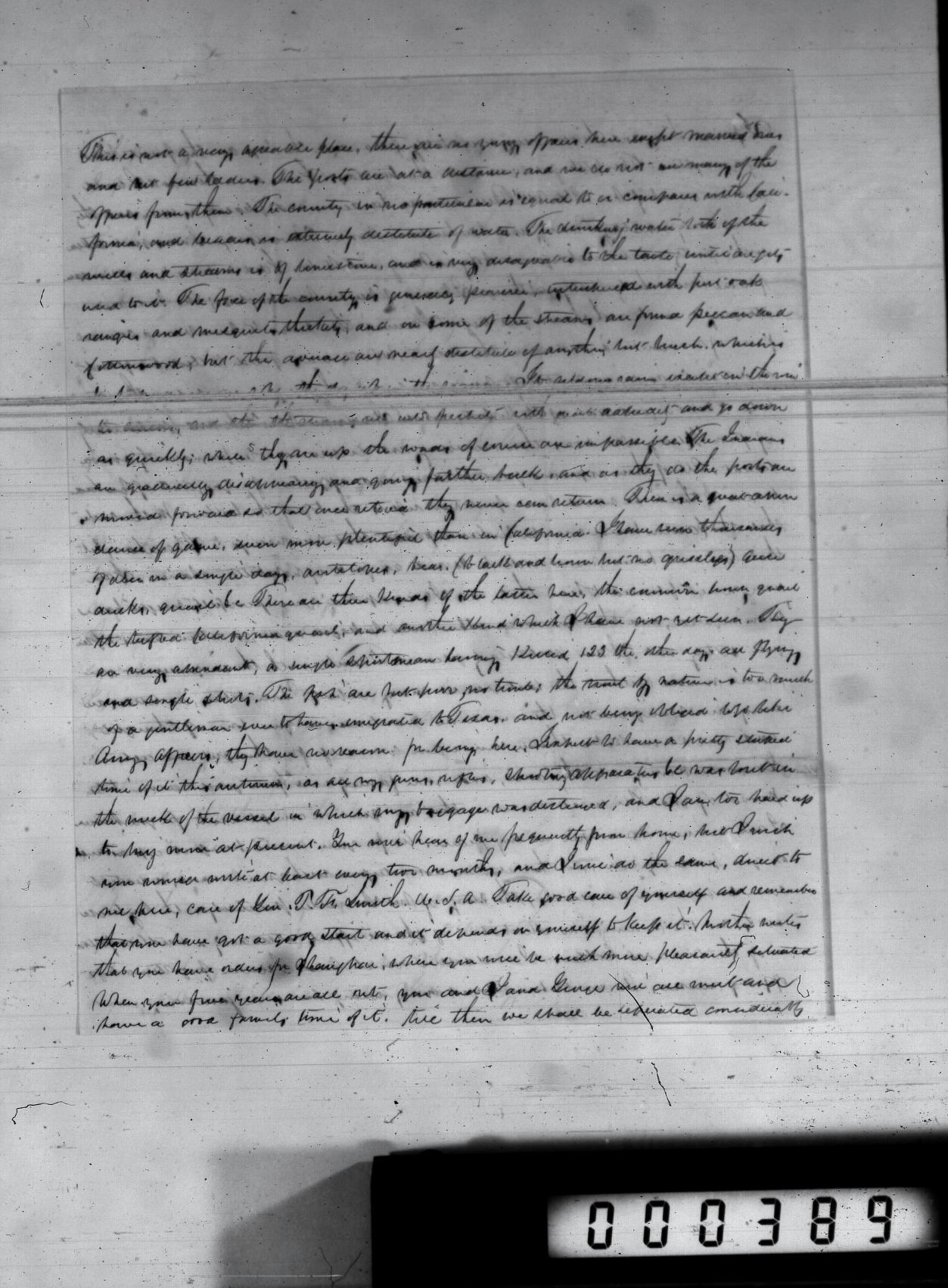
This is not a very agreeable place, there are no young officers here except married men and but few ladies. The posts are at a distance, and we do not see many of the officers from them. The country in no particular is equal to or compares with California, and besides is extremely destitute of water. The drinking water both of the wells and streams is of limestone, and is very disagreeable to the taste until one gets[?] used to it. The face of the country is generally prairies, interspersed with post oak ranges and mesquite thickets, and on some of the streams are found pecan and cottonwood, but the prairies[?] are nearly destitute of anything but brush, which is [about one line largely lost in a horizontal fold/scratch; visible fragments: “… It seldom rains …”] [?] and then[?] the streams rise with fearful[?] rapidity and go down as quickly; when they are up the roads of course are impassible. The Indians are gradually disappearing and going farther back, and as they do the posts are moved forward so that once retired they never can return. There is a great abundance of game, even more plentiful than in California. I have seen thousands of deer[?] in a single day, antelopes, bear, (black and brown but no grizzlys) ducks, quail &c. There are three kinds of the latter here, the common brown quail the tufted California quail, and another kind which I have not yet seen. They are very abundant, a single sportsman having killed 123 the other day, all flying and single shots. The fish are but few[?], no trout; the trout by nature is too much of a gentleman ever to have emigrated to Texas, and not being obliged to go[?] like Army officers, they have no reason for being here. I expect to have a pretty stupid time of it this autumn, as all my guns, rifles, shooting apparatus &c was lost in the wreck of the vessel in which my baggage was destined[?], and I am too hard up to buy more at present. You will hear of me frequently from home, but I wish you would write at least every two months, and I will do the same, direct to me here, care of Gen. P. F. Smith. U.S.A. Take good care of yourself and remember that you have got a good start and it depends on yourself to keep it. Mother writes that you have orders for Shanghai, where you will be much more pleasantly situated. When your five years are all out, you and I and George will all meet and have a good family time of it. till then we shall be separated[?] considerably[?]
1. This letter completes the Sonoma proof in the subject’s own hand: the post’s breakup, Gen. Persifor Smith’s estate for sale, Alfred’s own retained and leased farm, and his continuing service in Smith’s “direct care” at San Antonio. It stands with the 1848 Smith-care cover and Frank’s “fine farm” letter of May 1851.
2. “Col Hooker… is living on it with old Charlotte” farming barley at Sonoma is Joseph Hooker in his famous between-wars civilian interlude – a firsthand sighting by a fellow officer-farmer.
3. The letter as filmed ends at the sheet edge without a signature; the closing leaf was not photographed. The reel’s next frame is already the sister’s September letter. This archive shows what exists and says what is missing.
4. “It is just about a year now since you and I and George met together” – the three brothers in California, summer 1851 – and his closing hope (“you and I and George will all meet and have a good family time of it”) never came to pass in California again.
Archival citation
Gibbs Family Papers, 1763-1918. U.S. Mss Y; Micro 1117; Photo Lots 3696-3697. Wisconsin Historical Society, Division of Library, Archives, and Museum Collections, Madison, Wis. Digitized research copy (Green collection), Reel 2. Scans 1446-1449 (microfilm frames 000386-000389); microfilm frames 000386-000389. Every page of the letter is shown above; duplicate microfilm exposures are noted in the reel index.
Suggested citation (Chicago): Alfred Gibbs to Francis S. Gibbs, August 17, 1852. Gibbs Family Papers, 1763-1918, U.S. Mss Y, Micro 1117, reel 2. Wisconsin Historical Society, Madison, WI. Accessed via AlfredGibbs.com.
Related in the Record
References
Gibbs, A.. (1852, August 17). [Letter to Francis S. Gibbs]. Gibbs Family Papers, 1763-1918 (U.S. Mss Y, Micro 1117, reel 2) [Manuscript]. Wisconsin Historical Society, Madison, WI.
Gibbs family. (1763-1918). Gibbs Family Papers (U.S. Mss Y; Micro 1117; Photo Lots 3696-3697) [Manuscript collection]. Wisconsin Historical Society, Madison, WI.
Accuracy review: transcription checked against the full-resolution scans, July 11, 2026. Original spelling and punctuation are preserved; editorial matter appears in square brackets and uncertain readings are marked [?] rather than guessed. Corrections are made openly; this page will be updated, never silently, if better readings are established.
Update, November 1, 2026: page 1 earlier read “lost in the wreck of the Steamer.” The word on the scan (scan 1446, fourth line from the foot) is the ship’s name, “Meteor,” as Deb Dodge also reads it. The steamship Meteor of the Morgan line was lost on the Matagorda bar at Pass Cavallo on the night of April 18, 1852 (New-York Daily Tribune, April 30, 1852; New Orleans Daily Crescent, April 29, 1852).
Views: 6
Explore the evidence
View this article’s connected sources and media →
About this page
This article was brought over from AlfredGibbs.com. Its preserved text, media and citations remain available for comparison.