
From Following the Guidon, by Elizabeth B. Custer (1890). Chapter XXII. Back to Contents.
DANDY.
There is still one character in mj story of our summer camp who deserves a word, as, since the last chapter was written, he has gone to the heaven which we people who love animals believe is reserved for them. It is of our blithe, faithful, undaunted Dandy that I should like to tell you.
IXiring the Wichita campaign in Kansas and the Indian Territory, in the winter of 1868 and 1869, five hundred horses were sent to the Seventh Cavalry to mount a portion of the regiment. General Custer was in command of the expedition, and the horses were passed in review in front of his tent. Among them he noticed a spirited bay, which he ordered detained at his tent, and, after trying him, decided that he would avail himself of the privilege given to officers, and buy him from the Government. The horse, he discovered, had good blood, though not perfectly proportioned,
DANDY.
being too small. He was just within the height required by the quartermaster’s requisition; but his fire, his promising powers of endurance, his sound condition, made General Custer think that he would prove equal to the terrible marches, the exposure, and the insufficient forage to which a cavalry horse had to submit. He was given the name of ” Dandy ” on the spot, because of his spirited manner, and the little proud peacock airs he never forgot except when he slept.
DANDY.
Dandy had not been long in service before he was subjected to the roughest and hardest life. The soldiers’ rations gave out at one time, and the troops lived on the flesh of mules and horses that had died from exhaustion. But Dandy’s untiring nerve carried him through. He
grew tliiD from want of forage, but learned, with the otlier horses, to scrape the snow from the ground in the river valleys, to find little tufts of dried grass, and, failing in this, gnawed the bark from the cottonwood-trees. IsTothing seemed to tire him: no day was so cold or so wet that it did not find Dandy full of good cheer.
Test after test was tried on the plucky horse, and he never flagged. An all day’s march in the winter, with the blinding snow and tiny particles of ice cutting his face, toiling through depressions in the ground where drifts had accumulated, tugging up declivities to be met on the summit with a keen icy wind that had swept unchecked over hundreds of miles of prairie — all this never took the dance out of his heels, or made his head droop with fatigue. It was this indomitable will that so endeared him to his master. He had a hard gait for a steady march. He never walked, but went on, year in and year out, with a little dancing trot that was most fatiguing. Still, this uncomfortable motion was made up for to General Custer by marvellous powers of endurance and by exceeding good-humor through all vicissitudes.
Our horses were such intimate companions on the plains that we found ourselves as anxious to be en rapjpoH with them, and understand their humor, as with those of our friends beside whom we rode. Sometimes w^e divined as soon as we mounted that the animal under us was sulky or wilful or stubborn, and either we possessed our souls in patience till the ill -humor passed away, or one, more irritable or nervous, fretted at the
DANDY. 327
exhibition of temper, took Lis horse out of the ranks, and the rest, watching him, said, “Kow So-and-so is going to have another ‘ waltz ‘ with that brute of his, but it’s no good fighting anything so fi^endish.” One can realize, then, what it was to know that there was no variation in the temper of an animal. Imagine any one awakening in the gray dawn to the sound of reveille in a cavalry camp, and, after an ice-cold bath, a lukewarm breakfast, stepping shrinkingly forth into chilly drizzle that the troopers declared had ” come to stay.” “What if all about were silent, or dulled by the cold and damp? Was it not everything to be met by the dancing, joyous motion of a pair of nimble heels, and the softest, most affectionate eyes, while the head turned to rub itself against the arm or shoulder of one the animal loved? Let the elements do their worst — and they attempt every vagary on the plains — that indomitable will and sunshiny disposition of Dandy’s triumiDhed over everything. It was therefore worth while to endure the little choppy motion, which would have been immensely tiresome to many, for the sake of knowing that no day’s march could be so long, no storm so violent, as either to fatigue or depress the willing animal. There were those who said that no man, except one with the wonderful powers of endurance of General Custer, could have stood the gait.
One of our best riders used to say that th^re was no worse suffering for a man than to ride a horse that refused to come down to a walk. Occasionally it fell to the lot of a soldier to draw from the Government a
Lorse that had this fault. There was no appeaL The horse was purchased; he was sound. J^o horse-trade could be effected with a citizen, because of the deep ” U. S.” branded on the thigh. Sometimes, after a campaign, an officer can enter a complaint, and ask to turn in some brute with an irredeemable fault to the Quartermaster’s Department, to be condemned and sold; but after a campaign was started, it meant a whole season of jogging misery to the unfortunate trooper who had fallen heir to such an animal. A cavalry column marches at the rate of four miles an hour, and the length of a day’s journey varies from twenty-five to forty miles. After such torture going on month after month, the troopers would sometimes cry out in desperation, ” For God’s sake shoot me, and leave me behind!”
It was well that Dandy belonged to the commanding officer of his regiment, for he could brook no horses going before him. If it was unavoidable, he was flecked with foam and quivering with impatience in a few moments. It was difficult to keep him beside a horse; he champed his bit, tossed his liead, and pulled furiously on the rein unless he was permitted to stretch his neck in advance of everything. Then he became quiet with conquest, and ambled on like a graceful Andalusian palfrey.
‘No greater test of Dandy’s endurance could liave occurred than a winter’s campaign. It was the first that the regiment had ever attempted at that season of the year. The success of the expedition reconciled
DANDY. 329
the men to the liardships; but it was a fearful trial to the whole regiment, man and beast. After tltfe winter was ended, the Seventh Cavalry marched from the Indian Territory to Fort Hays, Kansas, to estabhsh a summer camp. The regiment, from that on, went up and down tlie State, as well as the adjoining Territories, for several seasons. On one of these marches, a number of years after, when they were traversing a more settled portion of the State, a farmer met, and was about to pass, the column, when General Custer accosted him, asking him about the crops, the ravages of the grasshoppers, then such a pest, and of the growth of the country, in which he was genuinely interested. The farmer turned to ride with him a while, and finally, after eying Dandy sharply, he said:
” Stranger, I’d like to en-quire, if it ain’t no offence, where you got your boss? It’s a good un, no mistake.”
” You are right,” replied the general. ” He is as tough as a pine-knot, as willing and spirited as any horse I ever saw,” And then he went on to tell him that he thought that he discovered some of these traits when he picked him out of hundreds of animals bought by the quartermaster for the regiment.
*'”Well, sir,” said the frontiersman, “that air boss once belonged to me. He’s got good blood in him. I’ve got the name of some of his sires at home. I can never get over the selling of him; but, you see, I got hard up, the grasshoppers ate my crops, and, while I was in a tight place, along cum a contractor, and I sold him for $140, the Government price. He was wuth a heap
sight more; but tlie ready money had to be got somehow, so I let him go.”
All General Custer could say was that he was sorry that he had lost him, but that hardly any price could tempt him to part with so good a campaigner. He was then five years old.
Dandy became a great pet with his master. It was a serious affair to lose a horse on the march, for they could not be replaced, and consequently the utmost precautions were taken to lariat or hohble the animals when the march was over for the day.
Dandy was often not tethered at all. As soon as the general selected camp he unsaddled and unbridled him, and turned him loose to graze until the command came up to pitch the tents. He took a roll or so on the grass, and grazed about the tent until it was time to saddle him next morning for the day’s march. He loved the dogs, and permitted all sorts of familiarities from them. Sometimes the stag-hounds, that make such tremendous leaps, would spring entirely over him in their antics. He played with them, nipping their skin to provoke a frolic, and no unexpected attack of the venturesome dogs was ever met by him with anything but the utmost good-nature. He was a picture in the midst of the pack of forty, all barking, growling, scuffling. The grave fox-hounds pressed about his legs in affection, looking up with luminous, expressive eyes. The stag-hounds made wild springs in the air, catching his mane or tail, or jumping to kiss his nose. He tossed his head, snorted, pranced with delight at all this atten-
DANDY. 331
tion, set his feet down with excessive caution for fear of hurting a puppy, and was capable of showing more affection in the few mute ways left open to him than people who have the human voice and expressive features at their disposal.
The soldier who took care of him Was the strangest contrast to the whole party — dashing cavalryman, mettlesome horse, and rollicking dogs. Indeed, he seemed 80 much out of place in a cavalry camp that I wanted always to ticket him ” Lost, strayed, or stolen,” He was slow of speech, thought, and movement, but in affectionate fidelity he was to be trusted even above the gayer and more active trooper. The man lived in a world by himself, with little in common with his comrades, going along a dull, beaten path at snail’s pace, while all the wild world of a cavalry camp, with its incessant excitements, its exhilaration, its enthusiasm, sung, shouted, and careered about him. Nothing moved him to a laugh; and if he had whistled I should have sent for the surgeon, thinking he had gone daft. I have a photograph of him standing between and holding with each hand the bridle of Yic, the general’s thorough-bred — which was shot in the battle of the Little Big Horn, June 25, 1876 — and Dandy. The dogs stand or lie about the group; and the soldier, with his solemn face, looks as if any remark England or America might make about ” duty ” to him would be superfluous. His horizon encompassed two horses, some dogs, and one yellow-haired officer. He may have had a past — a bald spot on his no longer youthful head spoke of one — but no ref-
erence was made to it; nor did he seem to wish for a future in which Dandy, Yic, Blucher, Tuck, and Cardigan (his favorite dogs) and their master were not inchided.
Dandy enjoyed a hunt above everything. The general could run down a deer with Yic, and for a spirited, quick dash the thorough-bred was best; but Dandy was the old love, and he made such demonstrations of delight over the preparations for the chase that he grew to seem almost human. The officers generally gathered before our quarters, and the horn was sounded as a signal for the kennel gate to be opened. Out swooped the pack, tumbling over each other in their haste, tearing around the house to the horses to have a few preparatory interchanges of animal language. The orderlies holding the horses let them rear and paw the earth; and in the din of the barking, whining dogs, tuning their voices to the horn, the laughter and jovial voices of the officers, the call from the windows and galleries of the women giving a good ” send off,” there Avas not an intelligible word. From all this wild scramble, in which dogs, men, and horses seemed involved in a hopeless tangle, the leader extricated himself, and Dandy proudly took the advance. He curveted, danced sidewise, tossed his head and mane, and evinced by every motion that he was born to lead.
Then, when the real work began, he proved that if he was a dandy there was good stuff in him; for he fell to the duty of the hour with a skill and determination that made his master, each time he returned from the chase, pat his neck as he leaped to the ground, and
DANDY. 333
say, “There never was such another horse created.” The cotton-wood timber along the Missouri Eiver was in places densely embedded in underbrush, and it took infinite patience to wend one’s way through the thicket; but Dandy was capital at this. His nerves were in the wildest state when the deer was spotted.
After the day’s sport was ended the horn sounded from down the valley, and soon the same exuberant throng poured into the garrison, the dogs leaping and barking still, the fox-hounds trotting sedately on, covered with burrs, porcupine quills, or cactus, their legs incased in mud, their rigid tails bleeding from the sharp thrashing through the thickets; still they gave tongue with the deep notes of their species. The horses of the hunters were usually fagged and glad to hear stable – call; but darting wp to the gallery came the undaunted Dandy, sometimes bearing on his back, behind the saddle, the game, though the deer was generally too large to admit of using any but a led-horse to transport it.
If in our rides about the post we saw a gray coyote skulking along, hiding in the divides or sneaking his solitary way back to his lair, Dandy spied him also, and begged for a run. He trembled Avith the ardor of a hunter; and it hurt him to see game disappear and he not chase it. He knew how to gather himself and turn like a flash when the jack-rabbit ” put down its fourth leg” and doubled on its pursuers. It required such agile legs as Dandy’s to circumvent the active hare. His lope was too short to take him over the country
quickly enough to overtake an antelope, but lie could be almost motionless for the moment of loading and firinor.
In another chapter of this book I have described Dandy’s skill and enthusiasm in buffalo-hunting, and need not repeat it here.
There were many obstructions to smooth going even on the apparently level plains. The buffalo wallow was one. Dandy, coming on these wallows full tilt, learned, if he was going too violently, to veer one side, to lea]) in and out like a cat. The buffalo trails to water, running in four or more parallel lines, he cleared with a bound. These also are deep ruts, hard and stubborn to the hoof, that have been baked by the sun as is the wallow. He picked his way through a prairiedog village unguided, and rarely did his hoof sink in the subterraneous traps. His best leaping was over the cactus -beds. Tliese he took with a bound. Dandy was sometimes lent to the wife of one of our officers, and she rode him out to the herd of Government cattle where her husband went on duty. She writes me, ” I always started without my stirrup; for it * was up and away ‘ with Dandy, and I had to find foothold as best I could afterwards.”
She was an excellent horsewoman; but her surprise when Dandy took a huge cactus-bed with one leap was something to remember. She said to General Custer, ” He shall not catch me again napping;” and he shook and chuckled with amusement, for he had purposely omitted telling her of Dandy’s little caper, knowing she would be equal to the situation.
DANDY. 335
The winter’s campaign liad been a trying beginning to Dandy’s career, but the long, hot summers that followed were a fearful strain on any horse. There was always much trouble about water on the plains. After the rainy season passed the streams went dry, the pools in the buffalo wallows and in the hollows had disappeared, and the whole day of a hot march was spent without so much as a look at water, with possibly the tantalizing mirage floating before their weary eyes all the time. The strongest animals became fagged, their heads drooped with exhaustion, and some dropped by the way to die; still the valiant Dandy kept up.
I do not know whence came all that inexhaustible spring of vitality. In the letters from old friends with us on the frontier that I have received regarding Dandy during the past week each one says, ” I never saw him walk.” He was in all the campaigns of the regiment for years — in the first Yellowstone campaign, in the Black Hills Expedition, and in the last campaign into the Yellowstone in 1876. As they were starting that spring General Custer said:
” I must take an extra horse this summer in addition to Yic, for Dandy must be favored a little; he begins to show a little let-down in strength.”
In the battle of the Little Big Horn, June 25th, he was with the led-horses and was wounded. After the battle he was sent home to me in Monroe, Mich., and I gave him to my father Custer. The horse, so identified with the three sons he had lost, seemed to be a
wonderful comfort to him. I was afraid to have him mount him, for he was then over seventy, and Dandy required every one to be very active who attempted to use him to the saddle. His journey of over fifteen hundred miles by boat and by cars had not tamed him, and I begged Father Custer to let an officer then with us at least ride him round the block. At last he yielded, and off Dandy tore through the quiet streets to the amazement of the town. The old gentleman was unmoved. He said, ” Daughter, I can ride him; there’s nothing vicious about him.” And he was riglit. It is my belief that he had been studying up his future master. He let him mount leisurely, and seemed instantly to tame down in gait and manner. Our father Custer was rather bent in walking, but there was no perceptible curve to his back in riding. He sat his horse splendidly. Except for his white hair and flowing, snowy beard, one could hardly imagine so many years had elapsed since he rode after the hounds in his early Virginia and Maryland days.
After leaving the army. Dandy never surprised you by unexpected moves, and it was not necessary to watch for sudden veering to the right and left. From the life of a gay, dashing cavalry steed he dropped into a steady-going family horse. The one marked evidence of the old life was displaced when our father Custer took him out for parades. It soon became a custom for the towns-people to invite the old gentleman and Dandy to head the temperance processions, the Fourth of July celebrations, or any sort of parade the town
DANDY. 337
might inaugurate. He and Dandy were invited to be the guests of Michigan at the State Fair. The invitation was worded, ” For Father Custer and his horse Dandj.” They led the grand procession that was under the guidance of the marslials of the day. Dandy never for one moment forgot his part. He sidled and ambled and pranced in a gentle sort of teeter, suitable for his aged master, but he scorned to walk like an ordinary every-day horse.
The etiquette of the past generation was to attend all funerals, and Dandy’s old master believed that one’s friends should be just as carefully attended to the grave as to the altar. Dandy therefore fell into the slow, solemn line, and subdued his step to the occasion. His politics never varied, owing to an unswerving quality in his old master. During the last political campaign his tossing head waved a bandanna through the streets of our town. If it blew in his eyes and interfered with his sight he never showed it, but bore the badge as if it had really been what his owner wanted it to be, a plume of triumph.
Whenever I went home to visit them my father Custer asked, as soon as the welcome was over; ” Daughter, would you like to see Dandy? If you would, sit by the front window, and he will be around.” When they appeared. Dandy did all the kittening possible in the way of little starts and flourishes, affecting coltish airs, and pretending timidity which was purely fictitious. This pleased the old gentleman, and he called out, as he waved his stove-pipe hat, ” You see he isn’t
an old man’s horse yet.” I could not help praising my father Custer’s firm seat in the saddle, so remarkable in a man between seventy and eighty. My gentle mother Custer, fearing I might plant the seeds of pride even in an old man, said, ” Don’t say too much to him, daughter; old men might get foolish about their riding.” But, nevertheless, my home-coming did not seem complete without the dress parade in front of the house.
During the later years my father Custer has lived on a farm near Monroe, with General Custer’s only brother. Dandy, coming in and out of town every day, was obliged to cross a bridge over the Kiver Raisin. Not for worlds would he go over without a little pantomime of sham fright. He minced and hesitated and shied the least bit in the world, arched his neck as if in surprise, and with all these skippy ways looked throuffh the cracks of the boards as if it was the first time that he had ever seen them. Hearing Father Custer’s voice, he instantly came down to every-day manners. All the timid girls who were afraid of other horses were willing to go with Father Custer; and many a happy mile has Dandy carried them through the fragrant roads and fields about the ” City of Flowers.”
Even until tliis year it has been Father Custer’s custom to drive off to the home of one of General Custer’s staff, and the thirty miles in a day seemed as nothing to the two veterans. For weeks at a time Dandy gambolled over a rich pasture, kicking up his heels like
DANDY. 339
a colt when let into it, or made himself comfortable without being tied in a box-stall, while his master was enjoying all the hospitality the house afforded. Returning home, they soon started for a forty-mile drive in another direction.
It has been a common sight in Monroe for years past to see Dandy quietly standing beside the street to allow his white-headed owner to dally by the wayside and carry on a hot political discussion. There were too many people in the town whom our father Custer thought needed to be set right in their views, especially as an election drew near. He would allow no one to feed or groom his horse, and in consequence of too many oats the graceful proportions of youth were fast losing themselves in a real aldermanic outline; but I could not convince our father Custer that it was not a line of beauty. lYlien he approached the stable the horse knew his step and whinnied; and he had the same welcome as he came out to get in the carriaare. The cars stand for a time on the track running through our town, and Father Custer once drove Dandy’s nose almost into the side of a car. In alarm I asked if he intended to drive over or creep under; but he quietly answered that he wanted me to see that the horse was not afraid of anything with him.
^’ The boys,” he added, ” had hard work to hold him, but he knows me; and, daughter, I don’t know how I could have lived without that horse. He’s been a comfort to me for thirteen long years.”
On a recent Sunday these two comrades went off up
the Raisin for a little time, and all was well. Life still held one joy for the two — they could go out into the sunshine together, for after all the bereavement of life God’s beautiful world remained.
On Monday no whinny of greeting met him as he undid the stable door. For the first time in all his twentysix years Dandy was ill. All the simple remedies of the farm were administered without avail. Two veterinary surgeons failed to help the suffering beast. He was still the same plucky Dandy. As he never showed a sign of heat, cold, thirst, or hunger in his old soldiering days, so now he met the suffering bravely, only turning his head around to show his appreciation of the presence of the family about him. As General Custer’s brother left the stall the poor beast walked after him, rubbing his head against him in affection. The children hardly left him. The mother, with all the maternal tenderness of heart, begged to stay all night in the stable, saying that it seemed cruel to leave him alone.
All day Tuesday our father Custer never left him; and weeping with grief at his suffering, and the sorrow at recalling all his past, the old man sat hour after hour brushing off the flies and caring for this beloved link with the past.
At night the family went out at twelve, and poor Dandy followed them; and looking over the half-door of his stall, they saw for the last time his pathetic eyes, dimmed but full of devotion. At four in the morning they went again, and he had fallen, the straw scarcely
DANDY. 341
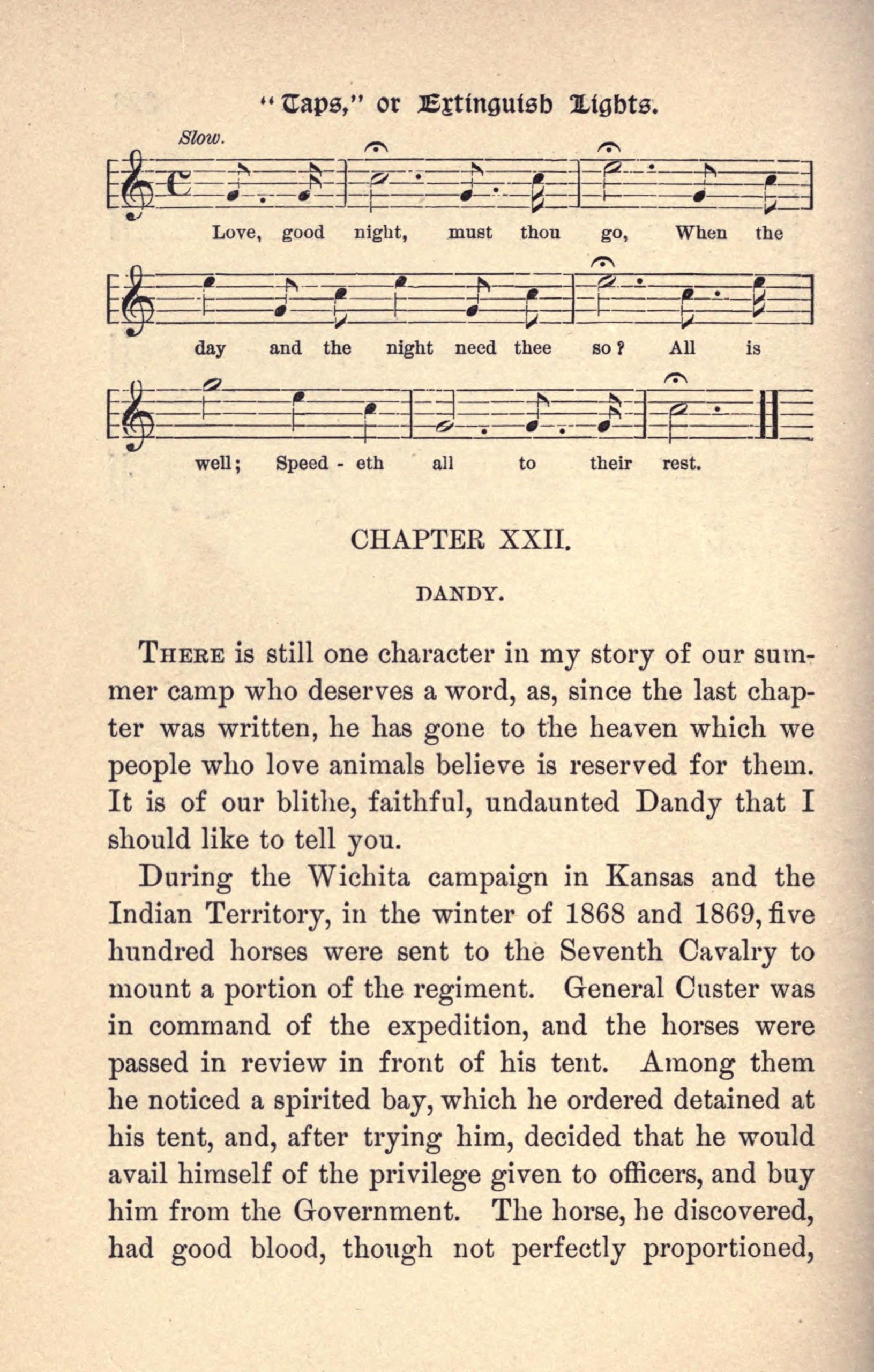
disturbed about bim, sbowing tbat be bad remained standing until tbe moment wben, tliinking be beard tbe bugle-call ” Taps,” liis ligbt went out forever.
Tbougb tbis veteran bad no muffled sound of drum, no vollej fired at bis grave, still it was a solemn burying. All day tbe boy wbo loved bim dug at bis grave in tbe orcbard, and tbe motber and cbildren, suspending work and play, vibrated between tbe bouse and tbe field wbere tbe “eartbly bed” of tbeir favorite was being prepared.
Tbere, every year, Nature, witb all ber fidelity, will bury our dear borse in a rosy sbower of blossoms wbicb tbe apple-tree scatters witb tbe least breatb of tbe summer wind.
Tbe silvery bead of an old man of eigbty-tbree bends lower tbis August day, and it is bard to take up bis few remaining years witbout bis comrade, tbe comfort of bis bereft life.
Or, Life in Dakota with General Custer. By Mrs. Elizabeth B. Custer. With Portrait of General Custer, pp. 312. 12mo, Cloth, $1 50.
A book of adventure is interesting reading, especially when it is all true, as is the case with ” Boots and Saddles.” * * * She docs not obtrude the fact that sunshine and solace went with her to tent and fort, but it inheres in her narrative none the less, and as a consequence ” these simple annals of our daily life,” as she calls them, are never dull nor uninteresting.— Evangelist, N. Y.
Mrs. Custer’s book is in reality a bright and sunny sketch of the life of her late husband, who fell at the battle of ” Little Big Horn.” * * * After the war, when General Custer was sent to the Indian frontier, his wife was of the party, and she is able to give the minute story of her husband’s varied career, since she was almost always near the scene of hia adventures. — Brooklyn Union.
We have no hesitation in saying that no better or more satisfactory life of General Custer could have been written. Indeed, we may as well speak the thought that is in us, and say plainly that we know of no biographical work anywhere which we count better than this. * * * Surely the record of such experiences as these will be read with that keen interest which attaches only to strenuous human doings; as surely we are right in saying that such a story of truth and heroism as that here told will take a deeper hold upon the popular mind and heart than any work of fiction can. For the rest, the narrative is as vivacious and as lightly and trippingly given as that of any novel. It is enriched in every chapter with illustrative anecdotes and incidents, and here and there a little life story of pathetic interest is told as an episode. — N. Y. Commercial Advertiser.
It is a plain, straightforward story of the author’s life on the plains of Dakota. Every member of a Western garrison will want to read this book; every person in the East who is interested in Western life will want to read it, too; and every girl or boy who has a healthy appetite for adventure will be sure to get it. It is bound to have an army of readers that few authors can expect. — Philadelphia Press.
These annals of daily life in the army are simple, yet interesting, and underneath all is discerned the love of a true woman ready for any sacrifice. She touches on themes little canvassed by the civilian, and makes a volume equally redolent of a loving devotion to an honored husband, and attractive as a picture of necessary duty by the soldier. — Commonwealth^ Boston.
Published by HARPER & BROTHERS, N. Y.
fl^ nAEPEB & Beothkrs loill Send the above, work hy mail, postage prepaid, to any part of the United States or Canada, on receipt of the price.
ARMY LIFE. Post 8vo, Cloth. {In Press.)
A WAR-TIME WOOING. Illustrated by R. F. Zogbaum. pp. iv., 19G. Post 8vo, Cloth, $1 00.
BETWEEN THE LINES. A Story of the War. Illustrated by Gilbert Gaul. pp. iv., 312. Post 8vo, Cloth, $1 25.
In all of Captain King’s stoiles the author holds to lofty ideals of manhood and womanhood, and inculcates the lessons of honor, generosity, courage, and self-control. — Literary World, Boston.
The vivacity and charm which signally distinguish Captain King’s pen…. He occupies a position in American literature entirely his own…. His is the literature of honest sentiment, pure and tender. — X. Y. Press.
A romance by Captain King is always a pleasure, because he has so complete a mastery of the subjects with which he deals…. Captain King has few rivals in his domain.,.. The general tone of Captain King’s stories is highly commendable. The heroes are simple, frank, and soldierly; the heroines are dignified and maidenly in the most unconventional situations. — Epoch, N. Y.
All Captain King’s stories are full of spirit and with the true ring about them. — Pluladelphia Item.
Captain King’s stories of army life are so brilliant and intense, they have such a ring of true experience, and his characters are so lifelike and vivid that the announcement of a new one is always received with pleasure.— Neio Haveii Palladium.
Captain King is a delightful story-teller. — Washington Post.
In the delineation of war scenes Captain King’s style is crisp and vig. orous, inspiring in the breast of the reader a thrill of genuine patriotic fervor.— Boston Comtnonwealth.
Captain King is almost without a rival in the field he has chosen…. His style is at once vigorous and sentimental in the best sense of that word, so that his novels are pleasing to young men as well as young women. — Pittsburgh Bulletin.
It is good to think that there is at least one man who believes that all tlie spirit of romance and chivalry has not yet died out of the world, and that there are as brave and honest hearts to-day as there were in the days of knights and paladins. — Philadelphia Record.
Published by HARPER & BROTHERS, New York.
t^Bf Either of the above toorks sent by mail, postage prepaid, to any part of the United States,Canada, or Mexico, on receipt of the price.
^.^^
^^ ‘^’K
‘^^■■^v.V^
^^—^ ‘-^
(^N.ON r.,. -^^^
.^^’
°/:
*^^^c^
■^, s-
,-i^
“^^ v-^^
Views: 3
Explore the evidence
View this article’s connected sources and media →
About this page
This article was brought over from AlfredGibbs.com. Its preserved text, media and citations remain available for comparison.