
From Following the Guidon, by Elizabeth B. Custer (1890). Chapter XXI. Back to Contents.
Before I close the story of our summer I would like to write of some of the neighbors about us whom we thought altogether too neighborly. The rattle-
snakes of the plains have been much written about by Western editors, but they can scarcely have too elaborate English expended on them; they were everywhere, and it was almost impossible to exaggerate the numbers of them that surrounded us. Our camp soon became too much of a thoroughfare to make it safe for a snake to dispute the territory, and the soldiers going back and forth on duty, the dogs constantly racing over every inch of the ground, the servants perpetually travelling to and fro from the cook tent to ours, protected us in the immediate vicinity of our habitation; but the moment we rode out of camp over the plains the reptiles appeared, sometimes gliding away, often coiled for a spring, occasionally torpid, and gorged with a toad or a bird which they had swallowed whole, and which went down slowly, distending and distorting their sides. There was no trouble with our horses in the matter of ceding to the snakes the right of way, but it was surprising that they showed so little fear of them.
It seems to need the support of the commanding general of all the United States forces to fortify any one who begins to talk about this subject. Snake stories, like the tales of fishermen, must always, on the part of the listener, be heard with a spirit of combativeness. People square themselves for a fight, and are ready to dispute step by step the progress of a stor3\ It was, therefore, with genuine pleasure at the privilege of listening to so good a talker, but with an atom of exultation, that I heard General Sherman hold forth
on our plains rattlesnakes. To begin with, the wildest spinner of yarns can scarcely say too much on the subject. The snakes swarmed over the route of our march; they lined the way when we went for a hunt or a pleasure ride. General Sherman, replying to a woman’s question, “And were not the soldiers often bitten?” replied that they were seldom fatally injured, as they were instructed as recruits by their officers, the surgeons, and the veteran soldiers how to protect themselves in case of the fatal sting. It is found that the snake throws itself about tliree times its own length from where it is coiled for a spring. ‘Not being able, therefore, to strike its fangs in higher than the calf of the leg, the trousers often absorb a portion of the poison. If the surgeon is near, he applies ammonia to the wound, and stupefies the injured man with liquor. The whiskey is poured down as fast as the man can swallow; this, retarding the circulation, prevents the blood-vessels from carrying the poison to the vitals.
The part of General Sherman’s conversation that touched me was his tribute to the affection and devotion of the j)rivate soldier. If the surgeon is too far away to be reached, the soldier resorts to his homely devices to save his comrade’s life. A bit of buffalo bone is used to scrape and irritate the flesh about the wound, and cause a flow of blood outwardly. One of the men, if he happens not to have an abrasion on the lips, stoops instantly to draw the poison from the places where the fangs have entered. There is never a lack of offers among those fearless devoted men to suck
into their own moiitlis the deadly fluid. If ammonia is not to be had, they seek the black mud which forms the baked surface of a sun-dried buffalo wallow. Wetting it, and applying this to the wound, enough ammonia is extracted to aid the cure. Then — ah! I know all this myself, because I have been among our self-sacrificing soldiers out there, and have been taught many a lesson of generosity and devotion; they either watch over their wounded comrade till he is restored, or if he be sunk into drunken lethargy, they lift him into an army wagon as carefully as the experienced surgeon and hospital nurse remove an injured man from our city pavement to the ambulance.
This reminds me of one of our surgeons. Dr. B. J. D. Irwin, of our army, General Custer’s warm personal friend. I remember the pleasure with which he discovered, at our first post at Fort Riley, a weed that he had not supposed grew there, which was an antidote for a snake bite. He held tliis little ugly scrap of vegetation in his hand as if he had in his possession a rare work of art, and breaking the stem, from which exuded the thick white sap, he gave me so animated a description of what cures it would effect, and of what benefit this discovery was to suffering humanity, that I was as pervaded with his spirit as if I knew the blessed art of the healer. It was to him that I was indebted for ray first insight into the fervor and enthusiasm of his profession, and the generous manner in which their discoveries are given to the world. He had written a paper, after making this successful investigation on a tour
of duty in l^ew Mexico, tliat there might be no delay in the use of this life-saving weed.
Our army surgeons have contributed a good deal to the learning of their profession, and yet how quietly! When the civilian doctor makes his successful experiments, he rarely is without rewards, often of a financial character, and he always receives the tribute of admiration from his professional brethren, from whom he hears personal acknowledgments on the street, at conventions, clubs, and the city hospitals. Our army surgeons experiment, study, practice in their distant hospitals, or in the field, and when they give some valuable discovery in science to their fellow -workers over the world they add nothing to their limited incomes, and the voice of applause is very faint when it reaches the isolated post where they live out their valuable lives.
My admiration of them — working as they must without the reward of wealth or the sound, sweet to every one, of deserved praise — must be my apology for leaving General Sherman and the snakes. His sense of humor made him stop in his descriptions, which are the result of his many years’ experience, to tell one of his Eastern hearers that the Seventh Cavalry had to move out of a dugout on account of the snakes. The dugout, he explained, is a hole in the side of a gulch or slough; around the four sides the men lay a low wall of turf, leaving an entrance framed by a hardtack box; over the piled-up sods the boughs of trees are laid as a roof, and on this dirt is heaped until it can hardly be distinguished from the ground around it. In this fortress
made of such materials as are snjDplied by mother-earth (barring the cracker-box door) he had known four men defend themselves against hundreds of Indians, as they stood on the dirt floor, only lifting themselves to the loop-hole in order to fire. But, he continued, when the Indians failed to dislodge them, and rode away discouraged, the rattlesnake succeeded. It was easy for them to crawl into the loop-holes, which were on a level with the surface of the plain, and short work to go on down into the blankets of the troopers. The general says they dearly love warmth. Finally, he added, the Seventh Cavalry grew discouraged, and made a bargain with the snakes, giving them the original dugout, while they went to work, patientl}^, to burrow themselves into another, and it was no easy thing, with few and jDoor tools, to get a hole excavated large enough to give shelter and safety to even a handful of soldiers.
When General Sherman began to speak of the soldiers utilizing the rattlesnake as food, his semicircle of women-listeners raised their hands in protest. I rejoiced to hear him speak of it, feeling sure he would fortify me in what I have already said, or intend to, about General Custer’s experiments in that gastronomic feat. He says that when the rattlesnake pokes his head out of the prairie-dog hole, where he has invited himself to live, without giving the architect of his home a voice in the matter, the watching, hungry soldier clips the snake’s head oli with his sabre, and, skinning him, gets as good a dinner by broiling him over the coals of a camp-fire as if he had an eel. I know that they often
did tliis; and, after all, what difference does it make to that d evil-ma j-care trooper how he possesses himself of that which will vary his salt pork and hardtack? Besides, do we not remember our child-stories of the giants and hobgoblins, and how, when they encountered any one they hated, they were made to say, ” I’ll eat you?” Surely it is a most effectual way of disposing of an enemy, especially a reptile that retains life in portions of his wriggling body when one part is cleft entirely from the other.
General Custer was the first among our officers to experiment on the rattlesnake as an entree. A scout told him how fine, juicy, and white the meat was, and straightway he tried it. The first difficulty was with the soldier cook. He was absolutely devoted to General Coster, and not only obedient to orders, but studied or anticipated what he might wish; but when his chief took a fine fat rattlesnake to his cook-tent, and gave directions to serve it, the man, really believing some mistake had been made, ventured to reply, ” But it’s a rattlesnake!” When answered in the affirmative, the obedient soldier accepted the situation, but was sure that the light of reason had fled forever from his chief. Still, sure that it was his duty to serve a crazy master as he would a sane one, lie prepared the dish that had been ordered. While General Custer was eating the meat, which, he said, separated from the bones readily, and was as white and delicate as that of a young quail, he saw the distended eyes of the alarmed cook cautiously peering in through a crack of the
tent, doubtless expecting that lie would drop down in a fit.
Once, when General Custer was dining in Xew York with that epicu]-e Mr. Sam Ward, the conversation turned on rare dishes, and Mr. Ward, having dined in all countries, and being able probably to giv^e an expert opinion on a greater variety of food than is known to any other gourmet of our day, offered it as his belief that our natures partake of the characteristics of whatever fish, flesh, or fowl we eat. General Custer’s eyes twinkled when he told me that he thought he gave a poser when he asked him, ” What effect would the rattlesnake have on a fellow?” Strange to say, Mr. Ward had never known that these reptiles were eaten either by Christian or savage.
One of our officers, to whom I have before referred, was terribly afraid of snakes. When a child one had wrapped itself about his body, and so unnerved him that he never regained his courage. Every one laughed at him, no one lost an opportunity to tease him; but, being a fearless rider, hunter, and fighter, he could afford to endure the taunts of his comrades. He had the advantage of a record for dauntless courage to back him.
Among our collection of pets was a strange little owl that had been dug out of a hole, where it and the rattlesnake and prairie-dog lived in a kind of co-operative house -keeping. Katuralists insist that there is no “happy-family” arrangement in this; that the rattlesnake is an intruder, and that he returns hospitality
by eating a young prairie-dog for breakfast occasionally. But tlie fact of their living together our soldiers proved over and over again. The soldier who gave the owl to General Custer showed him this family group, after he had dug down to the hole the prairie-dog had prepared. It was a wonder to me how the strange partnership came about. The prairie-dog always made the home; but whether the snake came in and possessed the land, or why the owl was rash enough to creep into this deep excavation, were questions that no one had been able to answer satisfactorily. The owl which we had made a sound so like the noise of the rattlesnake that no one could distinguish between them. The water-bucket, as a protection against the obtrusiveness of the dogs, had a cover fitted upon it. But for this precaution not a drop of water w^ould have been left for the toilet. As there was no box convenient, the owl was placed in the empty bucket. A favorite trick was purposely to occupy every seat, the bed and chairs, etc., as the officer who so hated snakes approached the tent. Then he was welcomed effusively, which alone ought to have warned him of mischief. The bucket being the only seat vacant, and he not knowing of this trick of the owl, of course took it; but the way in which he bounded into space when the disturbed little bird began to make the sound of the snake called forth shrieks of laughter. He was one of the athletes of the regiment, and the involuntary leap into the air was far better jumping than he did when he tried to accomplish some competitive feat at our famous trials
of agility, strengtli, and speed at Foiirtli-of-July and other holiday celebrations, in which most of the officers joined.
But all this continual joking was drawing to a close; for though in winter -quarters the merriment continues, there is a degree of privacy attainable when one has walls to one’s house, while in camp there is none. Through the thin cotton walls of a camp habitation men called out to each other very pointed remarks about snoring, or too much ” chinning,” as they said, when they wanted to slee]). From the intimate companionship there was no escape, and so the smallest fragment of a joke was apt to be worked up into something really amusing.
We could not but regret, when October came, that our happy summer was coming to an end; it had been such a peaceful time for our tired-out regiment. It is true the Indians had hovered round us to threaten, but they belonged to another department north; the southern tribes were only too glad to stay at home that year after their severe whipping the winter before. The plains were dear to us because of the happy hours spent there. Sometimes we sighed for hills, and occasionally for rocks, but our next thought was one of gratitude that the monotonous surface prevented us from being reminded by quack advertisements that we had livers. Indeed, out there, with the pure air and active life, we might be obliged to admit that we had the organ for the cure of which a nostrum was recommended, but it was a silent partner. Every one was well,
except when ill in consequence of some actual trifling with splendid health. The orioles that sang in the trees above our tents were not more contented than we. It was absolutely a trial to pack and start for garrison at Fort Leavenworth, where we must abandon our unconventional life, dress for dinner, struggle with back hair, and try to get our complexions into condition again.
Some of our officers had one bright outlook — they would at last have quarters for their families, and could begin domestic life again. The men with sweethearts were going home on leave. The fathers talked of their children, and wondered if they would recognize the bronzed and bearded “paternal.” We heard the oftrepeated tales of their brightness, and even now, thinking over those youngsters, they seem to have been very clever and precocious. Two tiny little urchins were fighters from the start. Coming into the world with their fists doubled up, they kept them closed most of the time when circumstances threw them with each other. The officers, in a spirit of mischief, incited the elder to ” go for ” the younger. They were too young to do each other harm. I can now see Davie coming down in front of the quarters, his legs full of swagger, his tiny face red with rage. Jumping on my godson, George Yates, he pounded and pommelled the two-yearand-a-half boy for a few brief moments; but the smaller of the two rolling uppermost, kept the top place, and returned the civilities offered. Then the young officers— who, not being fathers, did not look upon this fisti-
cuff as serious — applauded the winner. The under boy in the fight crawled out, and while he ran bawling to his mother this little son of a very brave father shrieked threateningly, in the borrowed language of the frontiersman, ” Got a pistol in my boot!” His little fat legs with *’ low-necked stockings” (as another bright dot dubbed his socks) and the small kid shoes looked anything but warlike. This same George, when he went into the States, and was teased by the children, knew no better threat in retaliation than to say, ” I’ll put you in the guard-house, I will,” which was Choctaw to the civilian children, as they did not know a prison was ever called a guard-house.
The son of one of my friends came in to his mother one day, and said that he had been beaten and kicked by another boy. “Well, what are you going to do about it?” said his military mother; ” you are not going to let him get the better of you, are you?” The little son, possibly six years old, not more, replied, energetically, “No, you bet I’m not.” ” Well, then, after supper go out and find him, and I don’t expect you to come in with any story of being worsted in this affair.”
All this had gone from the mother’s mind until after dinner, when, without explanation, he came to her again, and asked if he should change his clothes. “Why?” she queried. “Because these might get all bloody;” and then she remembered that it was the time appointed for the thrashing of his tormentor.
One of the officers, in pride over his four-year-old.
gave me a description of the tales of the war his son demanded. He had repeated and repeated the same stories time and time again, not being permitted a variation by the exacting child, who knew them all by heart. He said: ” The story is a little rough on me; but if any one knows a child, he knows that he wants a plentiful sprinkling of I’s, and nothing told in the third person. So I kept on as he demanded, until one day he looked up in my face and said, * And, father, couldn’t you get any one to help you put down the rebellion?’ ” Instead of tiring of the cunning speeches of the little fellows, we usually asked, as each officer received a letter, ”Well, what has ‘ Guy,’ or ‘ Davie,’ or ‘ George,’ or ‘ Freddie ‘ been getting off now?” And then the missives that devoted husbands carried in their inside pockets were brought out, and some clever speech of the child, written by the fond mother, was read aloud to us.
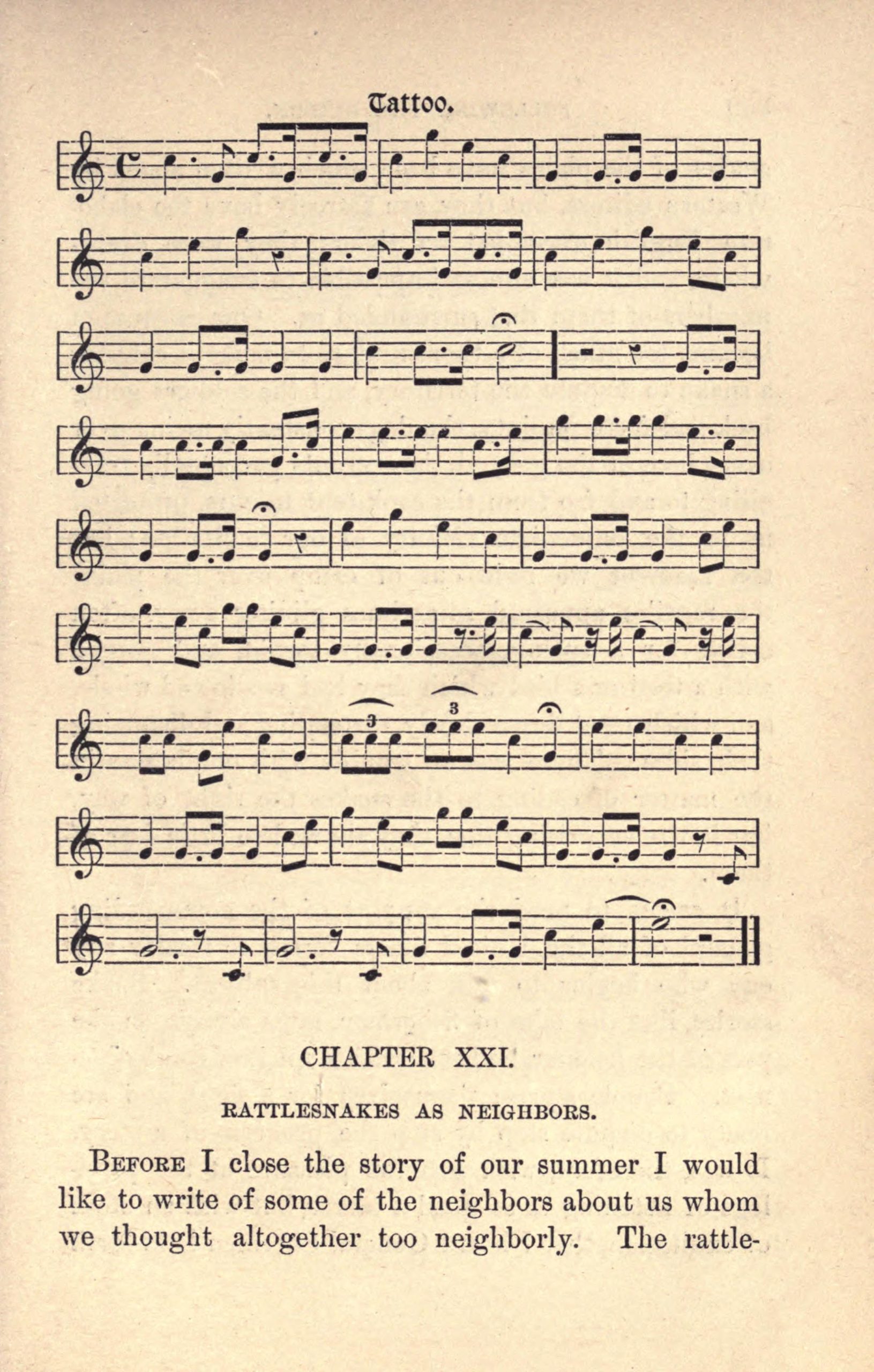
Before ” Taps” sounds I must not neglect to explain one of the calls that fortunately is rarely used. It is the ” Kogue’s March:”
“Poor old soldier, poor old soldier, Tarred and feathered and sent to ” —
something that rhymes with
“Because be would not soldier well.”
Court-martial is the usual mode of settling all irregularities, and sentence is pronounced, such as imprisonment, loss of pay, reducing a non-commissioned officer
to the ranks, etc. Sometimes, however^ the soldier is so absolutely incorrigible and worthless that he is sentenced to lose his hair, and is drummed out of camp. While I was at Leavenworth I saw the execution of this order. The soldier’s head was as blue and bald as close shaving could make it, and he marched bareheaded in front of a corps of drummers and fifers before the garrison assembled for parade. I should like to say that be hung his head in shame, but the truth is the audacious fellow, when at the limits of the garrison, leaped into a carriage at the hack stand, pulled on a wig, and waved a hat, which his waiting friend handed him, as he drove out of his military life into that of a civilian.
Occasionally the soldiers of a company rise in wratli over the obstinate determination of a soldier not to be clean, and ask leave to punish him themselves. When men ask permission, and the better men too, the officers know that they will not carry the affair too far. A double line of men is formed to the stream, each one having a switch. The offender is prepared for his compulsory bath, and started down the line. It is an effectual cure for the slovenly. He returns clean, and convinced that it is best to keep so.
But soldiers, clean or otherwise, camp women, officers and their wives, the dogs, the pets, and even the intelligent horses, soon were in a tremor of excitement, for orders had come to break camp, and march to Leavenworth for the winter. Preparations went steadily on. In a few hours we were packed. The wagons were drawn
up ready for tlie tents, and those the soldiers took down and stored away for the march. I sat at some distance from the row of tents, awaiting the bugle-call, ” Boots and Saddles,” while the eager and excited dogs raced hither and thither among the troopers, and the horses neighed and sniffed the fresh air. Looking back upon a deserted camp is not cheerful: the grass where the tents have stood is trampled, the trenches dug about them to let the water run off from the tent cut the ground into squares; hay and rubbish are strewn where once it was so trim. Our little arbor in the tree looked lonely enough, and the heap of stones which had formed the foundation was bare and forlorn. The noises that had disturbed me all summer under these rocks were now about to be explained. I had attributed them to rats, to weasels, and, as the night advanced and fears increased, to almost supernatural causes, the sounds were so uncanny; but no, it was only that a family, seeing something of domestic life above the floor, and being satisfied therewith, had established a hearth-stone of their own below; but when the floor was removed, and daylight, with prospective storms, let in, a procession, consisting of a mother and seven little soft- furred children, walked out from underneath, to seek other quarters. How it happened that Mrs. Polecat and her progeny had not been discovered by our dogs remains a mystery. It is needless to say that no one disturbed them, or failed to give them permission to do as they wished, and one triumphant woman said: ” There! what did I tell you all the time? There was
something gnawing, rooting, squirming under our tent all summer.” That was I.
The officers who served with us that summer have had their service chronicled by a government that keeps records of brave men, but the courageous EUza and the faithful Henry ought to have a word. Eliza still looks as young as when we ate her good dinners on Big Creek, and though the wife of a colored lawyer in Ohio, she refers to our life out there as among her happiest hours. Henry is janitor in one of the public schools of Topeka, and I hear that his big, tender heart is open still to even the smallest child, for if he sees one running down the street as the bell rings, and knows that he or she is likely to be marked late, he keeps on ringing till the delinquent has reached the door. He finally married his ” Mandy,” but the following account of his love passages with Eliza I venture to insert, to prove that Big Creek had a romance that summer, though neither the stream nor the romance ‘^ran smooth”:
” Miss Libbie, me and Eliza was mighty fond of each other, and off and on we was sparking; but I couldn’t say as w^e was always happy. When she went off down to Leavenworth that time, I begun to hear things she had said ‘gainst me, and I got mad. The more I thought about it the madder I got. I concluded I’d go and kill her. I took an ole pistol of the ginnel’s, and set to work to oil it, and get the rust off. It took me a right smart time; but I didn’t get no ways cool a-doin’ it. Then I says to Bishop ” (the general’s soldier), ^’off-hand like, would he take keer of my horses. He
said yes, and I started. When I got to Fort Harker I heerd more of Eliza’s stories, and I biled right over. On the way down I heerd more and more, and when I reached the city of Leavenworth, thar I saw some colored folks we both knew, and such a pack of lies as she had told made me jest jiimpin’ mad again. I went on out to whar she was staying, bound I’d kill her, and, Miss Libbie, if you’d believe it, the minute I sot eyes on her I forgot it all. I jest melted right down; but pretty soon I fired up again, and I says, ‘ Miss Eliza Brown, I’ve cum pretty nigh onto two hundred miles purpose for to kill you.’ She flared up, and asked, ‘ Why V Then I tole her; but. Miss Libbie, you know how ’tis, I forgot again, and then we kissed and we fought and we loved and we fought and we loved and we kissed, and I jest put up the ol’ horse-pistol for keeps.”
Eliza and Henry never married. This may be explained on Henry’s side by that old Virginia story of a colored swain who said, “Miss Loisa Cheers, I love you a heap, but I don’t love you to marry.” On Eliza’s part it was possibly a case of ” were t’other dear charmer away.”
As the bugles sent out the last notes of “Boots and Saddles,” we guided our horses out of the bend that had sheltered us, and nearly drowned us besides, and looking back to the bit of land almost surrounded with trees, we felt as Henry did towards his Eliza — with all its faults we loved it still. We joined with the band in the regimental song, of return and many a brave heart leaped with joy and said, silently^ ^* Soon I shall be with the girl I left behind me.”
The hour was sad I left the maid,
A ling’ring farewell taking; Her siglis and tears my steps delay’d —
I thought her heart was breaking. In hurried words her name I bless’d,
I breathed the vows that bind me, And to my heart in anguish press’d
The girl I left behind me.
Then to the East we bore away.
To win a name in story, And there, where dawns the sun of day,
There dawn’d our sun of glory: Both blaz’d in noon on Alma’s height,
When in the post assign’d me I shar’d the glory of that fight.
Sweet girl I left behind me.
Full many a name our banners bore
Of former deeds of daring, But they were of the days of j^ore,
la which we had no sharing; But now our laurels freshly won
With the old ones shall entwin’d be, Still worthy of our sires each son,
Sweet girl I left behind me.
The hope of final victory
Within my bosom burning, Is mingling with sweet thoughts of thee
And of my fond returning. But should I ne’er return again.
Still worth thy love thou’lt find me; Dishonor’s breath shall never stain
The name I’ll leave behind me.
Zbc 0frl ir Xett ifQchin^ /lfte»
Moderato.
:C5-
i=3=^
ii=:
B:rii:=-L3z:Jz:i=H
The
?=?:
-^— ^-
hour was sad I left the maid, A ling’ring fare-well
-^—-a
-*■ i;^: *
fL—t—ji-
§i«^
-^ ^
|E^3^:
^’ 0-
=S-
tak-ing; Her sighs and tears my steps de – lay’d — I
;^=3=
g^fEE^E^^^^j^!
t=ifc5:
i^f^-^*
§i|-ES=e=?
-tJ-
fc.-
3^=p;
-n—j-n-
;^==a
3^=”^^^=^=^^”^-^^
thought her heart was break-ing. In hur-ried words her
‘^—
-7-
— H — I 1 a — ^
f —
name I bless’d, I breath’d the vows that bind me, And
iEi^^^ES
iigilil
/T2 ^\IJL _^i3._^_
l^=g^-^1^.^^p^fe^r^
to my heart in an-g’iiish press’d The girl 1 loft be-
^7\
^iE:=r
^^-
‘—■i- — *-
i— Jf— i
^-f
j-|^r 7
^”9-%-
Ik-tz.
P^3
-+ -a^ -^ -+ ■^- +-
5? *
;^=^:#?^
— -“-^
hind me.
Then to the East we
I i I
=^=5=
I ^-^:’
;Bi
-H^ ^-S K-f-H^’ H^ ^^r^—d-0-\-P-‘-‘0—§ F*.;
bore a – way, To win a name in sto – ry, And
espress
con spirito.^
:^=:^-=?:
there,where dawns the sun of day, There dawn’d our sun of
-N-
:^=^
-n—A—n—
^zqizrjz^vz^izg.
cow exultazione.
-^ — 1 h — — y-
:t^:
‘-K-
-~s~
glo – ry: Bothblaz’d in noon on Al – raa’s heig]it,When
^-^f^>
j-^— i, — ^-F^ — ^ — ^— «,-p-g—
in the post as – sign’d me I shar’d the glo – ry
ii^il^^^
■I ij-
-_ con temrezza.
‘^^^^^^^
of… that fight, Sweet girl I left be – hind me.
ii^^
■a^ -•■ -5-, -t -*• -h
+-^’
=1::]^
3E^;
-jtll
The hope of fi – nal vie – to-ry With-
1^^ Sc r. V.
:?zz:5.-:^:
0 — # — ^-
■J^
“nv>
Full man-y a name our banners bore Of
^=r
ifp^^^p^_^
t^*-
M — F» • — «*— 1
in my bo – som burn-ing, Is mingling with sweet
for – mer deeds of dar – ing, But they were of the
T\ • 9 P ^ s”
thoughts of thee And of my fond re – turn – ing. But
T=^^^
:^-
:tjzr
days of yore, In which we had no shar – ing; But
should I ne’er re-turn a – gain, Still worth thy love thou’lt
now, our lau-rels fresh-ly won With the old ones shall en-
find me; Dis – hon- or’s breath shall never stain The
■^=^Sir.
-M-0.
^E^-
twin’d be, Still wor – thy of our sires each son. Sweet
3i — li!
rz3
^^* 5
-4^*-
—> —
name I’ll leave behind me.
mi]
girl 1 left be -hind me.
:«:
TTri “^ ^ T r *^
1 1 1 1 1
ggl
•♦^ap6/’ or Bjtingulsb Xfgbte.
Slow.
:ffr-r3±==*zrE5E
Love, good night, must thou go, When the
-^—
:t=
day
_5?_
and the night need thee so?
All
well; Speed – eth
all
their rest.
Views: 8
Explore the evidence
View this article’s connected sources and media →
About this page
This article was brought over from AlfredGibbs.com. Its preserved text, media and citations remain available for comparison.