
Documentary report (added 21 September 2026, corrected 23 September 2026)
John Greene of Quidnessett’s wife was Joan, named in his deeds of March 1681/2; her record has its own page, Joan, wife of John Greene of Quidnessett: the Narragansett record. The family long identified her with Mrs. Beggarly of Salem, whom the Massachusetts and Providence records name Alice Daniell. Two Providence town records show that Alice Daniell married John Greene the surgeon of Warwick, not John of Quidnessett, so she was not Joan. Every surviving record of Alice is transcribed and cited in Alice Daniell, called Mrs. Beggarly: second wife of John Greene the Surgeon. The Skelton child she raised at Salem, Susanna, who married John Marsh and then Thomas Rix, has her own record page, Susanna Skelton, the minister’s daughter (added 22 September 2026). The passenger list of the fleet Alice is said to have sailed with is on The Winthrop Fleet of 1630.
Sourcing note (added July 2026): the English origin is tradition, not proven fact
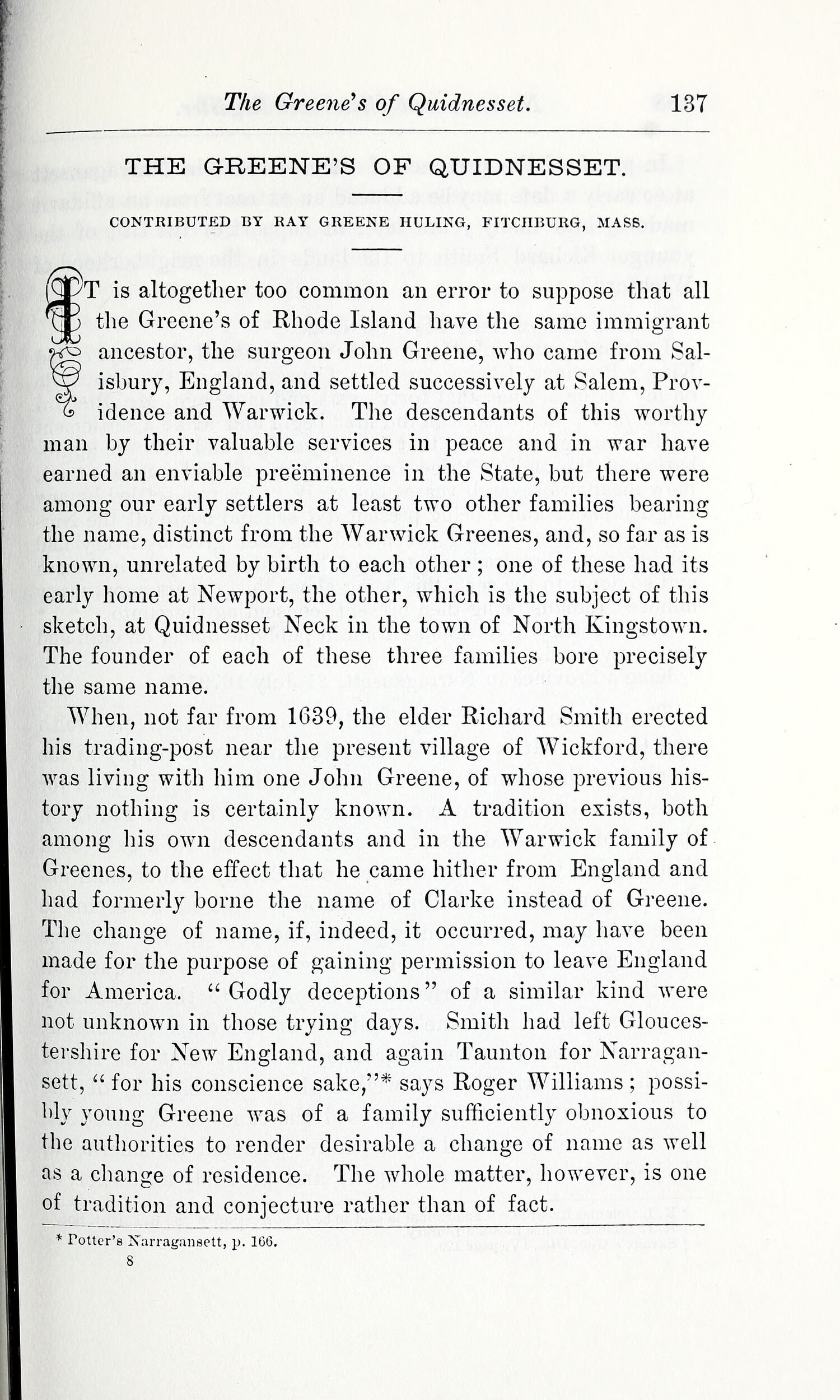
The line of descent from Bowridge Hill in Gillingham, England given below is a family tradition rather than confirmed record, and readers should weigh it as such. The two foundational studies of this family both say the immigrant’s English origin is unknown. Ray Greene Huling’s original 1884 study (shown at right) says of John Greene of Quidnessett that “nothing is certainly known” of his previous history, offers only a tradition that he came from England, and even records a separate tradition that he had first borne the name Clarke, not Greene; it never mentions Bowridge Hill. George Sears Greene’s The Greenes of Rhode Island (1903), reproduced in full on this site, carries no John Greene of 1529 and files the Quidnesset Greenes in a separate section with the plain caution that “a careful research is still necessary to prove the exact connection.” The fuller account is on the John Greene of Quidnessett page.
A Narrative Origin Story of the Greene Family Name and Line
RESEARCHER’S NOTE: If you are a registered member of the the website you will have access to the Greene Family Research Assistant linked [HERE]. You will be able to use the AI assistant to dig further into the history of the Greene family legacy. The data you will be able to access starts in the 1200s up until 1900. [Download that book here]
Below is a narrative that I am calling The Greene Family History, followed by a timeline graphic that visually links Boughton (Northamptonshire) to Quidnessett (Rhode Island). I’m grounding the “Lord Alexander → John Greene of Quidnessett” bridge in the exact pedigree statement from my linked sources, and I’m also flagging (plainly) where the evidence is strong vs. where it is genealogical tradition that should be verified with primary records.
Family histories often begin with an arrival, a ship, a settlement, a new life in a new land. The Greene story begins earlier, with something older than migration: a name formed out of land, and a landholding identity that survived the collapse of medieval society, the remaking of England, and the transplanting of families into colonial America.
In the earliest layers of the Greene tradition preserved in The Greene Family and Its Branches, the family’s stem father is Lord (Sir) Alexander de Greene de Boketon, identified as a knight in the reign of King John and the first of the line associated with Boughton in Northamptonshire.¹ His surname, in this telling, was not a casual label: it was the Norman habit of locating a person in the world by estate and lordship, a kind of geographic signature. Alexander’s name, de Greene de Boketon, signals both the family’s association with “green” (a park or enclosed preserve) and the place-name that evolved from Boketon to Boughton over time.²
The source text explains this clearly: “A green in the early day was a park,” and Boketon is treated as an ancient place-word connected to a paled or enclosed area, an estate known for parks and deer preserves, later rendered as Bucks/Buckston, and finally Boughton, “its present name,” in Northamptonshire.³ In other words, the Greene name is portrayed as a name born from landscape and function: parkland, enclosure, deer, stewardship.
This same early narrative also describes the social structure that came with such a grant. Alexander is presented as a “great baron,” a man holding directly from the crown, and thus obligated to supply men for the king’s wars and render ceremonial homage.⁴ Even if we read the terminology with caution (medieval ranks are not always used consistently in later genealogical writing), the underlying point remains historically plausible: in the medieval world, land tenure and military obligation were deeply linked. In that world, a family’s continuity depended less on romance than on governance: raising resources, maintaining boundaries, managing tenants, and guarding inheritance across generations.
The source text goes so far as to illustrate how boundaries were remembered: the annual “beating of the bounds,” a ritual in which the estate’s perimeter was physically traced and reinforced by communal memory, sometimes brutally, so that the estate remained an estate in practice, not just on parchment.⁵ This is not merely colorful detail; it reflects a medieval reality: the law was often embodied in living memory, and a manor’s continuity required recurring acts of recognition and enforcement.
The Greene Estate at Boughton — And Whether It Lasts Today
My question: is this the manor the Greene family was given, and does it last today?, deserves a careful and honest answer.
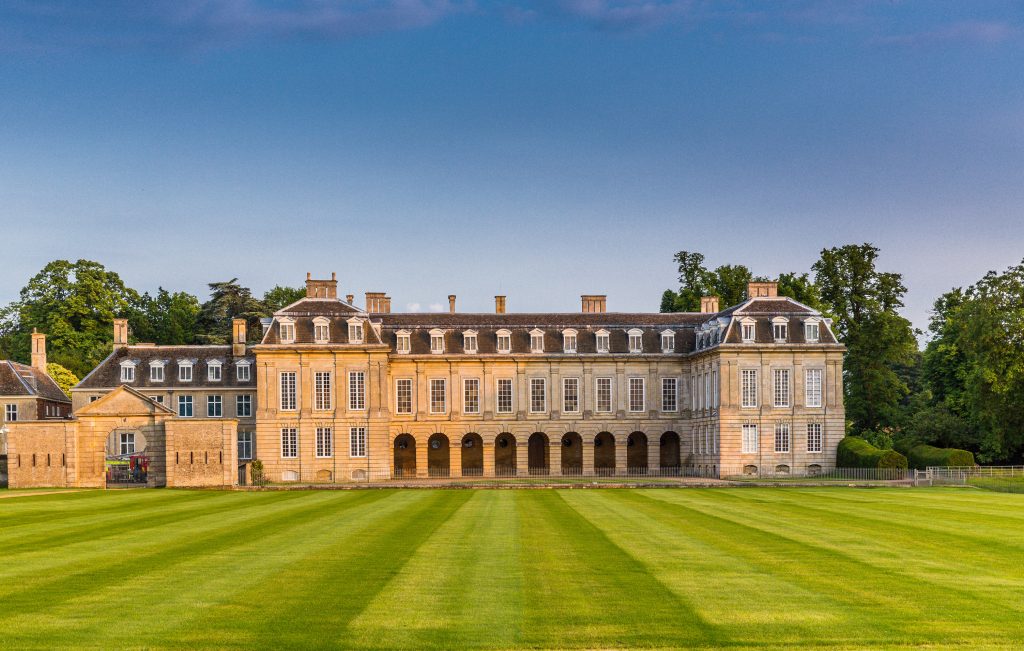
Boughton still exists, and the estate remains one of England’s best-known historic seats. Today’s Boughton House is famous for its scale, its French-influenced architecture, and its association with the Montagu line and later the Dukes of Buccleuch.⁶ The Wikipedia summary posted online is direct: Boughton House sits within an estate of about 11,000 acres, and the “present house” reflects major rebuilding after 1683, when Ralph Montagu inherited the estate and reshaped it with Versailles-inspired ideas.⁷ Historic Houses, an independent heritage organization, likewise emphasizes that the house “as it stands today” is “largely the work” of Ralph Montagu after 1683, when it was still a simpler earlier building.⁸ The Boughton House estate’s own historical overview (published by the house) notes that Boughton has been associated with the Montagu family and descendants since the 16th century and that it began as a Tudor manor with a Great Hall at its heart.⁹
So here is my clean takeaway:
- The place (Boughton) endures.
- The present building reflects later centuries, especially the late 1600s onward.
- The medieval estate, as land and locality, is the older continuity; the architecture you can visit today is the visible result of later owners and later wealth.
This matters for our Greene family history because it separates two ideas that are often unintentionally merged:
- Territorial origin (Boughton as the early estate associated with the name), and
- Architectural artifact (Boughton House as it appears now).
They are connected, but not identical.
How “de Greene” Became Greene — and Eventually Green
The same source text makes an important linguistic point: “de Greene de Boketon” was used in legal documents, but everyday speech shortened it to de Greene, and later political feeling encouraged dropping the “de” as too French.¹⁰ That kind of name-change fits the long arc of English history. After the Norman period, French prestige gradually gave way to a more self-conscious English identity, and by late medieval times, the “de” prefix often faded or disappeared across many families.
That transition de Greene → Greene, is not merely cosmetic. It signals a shift from a world where identity is anchored in formal lordship to a world where surnames are stabilized across social layers. It also sets the stage for what happens later: as estates fragment, younger sons branch out, and families shift into professions or new regions, the surname can remain even when land and title do not. In a sense, the name becomes portable, capable of surviving beyond the manor.
The Claimed Genealogical Bridge to John Greene of Quidnessett
Now we come to the question at the heart of my research: how does Lord Alexander link to John Greene of Quidnessett (1606–1695)?
My main source linked here provides a direct assertion: it states that : John Greene of Quidnessett was “fifteenth from Lord Alexander de Greene de Boketon, who received his title in 1202.”¹¹ It then supplies a pedigree chain (with some missing names) that runs from “Sir Alexander” through several medieval and early modern generations, including a notable junction involving Sir Thomas Greene and Lady Lucie de la Zouche, and later figures such as Lord Chief-Justice Sir Henry Greene and Sir Henry Greene (beheaded in 1399), before descending through Robert of Gillingham, and ultimately to John of Quidnessett.¹²
That is “our” internal family-history claim, in its own words, with a stated generational count. And because asked for a “strong connection,” the best way to handle this responsibly is to treat the claim in two layers:
Layer 1: What the book claims (and “we” can publish as family tradition)
- The Greene line begins with Lord/Sir Alexander de Greene de Boketon at Boughton.
- The Quidnessett line descends from him in fifteen generations.¹¹
- The book provides a proposed pedigree linking these points.¹²
Layer 2: What constitutes “proof” by modern genealogical standards
For publication aimed at family understanding, the narrative tradition is meaningful. But if we want it to be academically “hard,” the medieval-to-colonial bridge must be supported by primary or near-primary evidence across each transition (wills, manorial records, parish registers, deeds, court rolls, inquisitions post mortem, visitation pedigrees, etc.). The book I have used as my primary source for this article itself acknowledges gaps (“names are lost,” “unknown son”), which is common in older compiled genealogies.¹² Those gaps do not automatically falsify the line, but they do mean the connection is presented as a constructed pedigree rather than a fully documented chain in the modern sense.
That’s not a problem. It’s simply the honest way to present it:
This family history preserves a continuous tradition from medieval Boughton to colonial Rhode Island, and it supplies a working pedigree. Some links require further documentary confirmation due to missing or generalized generational identifiers.
We can say that plainly, and I hope I can gain credibility rather than lose it.
Why Rhode Island — and Why Quidnessett?
If Lord Alexander represents the origin of the Greene name in land, John Greene of Quidnessett represents its American reinvention in land.
Our source text situates the Quidnessett Greenes as descended from one of several brothers (Edward, John, Daniel, James, Benjamin), rooted in Rhode Island family clusters and disputes that shaped local identity.¹³ It also ties the numbering of “American generations” to John Greene of Quidnessett as the starting point for the colonial branch’s generational count.¹¹ In effect, the text treats him as the American anchor, the point where the Greene name becomes a New World lineage with its own geography and internal divisions.
The deeper “why” is cultural as much as geographic: Rhode Island, especially in its earliest decades, became a refuge for dissenters, boundary-pushers, and people who wanted local control. It is fitting, in a symbolic way, that a lineage grounded in estates and autonomy in medieval England becomes, in America, a lineage grounded in landholding and fierce local identity in Rhode Island.
That is not a genealogical proof; it is a historically consistent human pattern. And it makes for a strong opening chapter because it gives your family something more than names: it gives them a theme.
Timeline Graphic
Boughton (Northamptonshire) → Quidnessett (Rhode Island)
Below is a timeline that is intentionally “hybrid,” part chronology, part lineage, because that’s what readers actually understand.
KEY: Solid entries are explicitly stated in your source; dotted entries mark places where the source itself notes missing names.
1202–1695: The Greene Line in Two Continents
1202 (England, Northamptonshire)
Lord/Sir Alexander de Greene de Boketon receives title/estate association dated to 1202.¹¹
↳ Name arises from estate identity: de Greene de Boketon (park/“green” + Boketon → Boughton).²³
c. 1200s–1300s (England)
**…son and grandson (names lost in the source)…**¹²
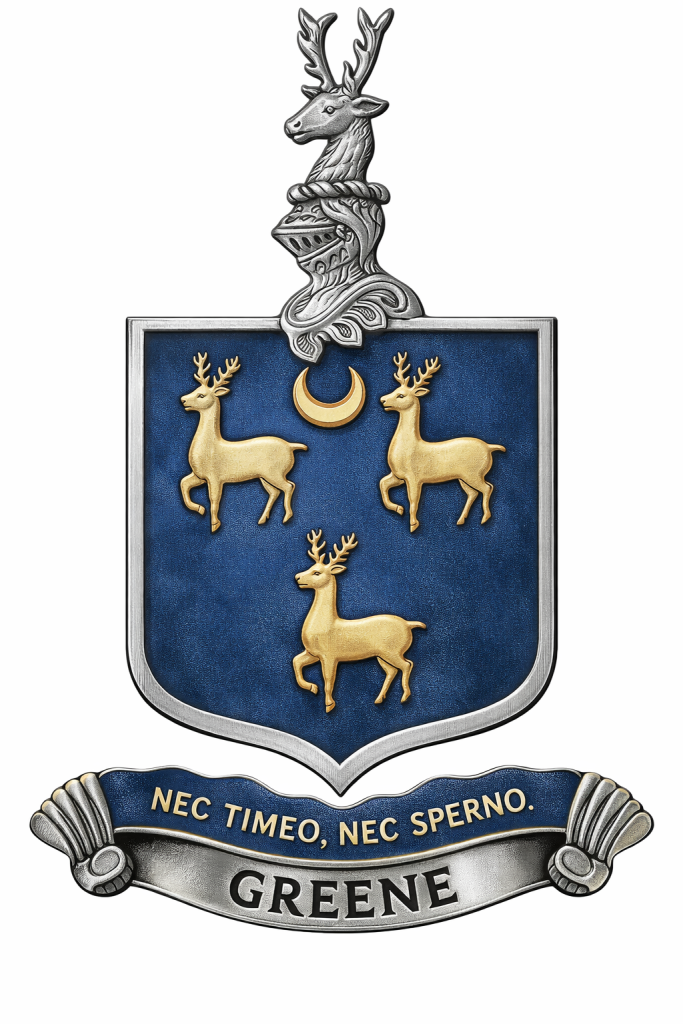
↳ Early heraldic identity emerges: three bucks trippant, gold on blue associated with the Boketon/Boughton identity.¹⁴
c. 1300s (England)
Sir Thomas Greene → Sir Thomas Greene (who marries Lady Lucie de la Zouche)¹²
↳ This marriage is treated as a prestige junction in the pedigree.¹²
Late 1300s (England)
Lord Chief-Justice Sir Henry Greene¹²
**Sir Henry Greene (beheaded 1399)**¹²
↳ The source places the Quidnessett John as ninth from this Sir Henry.¹¹
1400s–1500s (England)
Thomas → **…unknown son…**¹²
John “the Fugitive” (named in the pedigree)¹¹¹²
1600s (England → New England)
Robert of Gillingham → John → Henry → Robert¹²
↳ This sequence functions as the immediate run-up to the Rhode Island generation.¹²
1606–1695 (Rhode Island)
John Greene of Quidnessett (1606–1695) appears as the American generational starting point in the source’s numbering system.¹¹
↳ The Quidnessett Greenes descend from one of five brothers identified in the Rhode Island branch.¹³
Notes on How to Publish This Responsibly
If you want this to be the “starting point” for your family (and also something you won’t later have to walk back), I recommend including one short paragraph—right after the timeline—that tells the reader what kind of evidence is being used:
- This chapter uses a compiled family history as its base narrative (your book), and
- Later revisions may strengthen or adjust the medieval links as primary documentation is assembled.
That single paragraph prevents the most common family-history mistake: accidentally presenting a tradition as a fully proven chain. You’ll still tell a powerful story—just with your historian hat on straight.
Footnotes
- The source identifies Lord Alexander de Greene de Boketon as the stem father of the Greene line and places him in the medieval context described throughout the early chapters.
- The source defines “green” as a park and explains the meaning and evolution of Boketon as a place-name tied to enclosure/parkland.
- The same passage explicitly states the evolution of Boketon → Boughton and locates it in Northamptonshire.
- The text describes lordly obligations and homage traditions associated with the Lords de Greene holding from the crown.
- The text describes “beating the bounds” and the annual boundary ritual used to preserve estate limits.
- Boughton House is widely recognized as a major historic country house and remains associated with the Buccleuch family line.
- Wikipedia summarizes Boughton House’s location, estate scale, medieval core, and major rebuilding beginning after 1683 under Ralph Montagu.
- Historic Houses states that Boughton House “as it stands today” is largely the work of Ralph Montagu after inheriting it in 1683, with French influence.
- Boughton House’s own “Brief History” PDF describes the estate’s later ownership context and its development from an earlier manor house.
- The source describes the shortening from “de Greene de Boketon” to “de Greene,” and later dropping “de” in the reign of Henry VI.
- The source explicitly states that John Greene of Quidnessett was “fifteenth from Lord Alexander de Greene de Boketon” and that Alexander “received his title in 1202.”
- The source provides the pedigree sequence linking “Sir Alexander” through medieval and early modern generations to “John of Quidnessett,” including noted gaps (“names are lost,” “unknown son”).
- The source identifies the Quidnessett Greenes as descended from one of five brothers and situates the branch structure in Rhode Island.
- The source explains the early coat-of-arms tradition: “three bucks trippant, or, upon an azure field.”
Views: 626
Explore the evidence
View this article’s connected sources and media →
About this page
This article was brought over from AlfredGibbs.com. Its preserved text, media and citations remain available for comparison.