
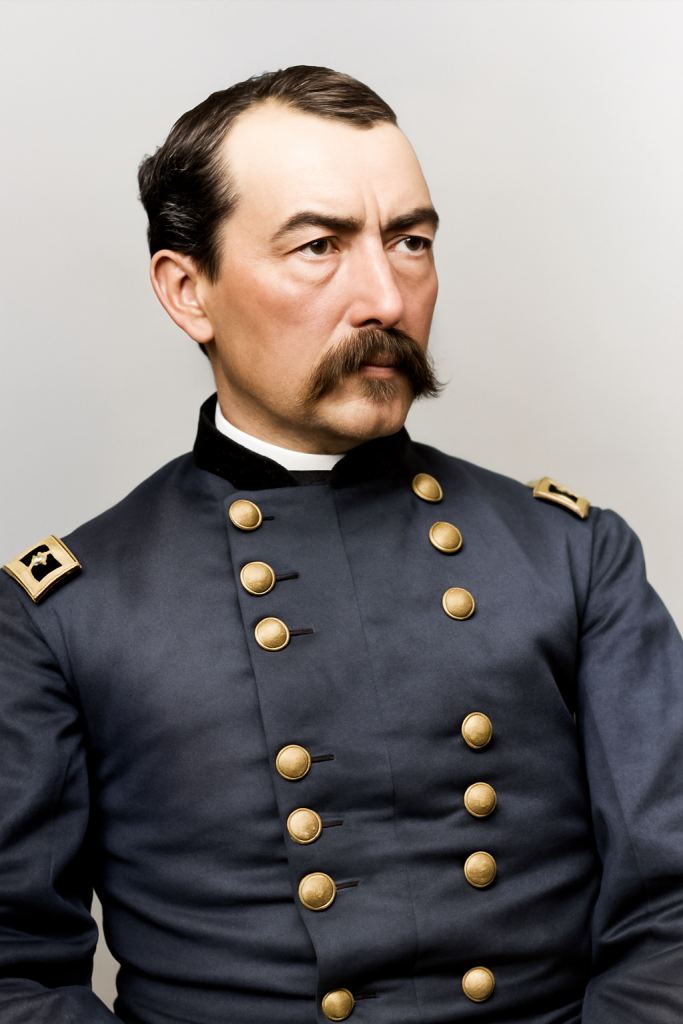
The Battle of Yellow Tavern, fought on May 11, 1864, was the climax of Maj. Gen. Philip H. Sheridan’s first great cavalry raid of the Overland Campaign. Six miles north of Richmond, Sheridan’s eleven thousand horsemen ran headlong into Maj. Gen. J.E.B. Stuart’s cavalry, thrown squarely across the road to the Confederate capital. The Union troopers carried the field, and Stuart — the most celebrated cavalry leader of the Confederacy — was mortally wounded and died in Richmond the next day. For the First New York Dragoons it was, in their own historian’s words, “the hardest fight thus far of our raid.”
Sheridan Strikes for Richmond
Having won from Meade the freedom to use the cavalry as he saw fit, Sheridan concentrated his three divisions and, early on May 9, 1864, led nearly eleven thousand troopers out onto the road to Richmond, passing in the rear of Lee’s army. His object was plain: to wreck the Confederate railroads and supplies — and, above all, to “fight and whip Stuart’s cavalry.” The column, moving in fours on a single road, stretched some thirteen miles. At Beaver Dam Station the advance, under Custer, captured three trains, freed four hundred Union prisoners bound for Southern prisons, and burned vast stores of bacon, flour, and medical supplies meant for Lee’s army.
Stuart, learning of the raid, overtook the column, harried its flanks and rear, and then pushed the heavier part of his command ahead to interpose between Sheridan and Richmond. He concentrated at Yellow Tavern, an abandoned wayside inn six miles from the city, and placed his troops squarely across the Union path — precipitating the fight on May 11.
The Dragoons Dismount and Charge
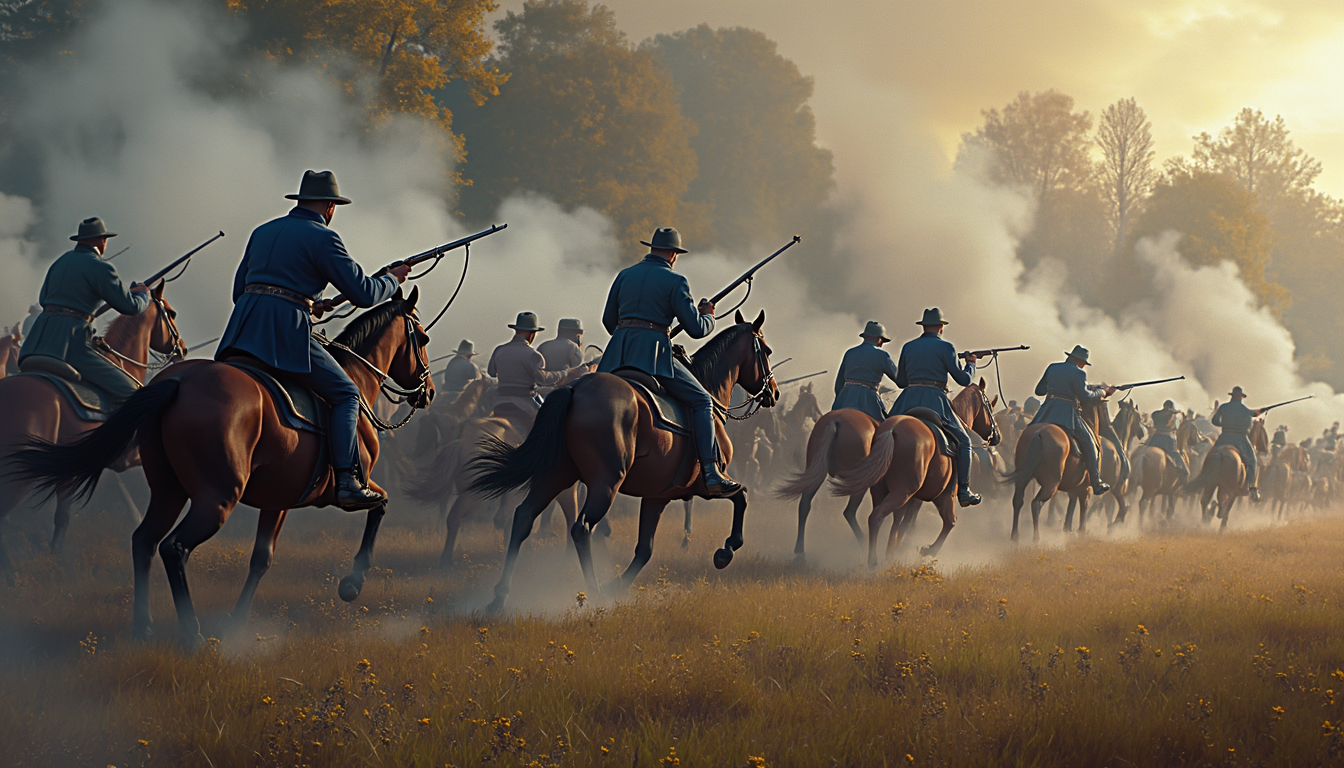
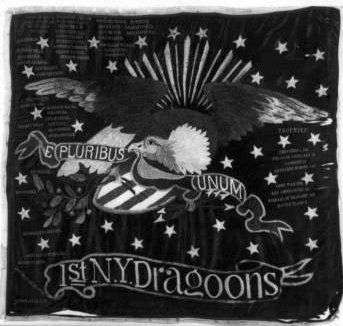
The First New York Dragoons rode in the Reserve Brigade of Brig. Gen. Wesley Merritt’s First Cavalry Division, the brigade commanded by Col. Alfred Gibbs; the regiment itself was led that day by Lt. Col. Thorp. When the Confederate guns opened on the Union advance from a well-chosen position, the whole column broke into a gallop, and within ten minutes the regiment wheeled into line of battle. At Thorp’s command the Dragoons dismounted and went forward on foot, the men working their new seven-shot Spencer carbines — a weapon that gave them a withering rate of fire — until the gray line broke and ran. The fight, fought across fences, woods, and open fields, lasted till dark, when the Confederates abandoned the field and left the Union troopers in possession of the road to Richmond.
“The hardest fight thus far of our raid occurred at Yellow Tavern on the 11th. … In less time than it can be written, Colonel Thorp’s ringing command was heard: ‘Dismount, and prepare to fight on foot! Forward, double-quick, march!’ The rebel line was scarcely twenty rods away, and they were throwing the lead about us like hail, while a battery was enfilading us … At this the boys broke into a yell, and began pumping the lead from their deadly seven-shooter carbines into that line of gray at such a terrible rate that they broke and ran like a flock of sheep.”— From a Dragoon’s letter dated “Malvern Hill, May 17, 1864,” reproduced verbatim in James R. Bowen, Regimental History of the First New York Dragoons (1900), pp. 156–157.
The Fall of J.E.B. Stuart
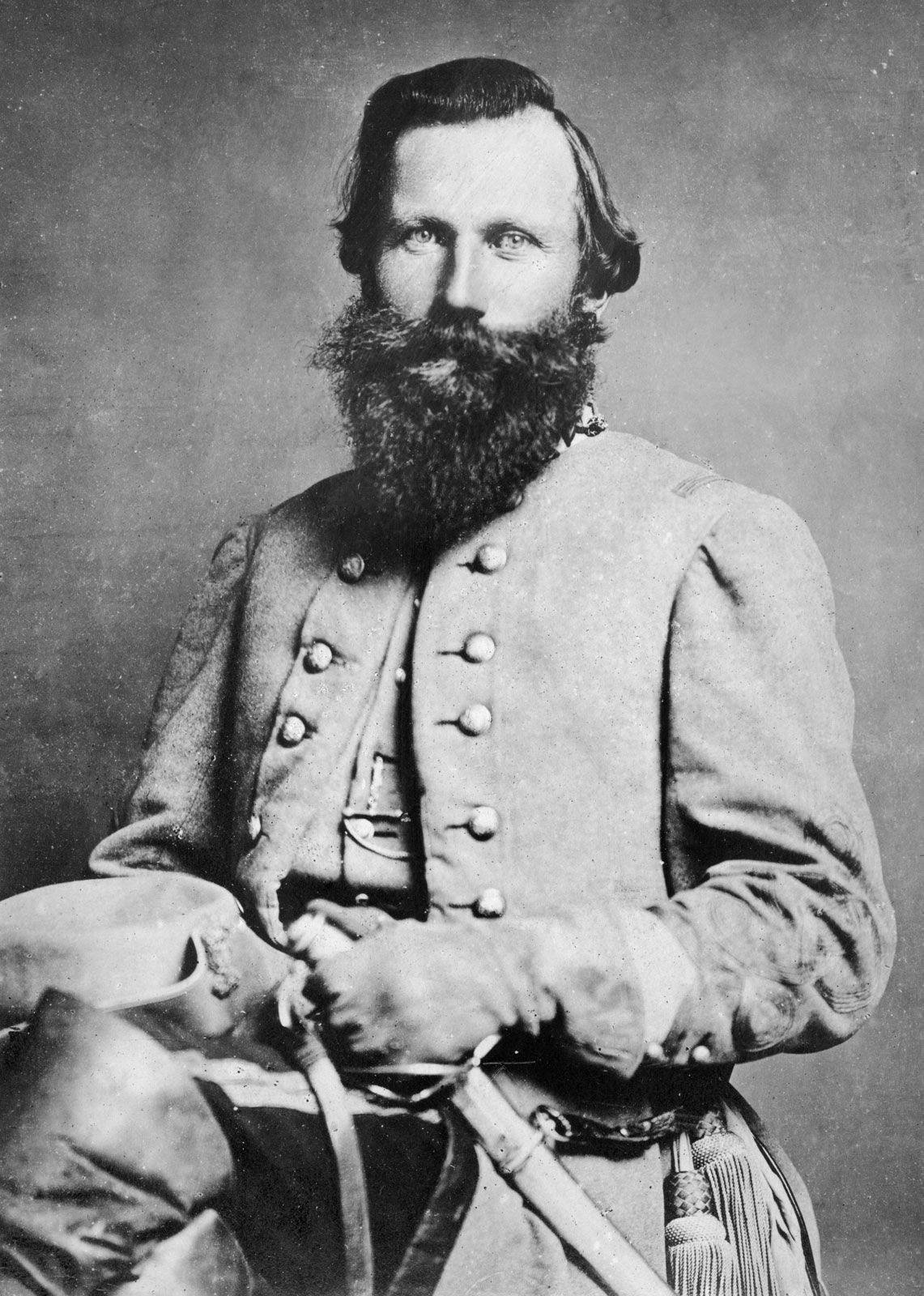
The most fateful result of Yellow Tavern was the mortal wounding of J.E.B. Stuart. Riding along his lines to steady his men, the Confederate cavalry chief was struck down; he was borne from the field and died in Richmond the next day. As one account reproduced by Bowen put it, “At Yellow Tavern, Stuart’s star, which had hitherto shone resplendent, sank, never to rise again.”
Out of the Trap and On to Richmond
The fighting did not end at Yellow Tavern. Marching off in the rain and darkness toward Richmond, the column was led by a false guide into a trap before the city’s defenses, raked with shell, grape, and canister, with torpedoes planted in the road and the alarm bells of Richmond ringing all night. Sheridan worked the command free, and at daylight on May 12 reached Meadow Bridge over the Chickahominy. There the Dragoons — for once held to fight mounted — supported the building of a bridge under fire, then crossed at a gallop and, dismounting again at a high rail fence, swept forward at the double-quick with their carbines “making a perfect hailstorm of leaden bullets.” A captured Confederate, Bowen recalled, knew his tormentors at once: they were “those … Dragoons, who loaded Sunday and fired all the week.”
Sources & Further Reading
- Primary James R. Bowen, Regimental History of the First New York Dragoons (originally the 130th N.Y. Vol. Infantry) (1900), ch. X, “Sheridan’s First Raid,” pp. 153–164 — the regiment’s own historian, reproducing soldiers’ letters and Capt. Leach’s recollections of Yellow Tavern, Meadow Bridge, and the claim to Stuart’s death. Full text: archive.org/details/regimentalhistor00bowe.
- Primary U.S. War Dept., The War of the Rebellion: Official Records of the Union and Confederate Armies, Series I, Vol. 36 — Sheridan’s, Merritt’s, and the Reserve Brigade reports of the Richmond raid and the action at Yellow Tavern.
- American Battlefield Trust — “Lost Battlefield: The Battlefield of Yellow Tavern, Virginia” (Daniel T. Davis): battlefields.org/learn/articles/lost-battlefield-battlefield-yellow-tavern-virginia.
- American Battlefield Trust — “The Fall of the Rebel Cavalier” (on J.E.B. Stuart’s death at Yellow Tavern): battlefields.org/learn/articles/fall-rebel-cavalier.
- National Park Service / Civil War Sites Advisory Commission (CWSAC) Battle Summary, Yellow Tavern (VA106) — classified a Union victory in Sheridan’s Richmond Raid.
- “Yellow Tavern, Battle of,” Encyclopedia Virginia: encyclopediavirginia.org/entries/yellow-tavern-battle-of.
Trevilian Station · The Shenandoah Valley Campaign · The Audiobook
Views: 42
Explore the evidence
View this article’s connected sources and media →
About this page
This article was brought over from AlfredGibbs.com. Its preserved text, media and citations remain available for comparison.