
The writing behind the research
Dragoons
Find a story. Preview its contents. Follow the evidence.
Browsing Dragoons. Subcategories are included.
American Civil War, "Gray-Backs"
During the American Civil War, soldiers on both sides of the conflict faced numerous hardships, ranging from brutal combat to harsh living conditions. One…
Preview article ↓Anderson’s Bridge, May 10, 1864
The action at Anderson’s Bridge, fought on May 10, 1864, was a minor cavalry skirmish that occurred during the Spotsylvania phase of the Overland Campaign…
Preview article ↓Andrew J. Lorish
AWARDS BY DATE OF ACTION: Medal of HonorAWARDED FOR ACTIONS DURING: Civil WarSERVICE: ArmyDIVISION: 19th New York Cavalry (1st New York Dragoons)
Preview article ↓Appomattox Courthouse, Va. (Lee’s surrender), April 9, 1865
On April 9, 1865, General Robert E. Lee surrendered the Army of Northern Virginia to Lieutenant General Ulysses S. Grant in the parlor of Wilmer McLean’s …
Preview article ↓Appomattox Station, Va., April 8, 1865
The last battle of the First New York Dragoons — the night before Lee’s surrender, when Sheridan’s cavalry seized the supply trains and threw itself acros…
Preview article ↓Baltimore Cross Roads, Va., July 4, 1863
The lone skirmish of Dix’s “second Peninsular campaign” — a demonstration toward Richmond that the 130th New York’s own historian called “a miserable fail…
Preview article ↓Battle Near Franklin, Va., June 13, 1863.
A skirmish on the Blackwater — the last shots the 130th New York fired in the Suffolk country before the regiment left for the Peninsula and its transform…
Preview article ↓Battle of Barnett’s Ford, Va., Feb. 6 and 7, 1864
A single hard day out of winter quarters — the First New York Dragoons crossing an icy river in the mud, one small wing of a Federal demonstration that ca…
Preview article ↓Battle of Deserted House: A Crucial Skirmish in the Blackwater Marches
The 130th New York’s first real battle — their “first severe baptism of fire,” and the dawn-lit charge in which Colonel Alfred Gibbs, under arrest and una…
Preview article ↓Beaver Dam Station. Va., May 9, 1864
The action at Beaver Dam Station on May 9, 1864, formed part of Union Major General Philip H. Sheridan’s independent cavalry operations during the Overlan…
Preview article ↓Biography of Dr. Benjamin Trumbull Kneeland
Benjamin Trumbull Kneeland, known as Dr. Kneeland, was born on June 3, 1825, in Onondaga County, New York, as one of twelve children. His father, Amasa Kn…
Preview article ↓Biography of Quartermaster Thomas M. Foster
Thomas M. Foster served as a Quartermaster-Sergeant in Company F of the First New York Dragoons during the Civil War. He enlisted as a Corporal on Septemb…
Preview article ↓Select a title to preview it. Open the full article when you’re ready to read.
American Civil War, "Gray-Backs"
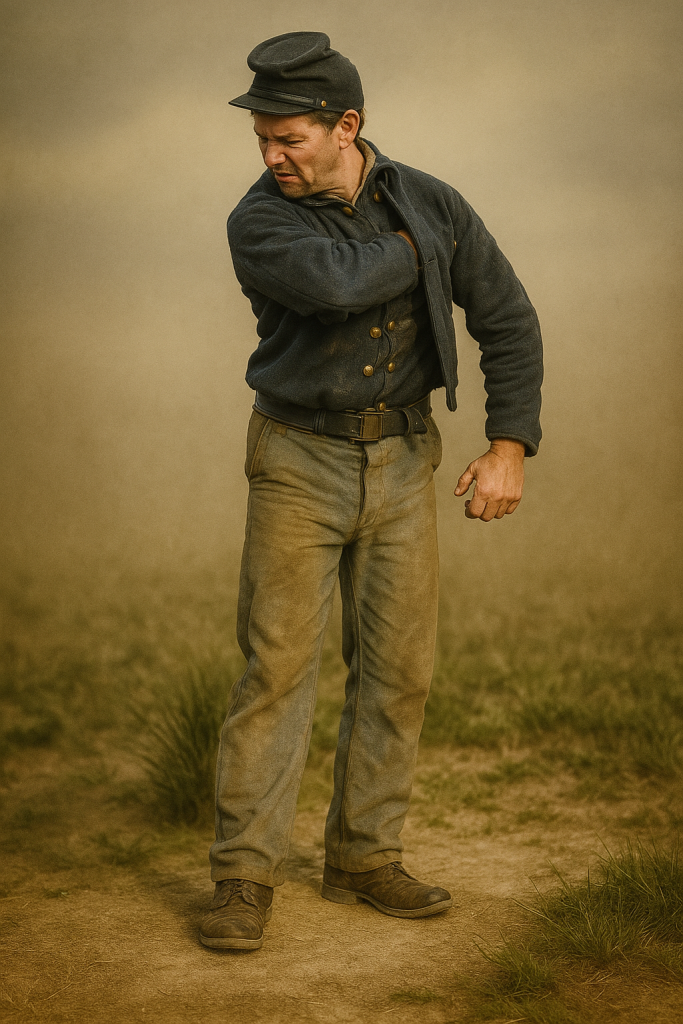
During the American Civil War, soldiers on both sides of the conflict faced numerous hardships, ranging from brutal combat to harsh living conditions. One of the less discussed but ever-present issues was the rampant infestation of body lice, colloquially known as “gray-backs.” This term, used commonly by soldiers, referred to the tiny parasites that thrived in the unsanitary conditions of war, adding another layer of misery to the already difficult life in camp.
- The Federal Record: A U.S. Army Surgeon, 1863
- References