
How do we know that Captain Alfred Gibbs was paroled after the surrender at San Augustine Springs, and how do we know he was later exchanged? Because the letters were printed, in full, in the government’s own compilation of Civil War records. Nothing about his release is hidden or hearsay. The documents gathered here are the source behind Cullum’s single line and behind every history that followed. They come from Series II of the Official Records, and the original printed pages are shown beside each transcription so the reader can check the word against the evidence.
✦
The Order
War Department, Washington · August 27, 1862
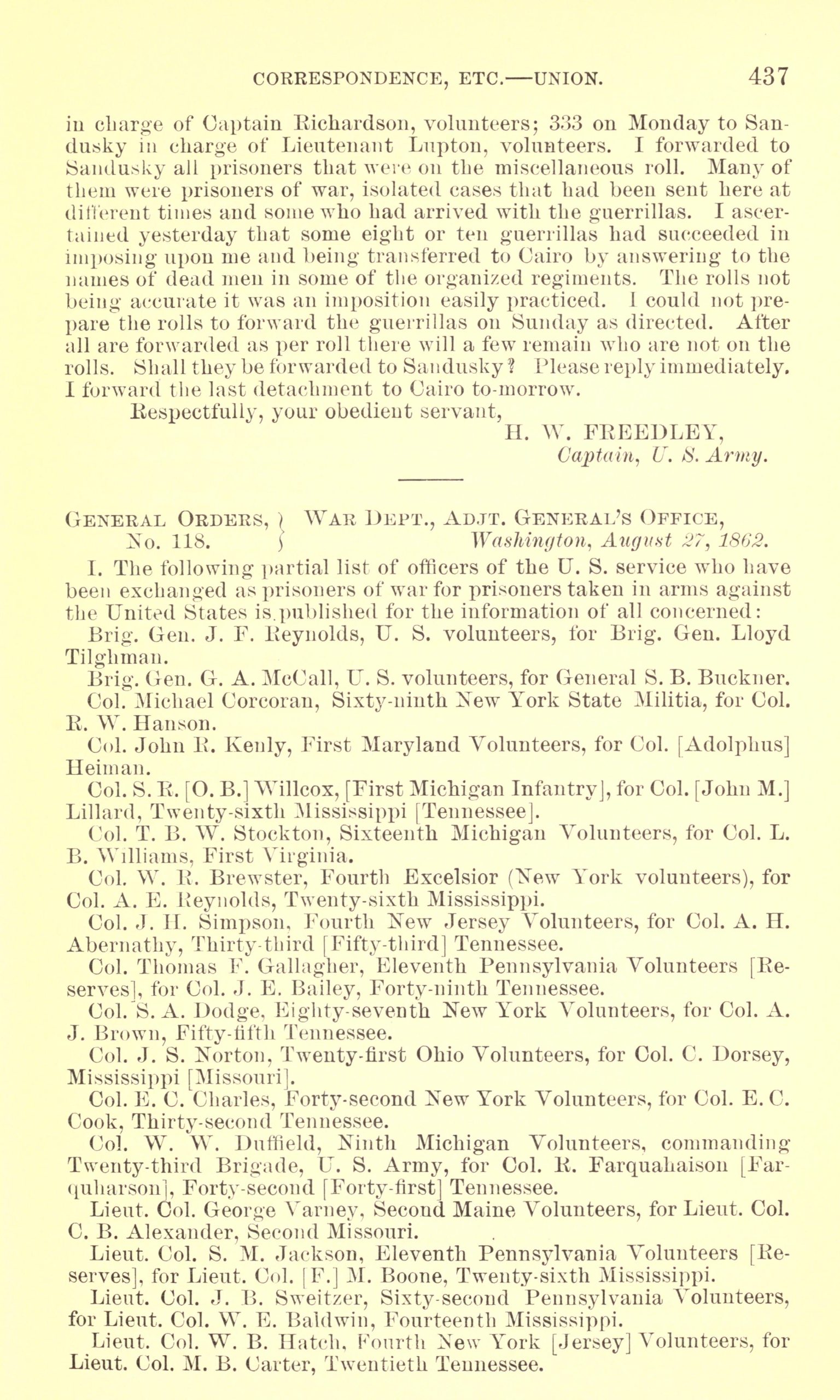
Everything on this page comes down to a single printed order. For thirteen months after his surrender, Captain Alfred Gibbs was a paroled prisoner, a soldier bound by oath not to fight. On August 27, 1862, the War Department published the men it had exchanged, and there, among generals and colonels, it set his name against a Confederate naval officer he had never met. This one order ended his captivity and made him free to fight; ten days later he was a colonel. It is shown here first, in full, because the story that follows is only the road to it.
I. The following partial list of officers of the U. S. service who have been exchanged as prisoners of war for prisoners taken in arms against the United States is published for the information of all concerned:
Brig. Gen. J. F. Reynolds, for Lloyd Tilghman · Brig. Gen. G. A. McCall, for S. B. Buckner · Col. Michael Corcoran · and some sixty more
The list ran to dozens of officers across four printed pages; Gibbs’s own entry stands on page 438, shown below. The same order also freed the Prussian engineer Captain von Scheliha, whose failed offer to be traded for Gibbs appears further down this page, matched in the end not to Gibbs at all but to Capt. Charles D. Jordan of the Eighth U.S. Infantry. The cartel simply paired each man with whatever counterpart the ledger required.
Official Records, Series II, Vol. IV (Serial 117), pp. 437 to 438
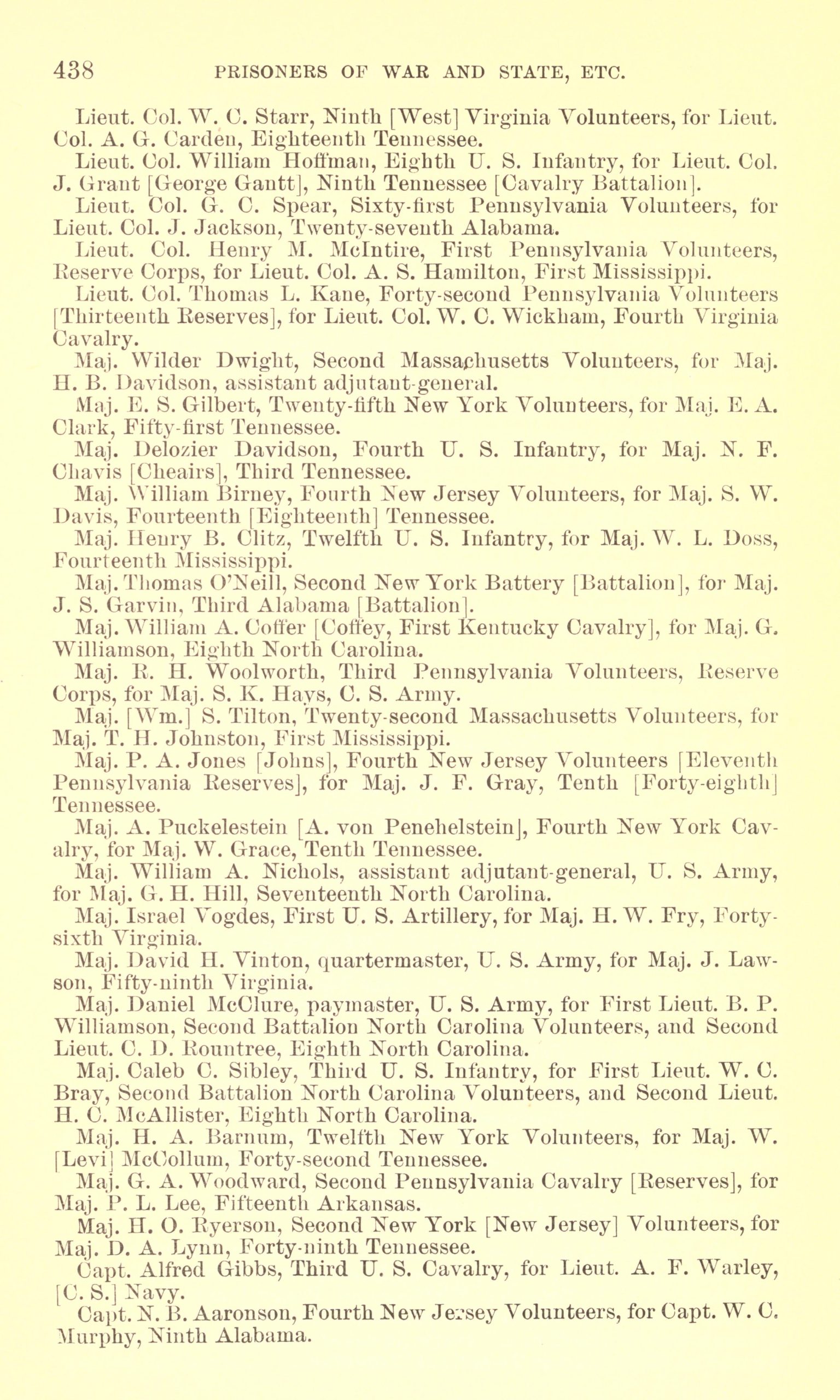
Warley was no ordinary prisoner. A South Carolinian and former United States naval officer, he had commanded the Confederate ironclad ram Manassas, the first ironclad to fire a shot in the war, at the Head of Passes in October 1861, and had driven her into Farragut’s fleet during the fall of New Orleans in April 1862. When the Manassas was shattered and set ablaze on the Mississippi, Warley was captured and sent north to Fort Warren, the same Boston harbor fort from which von Scheliha would write. He was exchanged in that same August wave, returned to sea, and later commanded the ironclad Albemarle. This was the counterweight the ledger set against a cavalry captain from Detroit: a fair exchange of rank, and an improbable pairing of a horseman and an ironclad sailor.
I
The Petition
Fort Wayne, Detroit & Washington · March 1862
It took more than a year to reach that one line, and the road began not in Washington but in Detroit. Gibbs did not wait quietly on parole. From Fort Wayne he asked to be exchanged, and he enlisted Michigan’s United States Senator and a leading Detroit citizen to carry his case to the Secretary of War. Three letters travelled together to Washington: Gibbs to the senator, a friend’s endorsement, and the senator’s cover letter to Edwin Stanton.
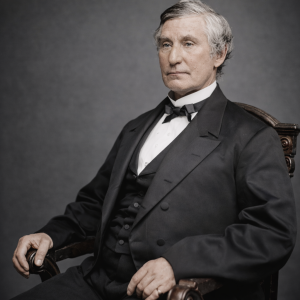
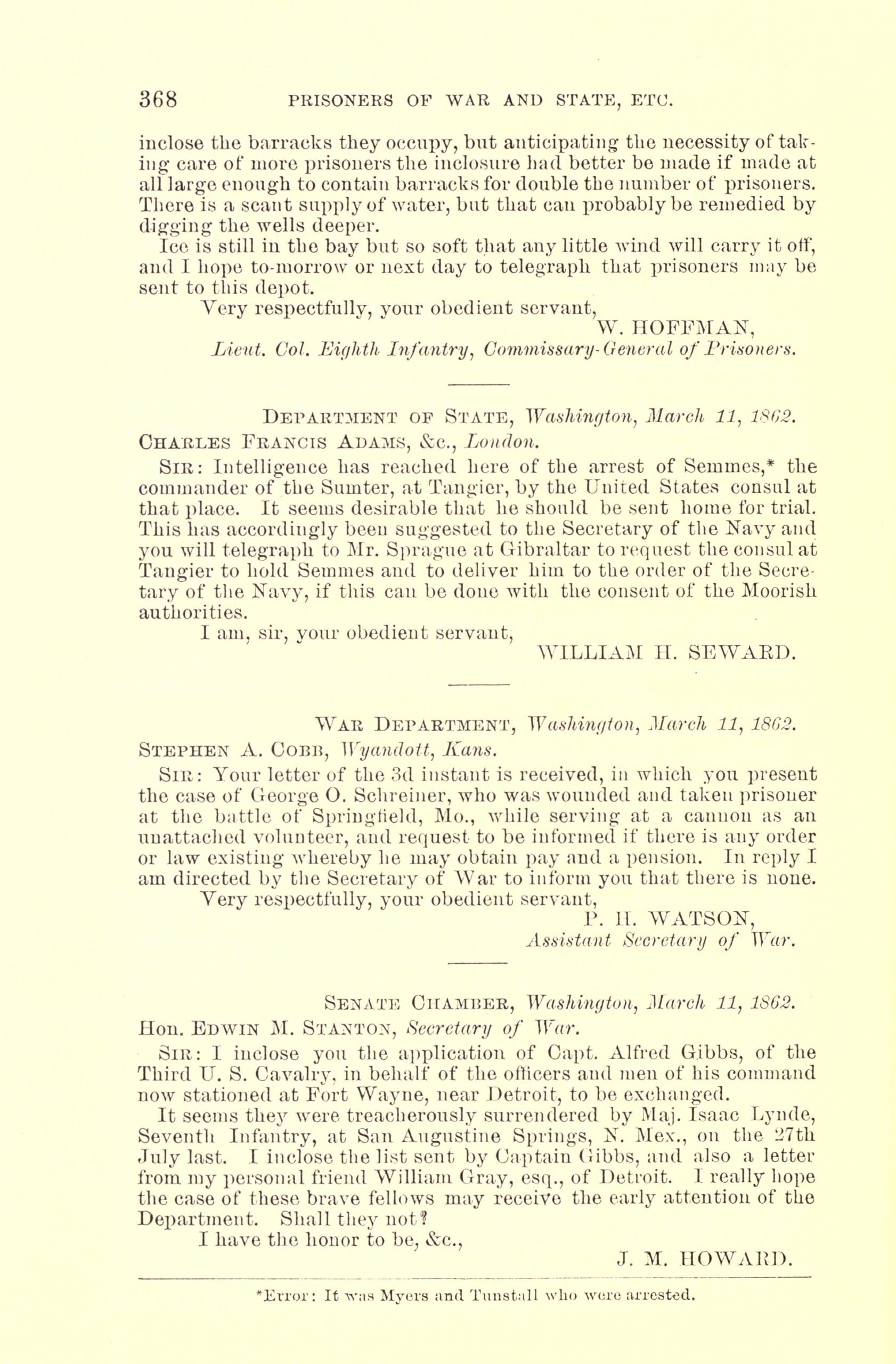
SIR: I have the honor to inclose you the official list [omitted in the printed record] of the officers and men under my command at this post. I beg to state that they compose the cavalry force included in the ignominious surrender of San Augustine Springs, N. Mex., July 27, 1861, made by Major Isaac Lynde, Seventh Infantry.
The officers and men above referred to have been in the service of the United States Government for periods varying from five to fifteen years and most keenly feel the disgrace to which they are subjected by their obedience to the orders of their lawful superior. Hearing of the successes of the Union arms at Roanoke, Forts Henry and Donelson and of the capture of over 15,000 rebel prisoners at these places, I have the honor in the name of the officers and soldiers of my command to ask you to take such steps as you may deem proper to urge upon the Secretary of War our exchange for prisoners of war of equal rank now in our possession that we may show to the Government of the United States that we are most anxious to do our duty in the field against any of the enemies of our country and our flag. I send inclosed letter from some of your personal friends substantiating the statements above made.
I am, sir, very respectfully, your obedient servant,
Official Records, Series II, Vol. III (Serial 116), p. 369
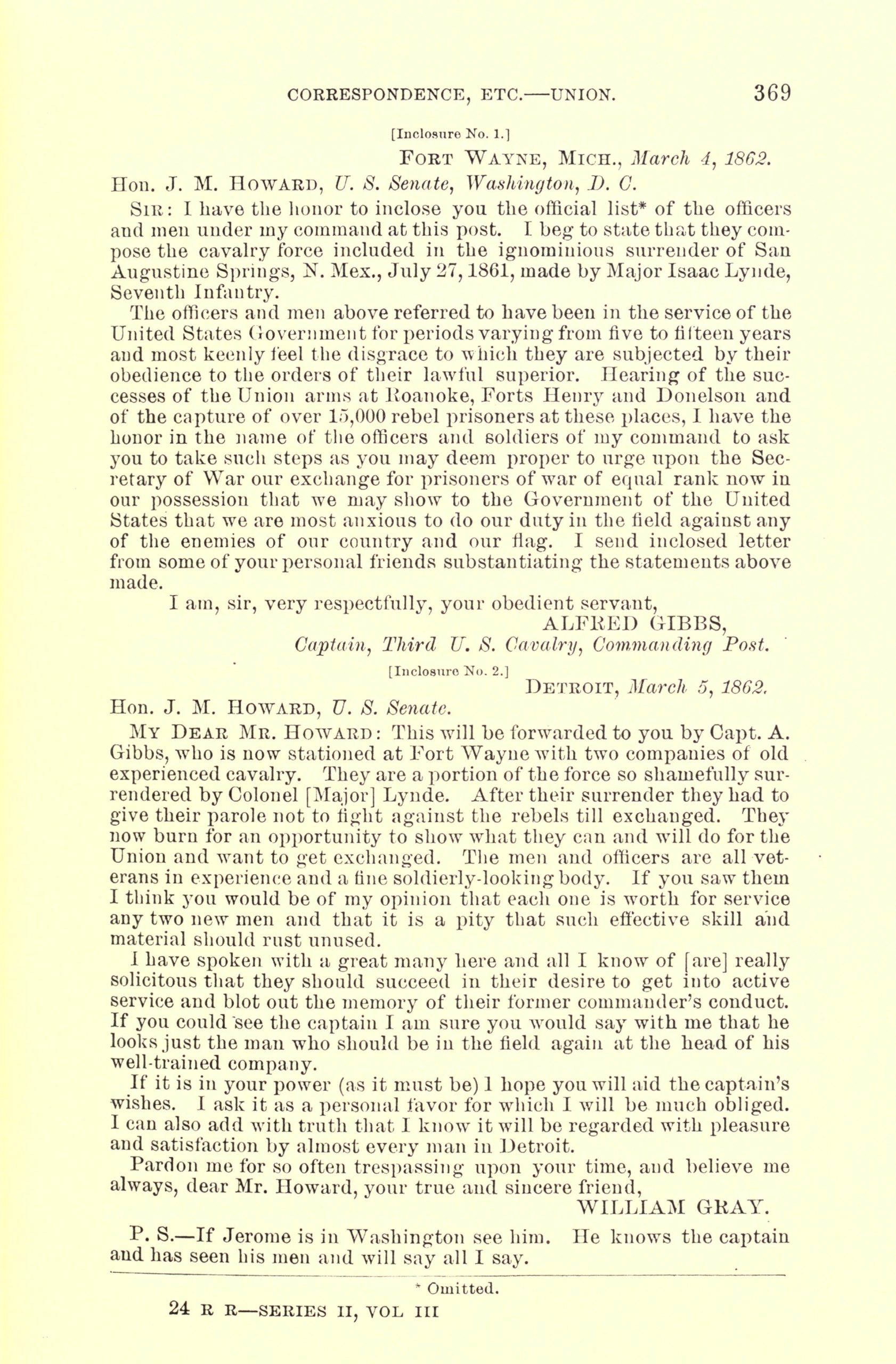
MY DEAR MR. HOWARD: This will be forwarded to you by Capt. A. Gibbs, who is now stationed at Fort Wayne with two companies of old experienced cavalry. They are a portion of the force so shamefully surrendered by Colonel [Major] Lynde. After their surrender they had to give their parole not to fight against the rebels till exchanged. They now burn for an opportunity to show what they can and will do for the Union and want to get exchanged. The men and officers are all veterans in experience and a fine soldierly-looking body. If you saw them I think you would be of my opinion that each one is worth for service any two new men and that it is a pity that such effective skill and material should rust unused.
I have spoken with a great many here and all I know of [are] really solicitous that they should succeed in their desire to get into active service and blot out the memory of their former commander’s conduct. If you could see the captain I am sure you would say with me that he looks just the man who should be in the field again at the head of his well-trained company.
If it is in your power (as it must be) I hope you will aid the captain’s wishes. I ask it as a personal favor for which I will be much obliged. I can also add with truth that I know it will be regarded with pleasure and satisfaction by almost every man in Detroit.
Pardon me for so often trespassing upon your time, and believe me always, dear Mr. Howard, your true and sincere friend,
P. S. If Jerome is in Washington see him. He knows the captain and has seen his men and will say all I say.
Official Records, Series II, Vol. III (Serial 116), p. 369
William Gray (1819 to 1869) was one of the eminent lawyers of Detroit, Irish-born, admitted to the bar in 1844, and appointed City Counsellor of Detroit the year after he wrote this letter. A friend of Senator Howard, he and the senator were both members of the Detroit bar, and the book that records his life calls him plainly “a patriot.” (Bench and Bar of Michigan; Johnston’s Detroit City Directory, 1861.)
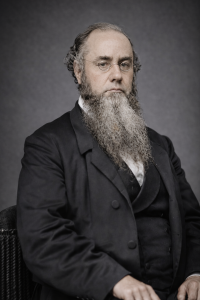
SIR: I inclose you the application of Capt. Alfred Gibbs, of the Third U. S. Cavalry, in behalf of the officers and men of his command now stationed at Fort Wayne, near Detroit, to be exchanged.
It seems they were treacherously surrendered by Maj. Isaac Lynde, Seventh Infantry, at San Augustine Springs, N. Mex., on the 27th July last. I inclose the list sent by Captain Gibbs, and also a letter from my personal friend William Gray, esq., of Detroit. I really hope the case of these brave fellows may receive the early attention of the Department. Shall they not?
I have the honor to be, &c.,
Official Records, Series II, Vol. III (Serial 116), p. 368
II
The Confederate Offer
Fort Warren, Boston Harbor · May 17, 1862
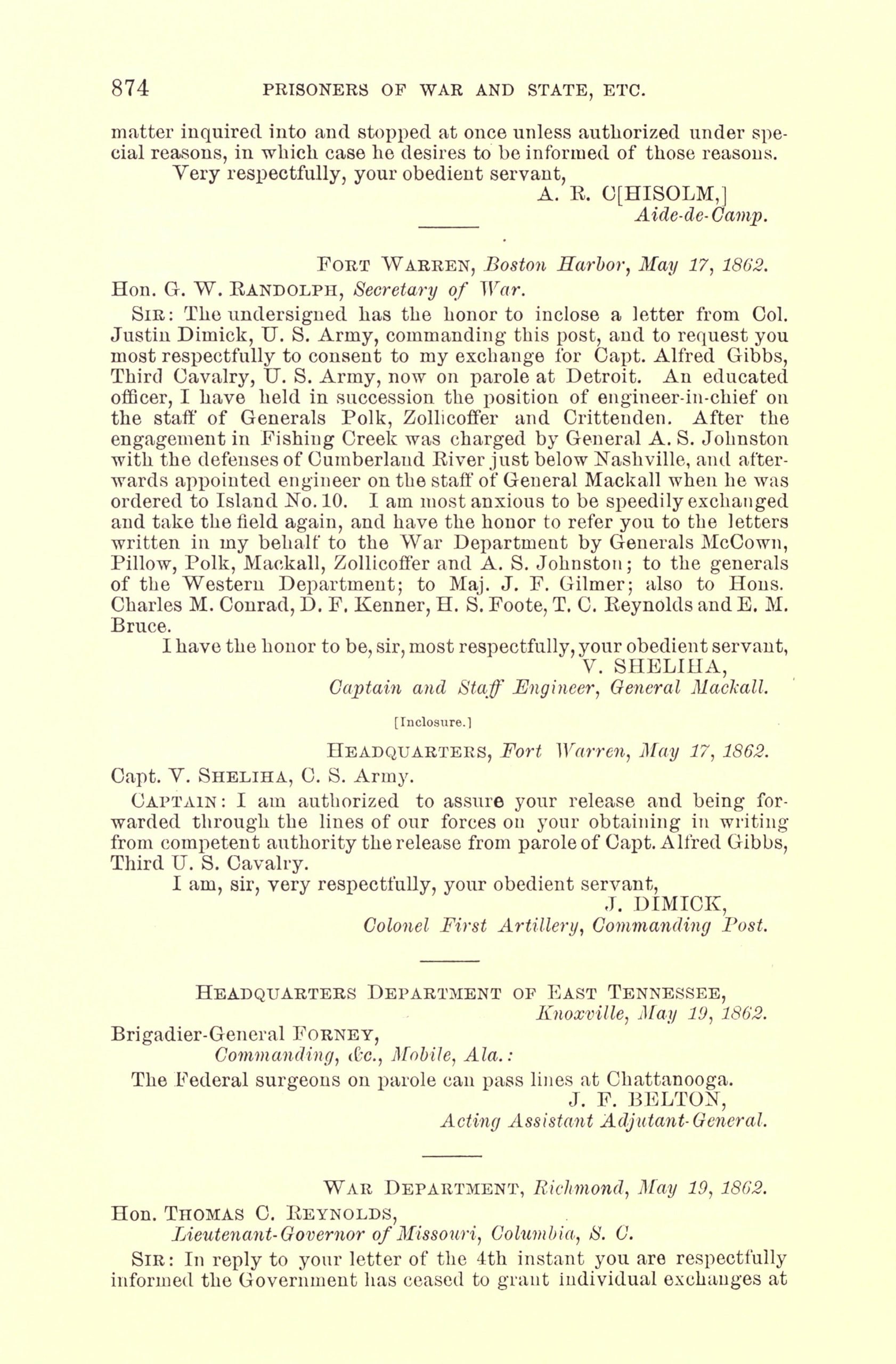
Two months later the matter surfaced from the other side of the war. At Fort Warren in Boston Harbor a captured Confederate engineer, the Prussian-born Captain Viktor von Scheliha, proposed himself in a direct exchange for Gibbs. The Union colonel commanding the post, Justin Dimick, endorsed the terms in an inclosure of the same date. Gibbs’s parole had become the price of another officer’s freedom.
SIR: The undersigned has the honor to inclose a letter from Col. Justin Dimick, U. S. Army, commanding this post, and to request you most respectfully to consent to my exchange for Capt. Alfred Gibbs, Third Cavalry, U. S. Army, now on parole at Detroit. An educated officer, I have held in succession the position of engineer-in-chief on the staff of Generals Polk, Zollicoffer and Crittenden. After the engagement in Fishing Creek was charged by General A. S. Johnston with the defenses of Cumberland River just below Nashville, and afterwards appointed engineer on the staff of General Mackall when he was ordered to Island No. 10. I am most anxious to be speedily exchanged and take the field again, and have the honor to refer you to the letters written in my behalf to the War Department by Generals McCown, Pillow, Polk, Mackall, Zollicoffer and A. S. Johnston; to the generals of the Western Department; to Maj. J. F. Gilmer; also to Hons. Charles M. Conrad, D. F. Kenner, H. S. Foote, T. C. Reynolds and E. M. Bruce.
I have the honor to be, sir, most respectfully, your obedient servant,
Official Records, Series II, Vol. III (Serial 116), p. 874
CAPTAIN: I am authorized to assure your release and being forwarded through the lines of our forces on your obtaining in writing from competent authority the release from parole of Capt. Alfred Gibbs, Third U. S. Cavalry.
I am, sir, very respectfully, your obedient servant,
Official Records, Series II, Vol. III (Serial 116), p. 874
III
The Door Closes
War Department, Richmond · May 19, 1862
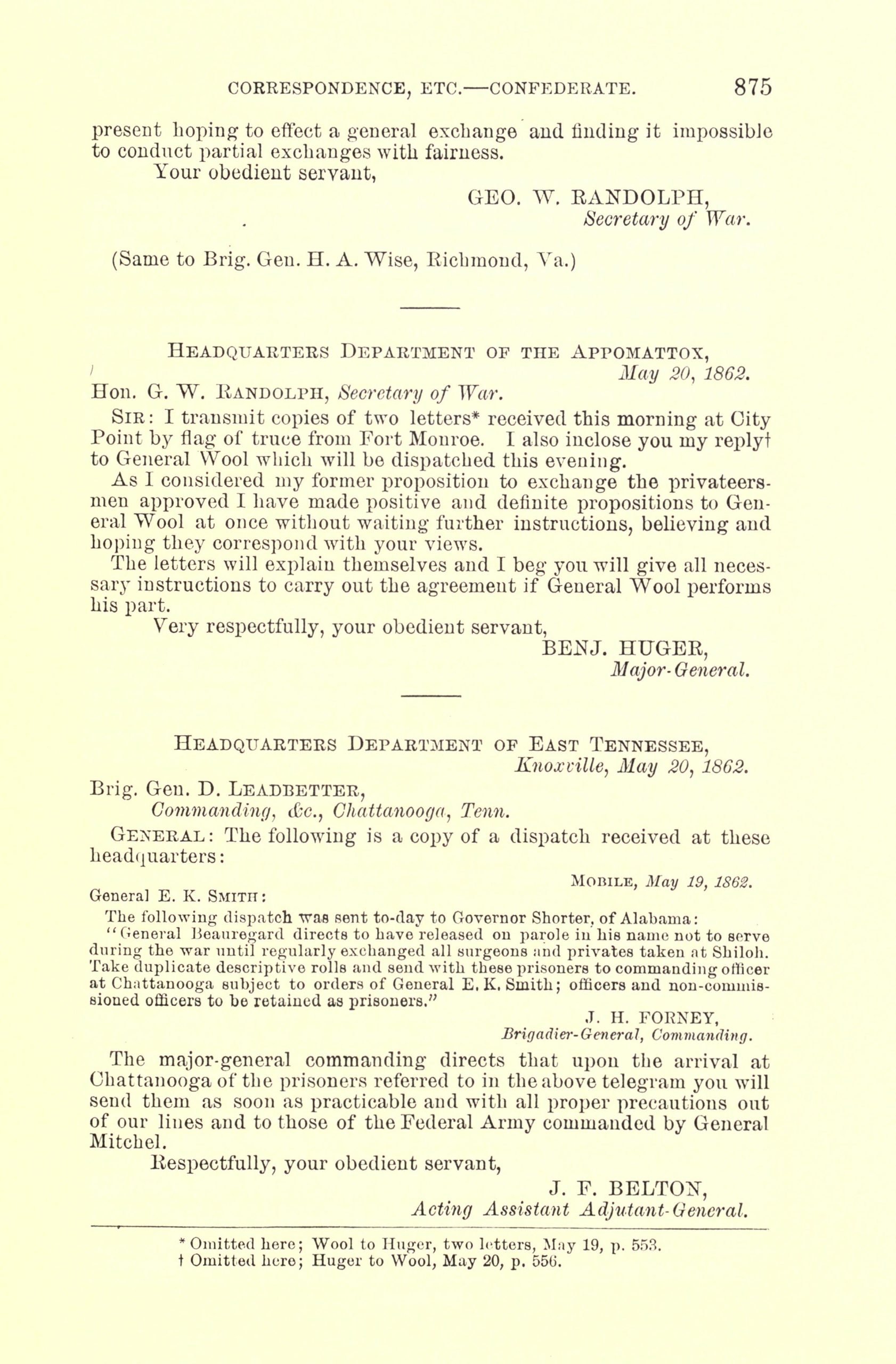
The individual swap never closed. On the very page of the Official Records that prints von Scheliha’s offer, two documents below it, the Confederate Secretary of War set down the reason in a circular reply to two other applicants. Richmond had just stopped trading man for man.
“The Government has ceased to grant individual exchanges at present.”
Randolph’s ruling is dated two days after von Scheliha wrote. It sits directly beneath the Gibbs correspondence on printed page 874. The offer and its refusal share a single page.
SIR: In reply to your letter of the 4th instant you are respectfully informed the Government has ceased to grant individual exchanges at present hoping to effect a general exchange and finding it impossible to conduct partial exchanges with fairness.
Your obedient servant,
(Same to Brig. Gen. H. A. Wise, Richmond, Va.)
Official Records, Series II, Vol. III (Serial 116), pp. 874 to 875
So Gibbs was not freed by a private bargain. The proposal from Fort Warren arrived in the exact week that Richmond abandoned man-for-man trades. Whatever became of him now would be decided not by one officer’s plea, but by the wholesale ledger of the general exchange.
✦
Freed
Fort Wayne, Michigan · August 1862
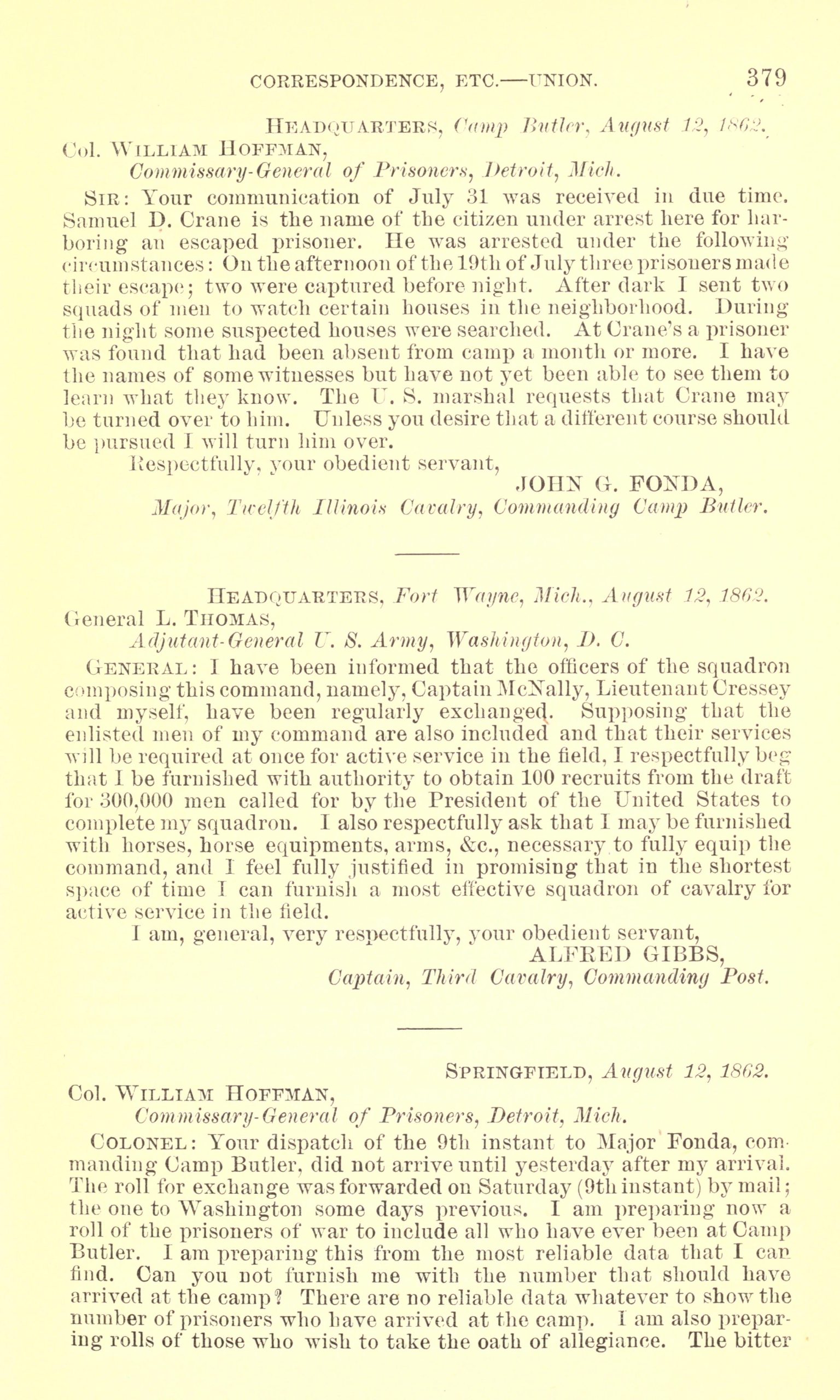
The order settled his legal status; this last document shows what he did with it. Word of the exchange ran ahead of the printed page, and on August 12, two full weeks before General Orders No. 118 was even issued, Gibbs already had it. He did not ask for leave. He asked for horses.
GENERAL: I have been informed that the officers of the squadron composing this command, namely, Captain McNally, Lieutenant Cressey and myself, have been regularly exchanged. Supposing that the enlisted men of my command are also included and that their services will be required at once for active service in the field, I respectfully beg that I be furnished with authority to obtain 100 recruits from the draft for 300,000 men called for by the President of the United States to complete my squadron. I also respectfully ask that I may be furnished with horses, horse equipments, arms, &c., necessary to fully equip the command, and I feel fully justified in promising that in the shortest space of time I can furnish a most effective squadron of cavalry for active service in the field.
I am, general, very respectfully, your obedient servant,
Official Records, Series II, Vol. IV (Serial 117), p. 379
Located, July 2026: a second letter from the same desk completes the picture, and here it is in full. On August 27, 1862 - the very day General Orders No. 118 declared him exchanged - Gibbs sat down at Fort Wayne and wrote Thomas Hillhouse, adjutant general of New York. He was working both chains of command at once: the Regular Army for a squadron, his home state for a regiment. It was New York that answered.
General,
Having received official information from the War Department that my exchange has been effected, and that I am free to go to duty, I have the honor respectfully to offer my services to His Excellency the Governor of the State of New York - my native State - in command of a Regiment. It will perhaps be remembered that I was commissioned as Colonel of the 8th Regt. N. Y. Vol’r Cavalry, which I was unable to accept while a prisoner of war on parole.
I am, General, very respectfully, Your obt servt,
[Addressed:] Gen. Thos. Hillhouse, Adjutant General N. York, Albany, N. Y.
Gilder Lehrman Collection, GLC02465.12 (autograph letter signed, 1 page)
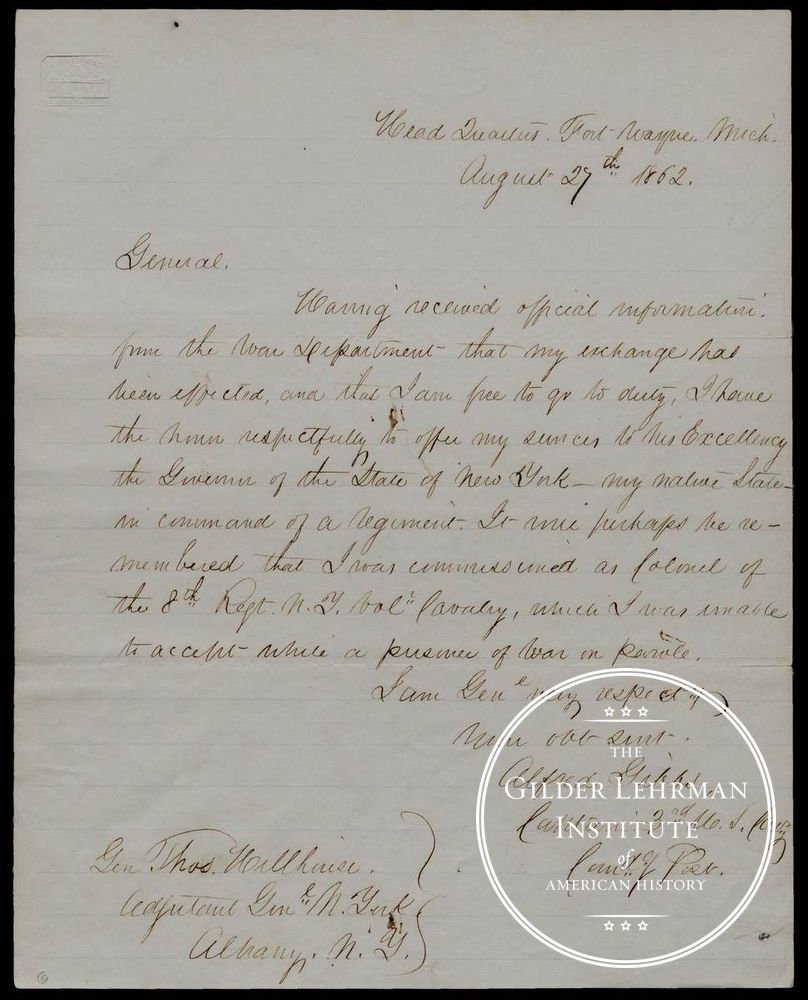
The rest came fast. Freed on paper on August 27, he sat in early September on a court of inquiry at Alton, Illinois, into the escape of thirty-six prisoners of war. Then, on September 6, 1862, the War Department made him colonel of the 130th New York. He had told the Adjutant-General in August exactly what he meant to do with a command, and within the year he did it: the 130th New York was converted to cavalry and became the First New York Dragoons. The horses he asked for from Fort Wayne, he got.
What this record settles
How the exchange is known. There is no secret source behind Cullum’s exchange date. It is War Department General Orders No. 118 of August 27, 1862, shown above, which names Gibbs and his Confederate counterpart on the same day Cullum records. The parole and the exchange entered history because the War Department printed the correspondence and the orders, and anyone may now read them on the pages shown here.
Who is documented pressing for his release. The men who appear in this file working for Gibbs’s exchange are Gibbs himself, Senator Jacob M. Howard of Michigan, and William Gray of Detroit, the city where Gibbs commanded Fort Wayne on parole. His brother George Gibbs, who two years later organized the campaign for Alfred’s brigadier’s star, does not appear anywhere in this exchange correspondence. The documented advocacy of 1862 was local and Michigan-born.
A step the archive can add. The Adjutant General’s own Register of Letters Received places Gibbs’s case on the desk in Washington in this very week: an entry dated May 14, 1862 reads “Gibbs, Capt. 3d Cav.,” cross-referenced to letter 445 W, three days before Colonel Dimick wrote from Fort Warren. The register is at the National Archives, RG 94, microfilm M711, roll 35; the letter it points to (445 W) is filed in the Adjutant General’s Letters Received and is not yet digitized.
A note on the citation
The petition and the von Scheliha offer are in Series II, Volume III (Serial 116), the volume of prisoner-of-war correspondence from February 19, 1861 to June 12, 1862; its title page and running foot read “Series II, Vol. III.” The Howard, Gibbs, and Gray letters are on pages 368 to 369, and von Scheliha and Dimick on page 874. (This correspondence is often miscited to Volume 4.) The exchange itself, General Orders No. 118, and Gibbs’s August letter are in the next volume, Series II, Volume IV (Serial 117), on pages 437 to 438 and page 379. The full volumes are Series II, Volumes III and IV of the Official Records.
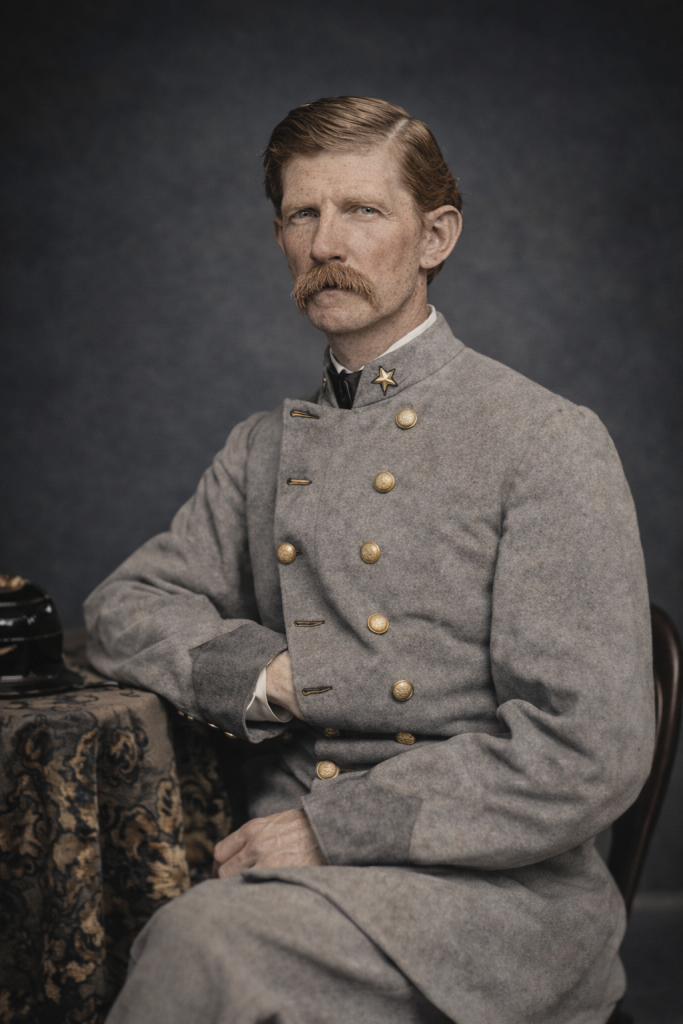
Born in Berlin in June 1826, Viktor von Scheliha led a life marked by military engineering and international migration. A graduate of the Prussian Military Academy in 1844, he brought his expertise across the Atlantic, immigrating to the United States in the early 1850s. He first established roots in Texas, later relocating to Louisiana.
When the Civil War erupted he offered his specialized skills to the Confederacy, rising to chief engineer for the Department of the Gulf. In that role he was charged with constructing the extensive defenses around Mobile, Alabama, a vital Confederate port. He designed and supervised key fortifications, including Fort Stonewall and Fort Sidney Johnston, and was known for innovative river defenses that placed heavy artillery in chambers sunk into the natural ground, terraced positions that proved effective against Union naval forces.
After the war he briefly returned to Prussia, then settled at last in Seattle, Washington, where he taught mathematics and languages. In 1903 he applied for admission to the Soldiers’ Home of Louisiana. His legacy as a military engineer endures in the records of his Civil War service preserved at the National Archives.
Views: 113
Explore the evidence
View this article’s connected sources and media →
About this page
This article was brought over from AlfredGibbs.com. Its preserved text, media and citations remain available for comparison.