
Read the original · Check the transcription
Gibbs Family Papers, Reel 1, frame 396 (reading copy)
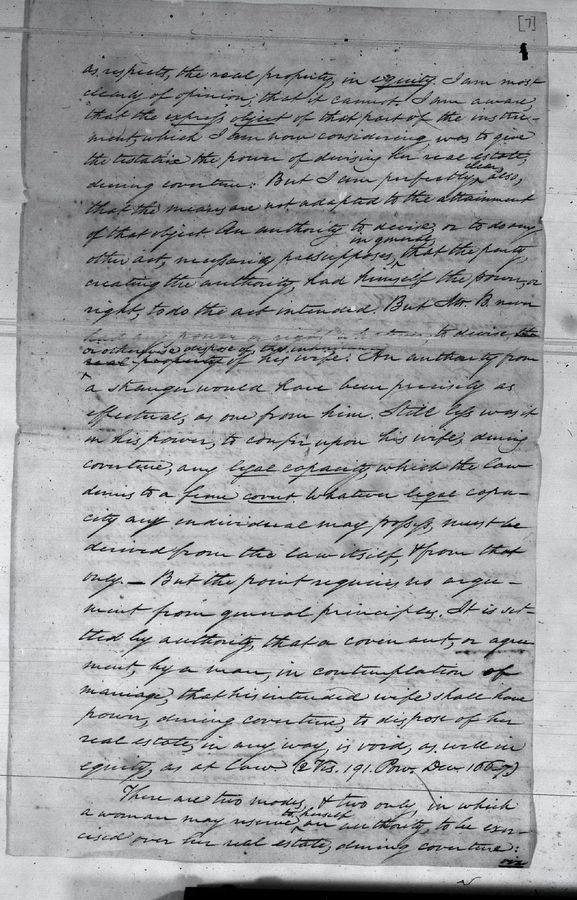
Preserved transcription
Transcription matched to this Wisconsin microfilm frame. Preserved from the supplied frame transcription; compare uncertain readings with the scan.
[7]
as respects, the real property, in equity, I am most
clearly of opinion, that it cannot. I am aware,
that the express object of that part of the instru-
ment, which I am now considering, was to give
the testatrix the power of devising her real estate,
during coverture. But I am perfectly [inserted: clear] also,
that the means are not adapted to the attainment
of that object. An authority to devise, or to do any
other act, necessarily presupposes, [inserted: in general,] that the party
creating the authority, had himself the power, or
right, to do the act intended. But Mr. B. never
had any power or right whatever, to devise, [struck: the]
[inserted: or otherwise dispose of, the inheritance[?]] [struck: real property] of his wife. An authority from
a stranger would have been precisely as
effectual, as one from him. Still less was it
in his power, to confer upon his wife, during
coverture, any legal capacity, which the law
denies to a feme covert. Whatever legal capa-
city any individual may possess, must be
derived from the law itself, & from that
only. — But the point requires no argu-
ment from general principles. It is set-
tled by authority, that a covenant, or agree-
ment, by a man, in contemplation of
marriage, that his intended wife shall have
power, during coverture, to dispose of her
real estate, in any way, is void, as well in
equity, as at law. (2 Ves. 191. Pow. Dev. 166-7.)
There are two modes, & two only, in which
a woman may reserve [inserted: to herself] an authority, to be exer-
cised over her real estate, during coverture:
viz
Wisconsin Historical Society · WHS-R1-396 · " ""Opinion"" (p1)" (legal), 1816, July 25 (docket)
Open the complete archive frame record →