
Read the original · Check the transcription
Gibbs Family Papers, Reel 2, frame 3916 (reading copy)
Preserved transcription
Transcription matched to this Wisconsin microfilm frame. Preserved from the supplied frame transcription; compare uncertain readings with the scan.
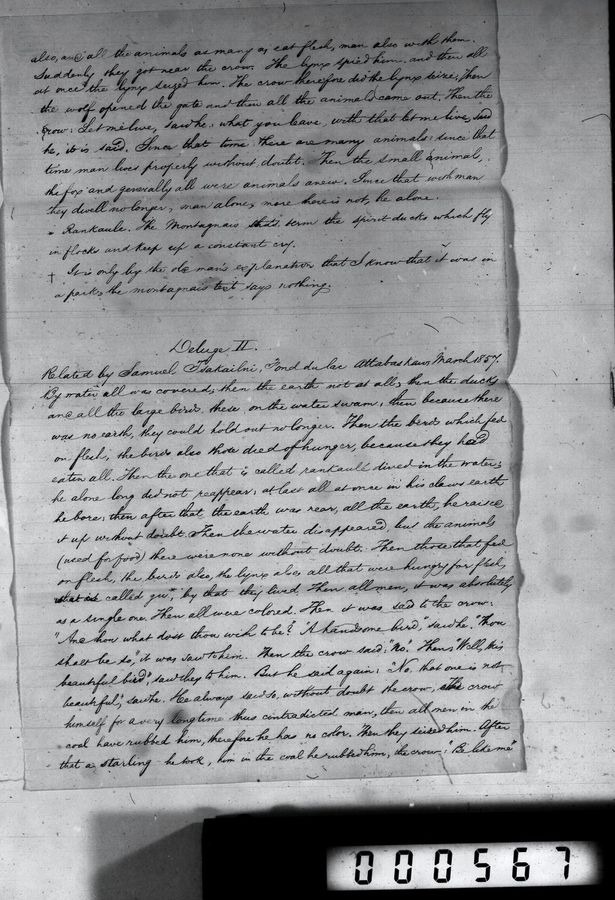
also, and all the animals as many as eat flesh, man also with them.
Suddenly they got near the crow. The lynx spied him. and then all
at once the lynx seized him. The crow therefore did the lynx seize, Then
the wolf opened the gate and then all the animals came out. Then the
crow: Let me live, said he: what you leave, with that let me live, said
he, it is said. Since that time there are many animals: since that
time man lives properly without doubt. Then the small animal,
the fox and generally all were animals anew. Since that with man
they dwell no longer, man alone, more there is not, he alone.
* Rankaule. The Montagnais thus[?] term the spirit ducks which fly
in flocks and keep up a constant cry.
† It is only by the old man's explanation that I know that it was in
a park, the montagnais text says nothing.
Deluge II.
Related by Samuel Tsakailni, Fond du lac Attabaskaws March 1857.
By water all was covered; then the earth not at all; then the ducks
and all the large birds, these on the water swam; then because there
was no earth, they could hold out no longer. Then the birds which fed
on flesh, the birds also those died of hunger, because they had
eaten all. Then the one that is called rankaulé dived in the water;
he alone long did not reappear; at last all at once in his claws earth
he bore; then after that the earth was rear[?], all the earth, he raised
it up without doubt. Then the water disappeared, but the animals
(used for food) there were none without doubt. Then those that fed
on flesh, the birds also, the lynx also, all that were hungry for flesh,
what is[?] called gu*, by that they lived. Then all men, it was absolutely
as a single one. Then all were colored. Then it was said to the crow:
"And thou what dost thou wish to be?" "A handsome bird," said he. "Thou
shalt be so," it was said to him. Then the crow said: "No." Then; "Well, this
beautiful bird", said they to him. But he said again: "No, that one is not
beautiful," said he. He always said so, without doubt the crow, the[?] crow
himself for a very long time thus contradicted man, then all men in the
coal have rubbed him, therefore he has no color. Then they seized him. After
that a starling he took, him in the coal he rubbed him, the crow: "Be like me"
Wisconsin Historical Society · WHS-R2-3916 · George Gibbs IV (manuscript volume, n.p.), 1856 (Olympia) and later additions
Open the complete archive frame record →