
Read the original · Check the transcription
Gibbs Family Papers, Reel 2, frame 3797 (reading copy)
Preserved transcription
Transcription matched to this Wisconsin microfilm frame. Preserved from the supplied frame transcription; compare uncertain readings with the scan.
[page number: 151]
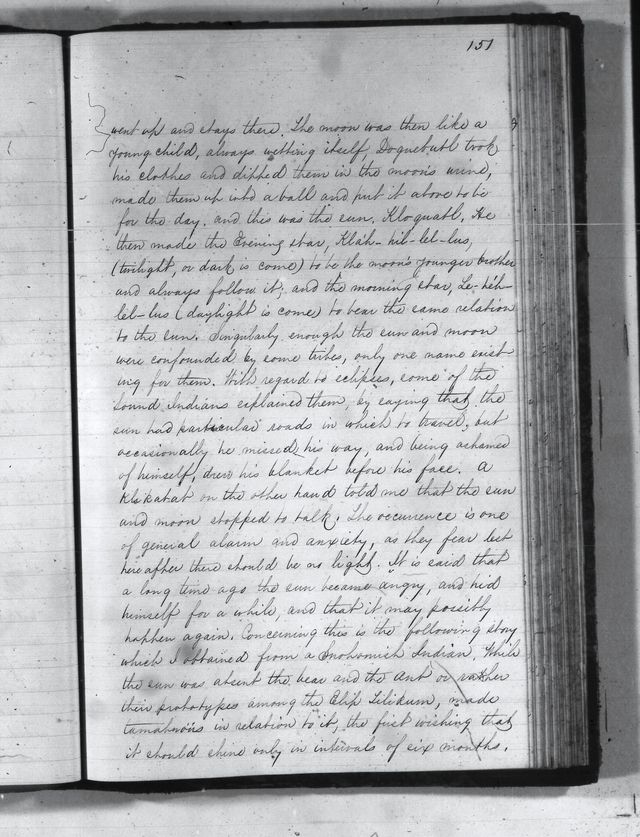
went up and stays there. The moon was then like a
young child, always wetting itself, Doquebutl[?] took
his clothes and dipped them in the moon's urine,
made them up into a ball and put it above to be
for the day, and this was the sun, Kloquatl[?]. He
then made the Evening star, Kláh-hil-lel-lus,
(twilight, or dark is come) to be the moon's younger brother
and always follow it; and the morning star, Le-kéh[?]-
lel-lus (daylight is come) to bear the same relation
to the sun. Singularly enough the sun and moon
were confounded by some tribes, only one name exist-
ing for them. With regard to eclipses, some of the
Sound Indians explained them, by saying that the
sun had particular roads in which to travel, but
occasionally he missed his way, and being ashamed
of himself, drew his blanket before his face. A
Klikatat on the other hand told me that the sun
and moon stopped to talk. The occurrence is one
of general alarm and anxiety, as they fear lest
hereafter there should be no light. It is said that
a long time ago the sun became angry, and hid
himself for a while, and that it may possibly
happen again. Concerning this is the following story
which I obtained from a Snohomish Indian. While
the sun was absent the bear and the ant or rather
their prototypes among the Elip Tilikum[?], made
tamahnoüs[?] in relation to it, the first wishing that
it should shine only in intervals of six months.
Wisconsin Historical Society · WHS-R2-3797 · George Gibbs IV (manuscript volume, ms p. 151), 1856 (Olympia) and later additions
Open the complete archive frame record →