
Read the original · Check the transcription
Gibbs Family Papers, Reel 2, frame 3746 (reading copy)
Preserved transcription
Transcription matched to this Wisconsin microfilm frame. Preserved from the supplied frame transcription; compare uncertain readings with the scan.
[page number, top right: 104]
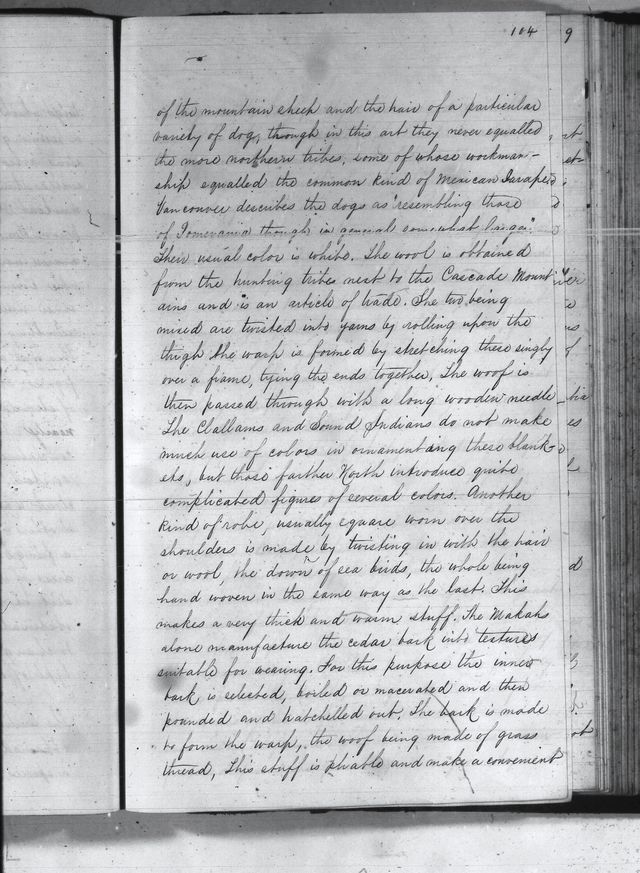
of the mountain sheep and the hair of a particular
variety of dog; though in this art they never equalled
the more northern tribes, some of whose workman-
ship equalled the common kind of Mexican Sarapes[?].
Vancouver describes the dogs as 'resembling those
of Pomerania though in general somewhat larger."
Their usual color is white. The wool is obtained
from the hunting tribes next to the Cascade Mount-
ains and is an article of trade. The two being
mixed are twisted into yarns by rolling upon the
thigh The warp is formed by stretching these singly
over a frame, tying the ends together, The woof is
then passed through with a long wooden needle
The Clallams and Sound Indians do not make
much use of colors in ornamenting these blank-
ets, but those farther North introduce quite
complicated figures of several colors. Another
kind of robe, usually square worn over the
shoulders is made by twisting in with the hair
or wool, the down of sea birds, the whole being
hand woven in the same way as the last. This
makes a very thick and warm stuff. The Makahs
alone manufacture the cedar bark into textures
suitable for wearing. For this purpose the inner
bark is selected, boiled or macerated and then
pounded and hatchelled out. The bark is made
to form the warp, the woof being made of grass
thread, This stuff is pliable and make a convenient
Wisconsin Historical Society · WHS-R2-3746 · George Gibbs IV (manuscript volume, ms p. 104), 1856 (Olympia) and later additions
Open the complete archive frame record →