
Read the original · Check the transcription
Gibbs Family Papers, Reel 2, frame 1711 (reading copy)
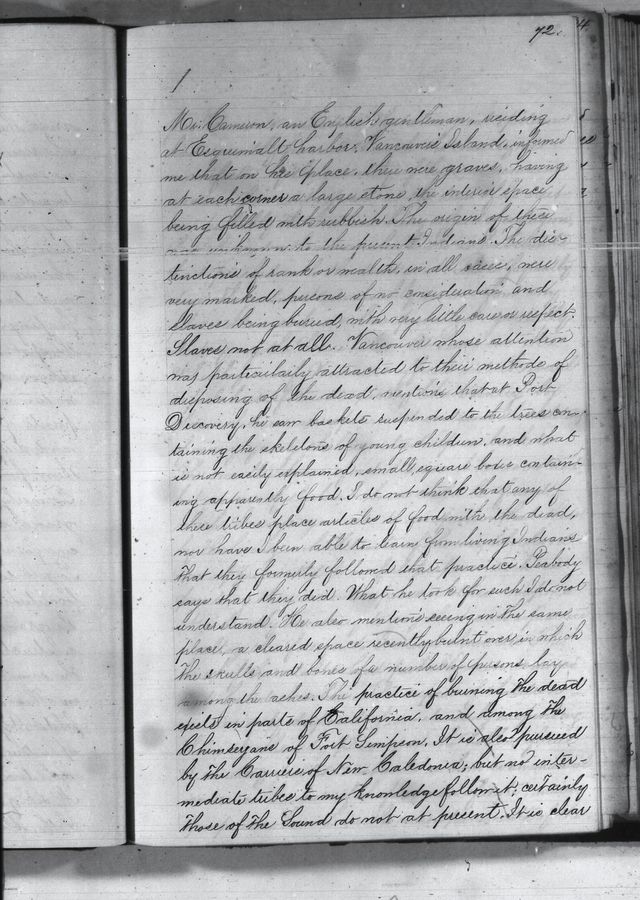
Preserved transcription
Transcription matched to this Wisconsin microfilm frame. Preserved from the supplied frame transcription; compare uncertain readings with the scan.
[margin, top right: 72.]
1.
Mr. Cameron, an English gentleman, residing
at Esquimalt harbor, Vancouver's Island, informed
me that on his place, there were graves, having
at each corner a large stone, the interior space
being filled with rubbish. The origin of these
was unknown to the present Indians. The dis-
tinctions of rank or wealth, in all cases, were
very marked, persons of no consideration and
slaves being buried, with very little care or respect.
Slaves not at all. Vancouver whose attention
was particularly attracted to their methods of
disposing of the dead, mentions that at Port
Discovery, he saw baskets suspended to the trees con-
taining the skeletons of young children, and what
is not easily explained, small, square boxes contain-
ing apparently food. I do not think that any of
these tribes place articles of food with the dead,
nor have I been able to learn from living Indians
that they formerly followed that practice. Peabody[?]
says that they did. What he took for such I do not
understand. He also mentions seeing in the same
place, a cleared space recently burnt over, in which
the skulls and bones of a number of persons lay
among the ashes. The practice of burning the dead
exists in parts of California, and among the
Chimseyans[?] of Fort Simpson. It is also pursued
by the Carriers of New Caledonia; but no inter-
mediate tribes to my knowledge follow it; certainly
those of the Sound do not at present. It is clear
Wisconsin Historical Society · WHS-R2-1711 · George Gibbs ms. draft on Washington Territory Indians (notebook p.61) (document), n.d. (c.1854-57?)
Open the complete archive frame record →