
Read the original · Check the transcription
Gibbs Family Papers, Reel 2, frame 1708 (reading copy)
Preserved transcription
Transcription matched to this Wisconsin microfilm frame. Preserved from the supplied frame transcription; compare uncertain readings with the scan.
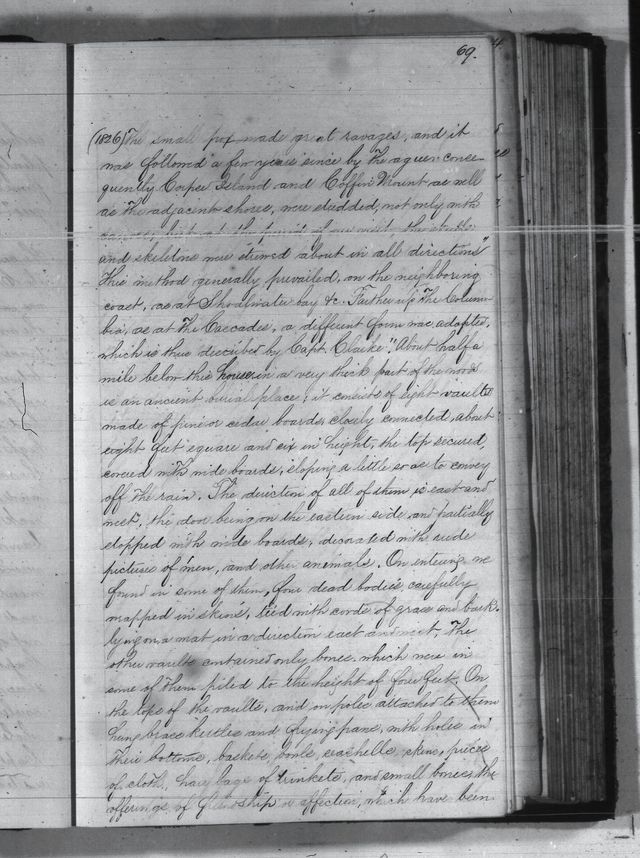
(1826) The small pox made great ravages, and it
was followd[?] a few years since by the ague. Conse-
quently Corpse Island and Coffin Mount as well
as the adjacent shores, were studded, not only with
canoes, but at the period of our visit, the skulls[?]
and skeletons were strewed about in all directions"
This method generally prevailed, on the neighboring
coast, as at Shoalwater bay &c. Farther up the Colum-
bia, as at the Cascades, a different form was adopted,
which is thus described by Capt. Clarke": "About half a
mile below this house in a very thick part of the woods
is an ancient burial place; it consists of eight vaults
made of pine or cedar boards closely connected, about
eight feet square and six in height, the top secured,
covered with wide boards, sloping a little so as to convey
off the rain. The direction of all of them is east and
west, the door being on the eastern side and partially
stopped with wide boards, decorated with rude
pictures of men, and other animals. On entering we
found in some of them, four dead bodies, carefully
wrapped in skins, tied with cords of grass and bark.
lying on a mat in a direction east and west; the
other vaults contained only bones which were in
some of them piled to the height of four feet. On
the tops of the vaults, and on poles attached to them
hung brass kettles and frying pans, with holes in
their bottoms, baskets, bowls, seashells, skins, pieces
of cloth, hair bags of trinkets, and small bones, the
offerings of friendship or affection, which have been
Wisconsin Historical Society · WHS-R2-1708 · George Gibbs ms. draft on Washington Territory Indians (notebook p.61) (document), n.d. (c.1854-57?)
Open the complete archive frame record →