
Read the original · Check the transcription
Gibbs Family Papers, Reel 2, frame 1695 (reading copy)
Preserved transcription
Transcription matched to this Wisconsin microfilm frame. Preserved from the supplied frame transcription; compare uncertain readings with the scan.
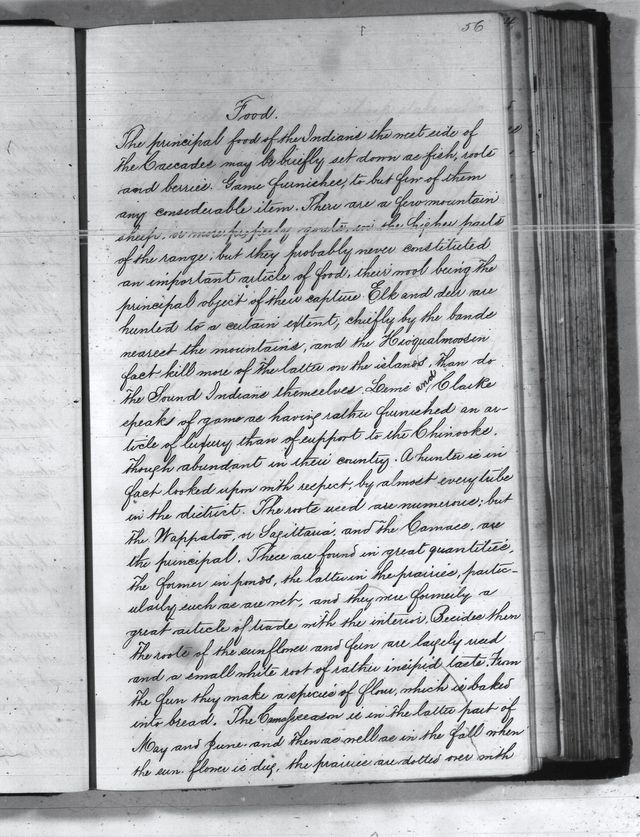
[page number, top right: 56]
Food.
The principal food of the Indians the west side of
the Cascades may be briefly set down as fish, roots
and berries. Game furnishes, to but few of them
any considerable item. There are a few mountain
sheep, or more properly goats, on[?] the higher parts
of the range, but they probably never constituted
an important article of food, their wool being the
principal object of their capture. Elk and deer are
hunted to a certain extent, chiefly by the bands
nearest the mountains, and the Snoqualmoos[?] in
fact kill more of the latter on the islands, than do
the Sound Indians themselves. Lewis [inserted: and] Clarke
speaks of game as having rather furnished an ar-
ticle of luxury than of support to the Chinooks.
though abundant in their country. A hunter is in
fact looked upon with respect, by almost every tribe
in the district. The roots used are numerous; but
the Wappatoo, or Sagittaria, and the Camass, are
the principal. These are found in great quantities,
the former in ponds, the latter in the prairies, partic-
ularly such as are wet, and they were formerly a
great article of trade with the interior. Besides them[?]
the roots of the sunflower and fern are largely used
and a small white root of rather insipid taste. From
the fern they make a species of flour, which is baked
into bread. The Camasseason is in the latter part of
May and June, and then as well as in the fall when
the sun-flower is dug, the prairies are dotted over with
Wisconsin Historical Society · WHS-R2-1695 · Manuscript (George Gibbs ethnography)
Open the complete archive frame record →