
Read the original · Check the transcription
Gibbs Family Papers, Reel 2, frame 1694 (reading copy)
Preserved transcription
Transcription matched to this Wisconsin microfilm frame. Preserved from the supplied frame transcription; compare uncertain readings with the scan.
[page number, top right: 55]
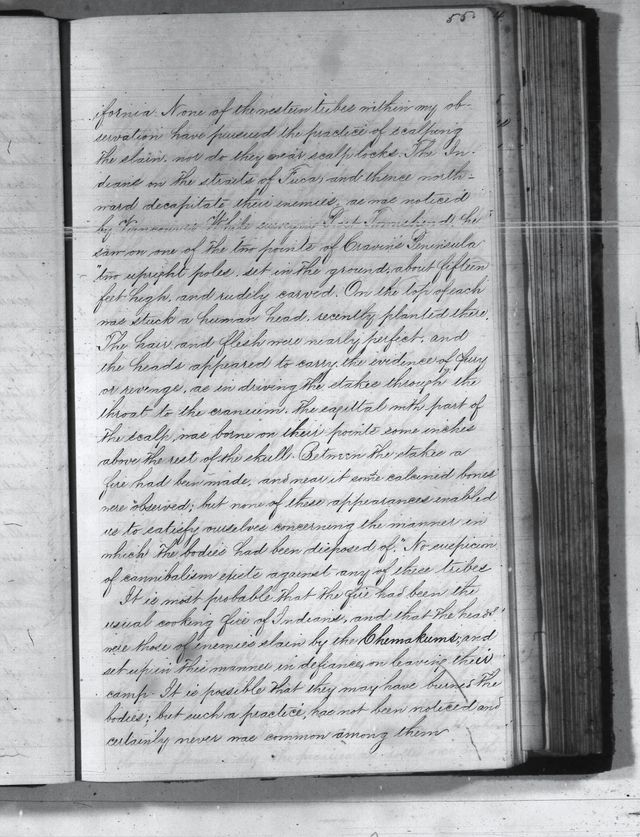
ifornia. None of the western tribes within my ob-
servation have pursued the practice of scalping
the slain. nor do they wear scalplocks. The In-
dians on the straits of Fuca, and thence north-
ward decapitate their enemies, as was noticed
by Vancouver[?] While surveying[?] Port Townshend[?]. he
saw on one of the two points of Craven's[?] Peninsula
"two upright poles. set in the ground, about fifteen
feet high, and rudely carved. On the top of each
was stuck a human head, recently planted there.
The hair and flesh were nearly perfect, and
the heads appeared to carry the evidence of fury
or revenge, as in driving the stakes through the
throat to the cranium. the sagittal[?] with part of
the scalp, was borne on their points some inches
above the rest of the skull. Between the stakes a
fire had been made, and near it some calcined bones
were observed; but none of these appearances enabled
us to satisfy ourselves concerning the manner in
which the bodies had been disposed of." No suspicion
of cannibalism exists against any of these tribes
It is most probable that the fire had been the
usual cooking fire of Indians, and that the heads
were those of enemies slain by the Chemakums; and
set up in this manner in defiance, on leaving their
camp. It is possible that they may have burned the
bodies; but such a practice, has not been noticed and
certainly never was common among them
Wisconsin Historical Society · WHS-R2-1694 · Manuscript (George Gibbs ethnography)
Open the complete archive frame record →