
Read the original · Check the transcription
Gibbs Family Papers, Reel 2, frame 1686 (reading copy)
Preserved transcription
Transcription matched to this Wisconsin microfilm frame. Preserved from the supplied frame transcription; compare uncertain readings with the scan.
[page number, top right:] 48.
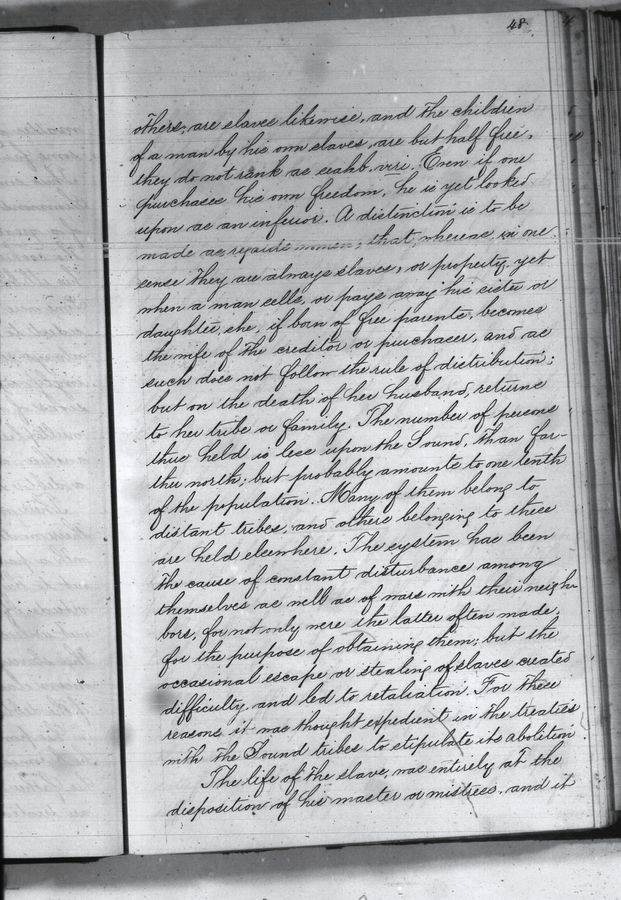
others; are slaves likewise, and the children
of a man by his own slaves, are but half free,
they do not rank as saahb. wis[?]. Even if one
purchases his own freedom, he is yet looked
upon as an inferior. A distinction is to be
made as regards women; that, whereas in one
sense they are always slaves, or property, yet
when a man sells, or pays away his sister or
daughter, she, if born of free parents, becomes
the wife of the creditor or purchaser, and as
such does not follow the rule of distribution;
but on the death of her husband, returns
to her tribe or family. The number of persons
thus held is less upon the Sound, than far-
ther north; but probably amounts to one tenth
of the population. Many of them belong to
distant tribes, and others belonging to these
are held elsewhere. The system has been
the cause of constant disturbance among
themselves as well as of wars with their neigh-
bors, for not only were the latter often made,
for the purpose of obtaining them; but the
occasional escape or stealing of slaves created
difficulty, and led to retaliation. For these
reasons it was thought expedient in the treaties
with the Sound tribes to stipulate its abolition.
The life of the slave, was entirely at the
disposition of his master or mistress. and it
Wisconsin Historical Society · WHS-R2-1686 · Manuscript (George Gibbs ethnography)
Open the complete archive frame record →