
Read the original · Check the transcription
Gibbs Family Papers, Reel 2, frame 1685 (reading copy)
Preserved transcription
Transcription matched to this Wisconsin microfilm frame. Preserved from the supplied frame transcription; compare uncertain readings with the scan.
[page number, top right: 47.]
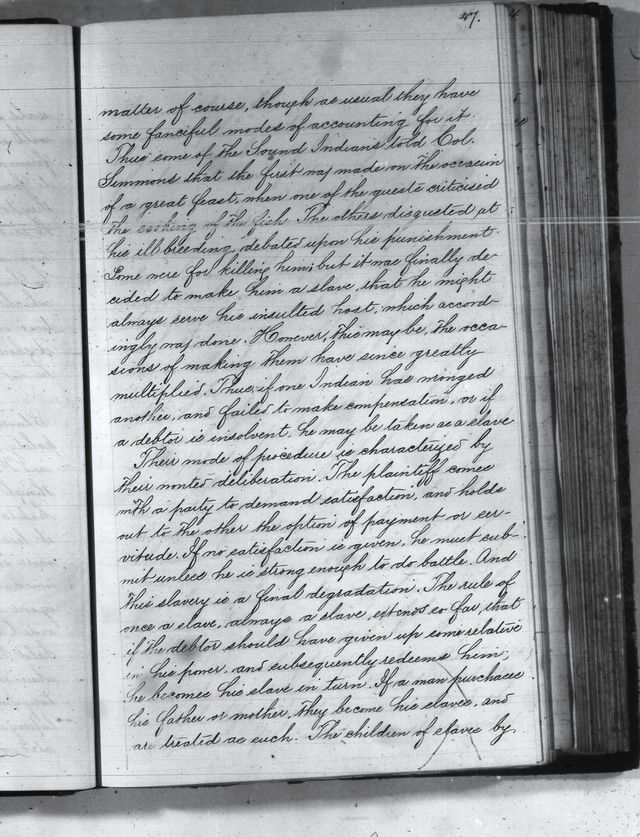
matter of course, though as usual they have
some fanciful modes of accounting for it.
Thus some of the Sound Indians told Col.
Simmons that the first was made on the occasion
of a great feast, when one of the guests criticised
the cooking of the fish. The others disgusted at
his ill breeding, debated upon his punishment.
Some were for killing him; but it was finally de-
cided to make him a slave, that he might
always serve his insulted host, which accord-
ingly was done. However, this may be, the occa-
sions of making them have since greatly
multiplied. Thus, if one Indian has wronged
another, and failed to make compensation, or if
a debtor is insolvent, he may be taken as a slave
Their mode of procedure is characterized by
their wonted deliberation. The plaintiff comes
with a party to demand satisfaction, and holds
out to the other the option of payment or ser-
vitude. If no satisfaction is given, he must sub-
mit unless he is strong enough to do battle. And
This slavery is a final degradation. The rule of
once a slave, always a slave, extends so far, that
if the debtor should have given up some relative
in his power, and subsequently redeems him,
he becomes his slave in turn. If a man purchases
his father or mother, they become his slaves, and
are treated as such. The children of slaves by
Wisconsin Historical Society · WHS-R2-1685 · Manuscript (George Gibbs ethnography)
Open the complete archive frame record →