
Read the original · Check the transcription
Gibbs Family Papers, Reel 2, frame 1674 (reading copy)
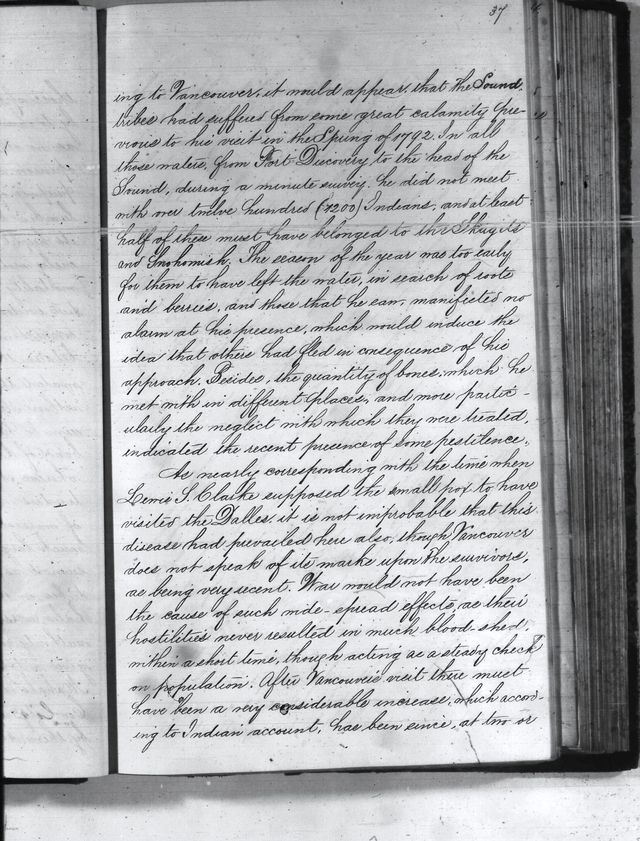
Preserved transcription
Transcription matched to this Wisconsin microfilm frame. Preserved from the supplied frame transcription; compare uncertain readings with the scan.
[page number, top right: 37]
ing to Vancouver, it would appear, that the Sound
tribes had suffered from some great calamity pre-
vious to his visit in the Spring of 1792. In all
those waters, from Port Discovery, to the head of the
Sound, during a minute survey, he did not meet
with over twelve hundred (1200) Indians; and at least
half of these must have belonged to the Skagits
and Snohomish. The season of the year was too early
for them to have left the water, in search of roots
and berries, and those that he saw, manifested no
alarm at his presence, which would induce the
idea that others had fled in consequence of his
approach. Besides, the quantity of bones, which he
met with in different Places[?], and more partic-
ularly the neglect with which they were treated,
indicated the recent presence of some pestilence.
As nearly corresponding with the time when
Lewis &[?] Clarke supposed the small pox to have
visited the Dalles, it is not improbable that this
disease had prevailed here also, though Vancouver
does not speak of its marks upon the survivors,
as being very recent. War would not have been
the cause of such wide-spread effects, as their
hostilities never resulted in much blood-shed,
within a short time, though acting as a steady check
on population. After Vancouver's[?] visit there must
have been a very considerable increase, which accord-
ing to Indian account, has been since, at two or
Wisconsin Historical Society · WHS-R2-1674 · George Gibbs manuscript, ethnography of Washington Territory Indians (notebook p.29), n.d. [c.1856]
Open the complete archive frame record →