
Read the original · Check the transcription
Gibbs Family Papers, Reel 2, frame 1575 (reading copy)
Preserved transcription
Transcription matched to this Wisconsin microfilm frame. Preserved from the supplied frame transcription; compare uncertain readings with the scan.
[page number, top right:] 43
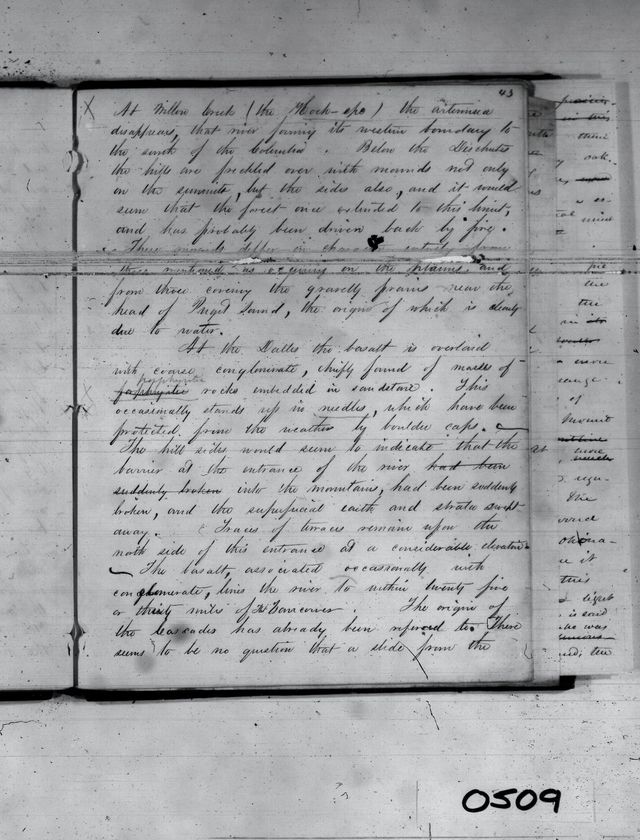
At Willow Creek (the Hock-ope[?]) the artemisia
disappears, that river forming its western boundary to
the south of the Columbia. Below the Deschutes
the hills are freckled over with mounds not only
on the summits, but the sides also, and it would
seem that the forest once extended to this limit,
and has probably been driven back by fire.
These mounds differ in character entirely from
those mentioned as occuring[?] on the plains and
from those covering the gravelly prairies near the
head of Puget Sound, the origin of which is clearly
due to water.
At the Dalles the basalt is overlaid
with coarse conglomerate, chiefly formed of masses of
[struck: porphyritic[?]] [inserted: porphyritic] rocks embedded in sandstone. This
occasionally stands up in needles, which have been
protected from the weather by boulder caps. —
The hill sides would seem to indicate that the
barrier at the entrance of the river [struck: had been
suddenly broken] into the mountains, had been suddenly
broken, and the superficial earth and strata swept
away. Traces of terraces remain upon the
north side of this entrance at a considerable elevation.
— The basalt, associated occasionally with
conglomerate, lines the river to within twenty five
or thirty miles of Ft Vancouver. The origin of
the Cascades has already been referred to. There
seems to be no question that a slide from the
Wisconsin Historical Society · WHS-R2-1575 · George Gibbs draft report (geology, upper Columbia) (document), n.d. [c.1853-54]
Open the complete archive frame record →