
Read the original · Check the transcription
Gibbs Family Papers, Reel 2, frame 1564 (reading copy)
Preserved transcription
Transcription matched to this Wisconsin microfilm frame. Preserved from the supplied frame transcription; compare uncertain readings with the scan.
32
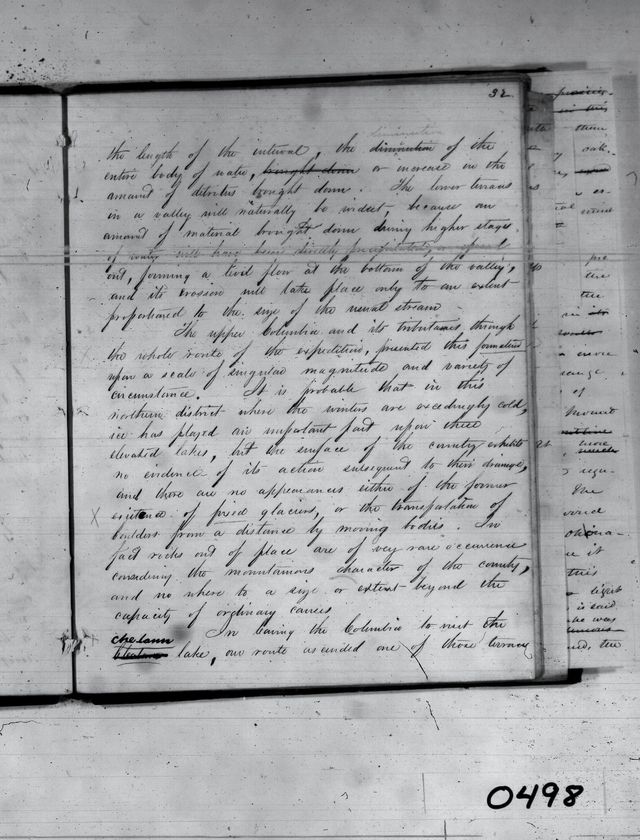
the length of the interval, the [struck: diminution] [inserted: diminution[?]] of the
entire body of water, [struck: brought down] or increase in the
amount of detritus brought down. The lower terraces
in a valley will naturally be widest, because an
amount of material brought down during higher stages
of water will have been directly precipitated, or spread[?]
out, forming a level floor at the bottom of the valley,
and its erosion will take place only to an extent
proportioned to the size of the usual stream.
The upper Columbia and its tributaries through
the whole route of the expedition, presented this formation
upon a scale of singular magnitude and variety of
circumstance. It is probable that in this
northern district where the winters are exceedingly cold,
ice has played an important part upon these
elevated lakes, but the surface of the country exhibits
no evidence of its action subsequent to their drainage,
and there are no appearances either of the former
existence of fixed glaciers, or the transportation of
boulders from a distance by moving bodies. In
fact rocks out of place are of very rare occurrence
considering the mountainous character of the country,
and no where to a size or extent beyond the
capacity of ordinary causes
In leaving the Columbia to visit the
[inserted: Chelann] [struck: Kleatam[?]] lake, our route ascended one of those terraces
[stamp: 0498]
Wisconsin Historical Society · WHS-R2-1564 · George Gibbs draft report (geology, upper Columbia) (document), n.d. [c.1853-54]
Open the complete archive frame record →