
Read the original · Check the transcription
Gibbs Family Papers, Reel 2, frame 1550 (reading copy)
Preserved transcription
Transcription matched to this Wisconsin microfilm frame. Preserved from the supplied frame transcription; compare uncertain readings with the scan.
18
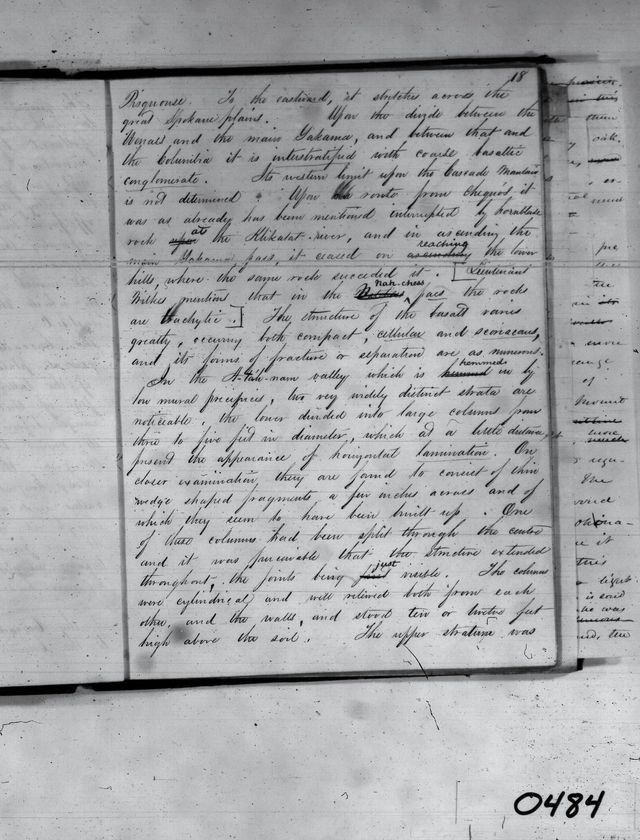
Pisquouse. To the eastward, it stretches across the
great Spokane plains. Upon the divide between the
Wenass and the main Yakama, and between that and
the Columbia it is interstratified with coarse basaltic
conglomerate. Its western limit upon the Cascade Mountains
is not determined. Upon our[?] route from Chequós[?] it
was as already has been mentioned interrupted by hornblende
rock [struck: upon] [inserted: at] the Klikatat river, and in ascending the
main Yakama pass, it ceased on [struck: ascending] [inserted: reaching] the lower
hills, where the same rock succeeded it. [Lieutenant
Wilkes mentions that in the [struck: Natches[?]] [inserted: Nah-chess] pass the rocks
are trachytic.] The structure of the basalt varies
greatly, occurring both compact, cellular and scoriaceous,
and its forms of fracture or separation are as numerous.
In the A-tah-nam valley which is [struck: hemmed[?]] [inserted: hemmed] in by
low mural precipices, two very widely distinct strata are
noticeable, the lower divided into large columns from
three to five feet in diameter, which at a little distance
present the appearance of horizontal lamination. On
closer examination they are found to consist of thin
wedge shaped fragments a few inches across and of
which they seem to have been built up. One
of these columns had been split through the centre
and it was perceivable that the structure extended
throughout, the joints being [struck: faint[?]] [inserted: just] visible. The columns
were cylindrical and well relieved both from each
other, and the walls, and stood ten or twelve feet
high above the soil. The upper stratum was
[stamp: 0484]
Wisconsin Historical Society · WHS-R2-1550 · George Gibbs draft report (McClellan Pacific RR survey), ms p.12 (document), c.1853-54
Open the complete archive frame record →