
Read the original · Check the transcription
Gibbs Family Papers, Reel 2, frame 1543 (reading copy)
Preserved transcription
Transcription matched to this Wisconsin microfilm frame. Preserved from the supplied frame transcription; compare uncertain readings with the scan.
12
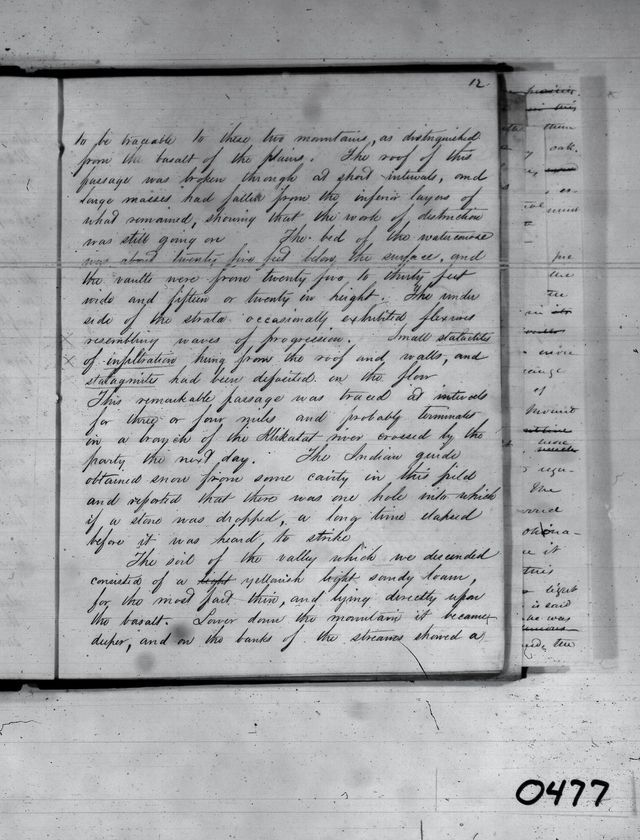
to be traceable to these two mountains, as distinguished
from the basalt of the plains. The roof of this
passage was broken through at short intervals, and
large masses had fallen from the inferior layers of
what remained, showing that the work of destruction
was still going on The bed of the watercourse
was about twenty five feet below the surface, and
the vaults were from twenty five to thirty feet
wide and fifteen or twenty in height. The under
side of the strata occasionally exhibited flexures
resembling waves of progression. Small stalactites
of infiltration hung from the roof and walls, and
stalagmites had been deposited on the floor
This remarkable passage was traced at intervals
for three or four miles and probably terminates[?]
in a branch of the Klikatat river crossed by the
party the next day. The Indian guide
obtained snow from some cavity in this field
and reported that there was one hole into which
if a stone was dropped, a long time elapsed
before it was heard to strike
The soil of the valley which we decended
consisted of a [struck: light] yellowish light sandy loam,
for the most part thin, and lying directly upon
the basalt. Lower down the mountain it became
deeper, and on the banks of the streams showed a
Wisconsin Historical Society · WHS-R2-1543 · George Gibbs draft report (McClellan Pacific RR survey), ms p.12 (document), c.1853-54
Open the complete archive frame record →