
Read the original · Check the transcription
Gibbs Family Papers, Reel 2, frame 1539 (reading copy)
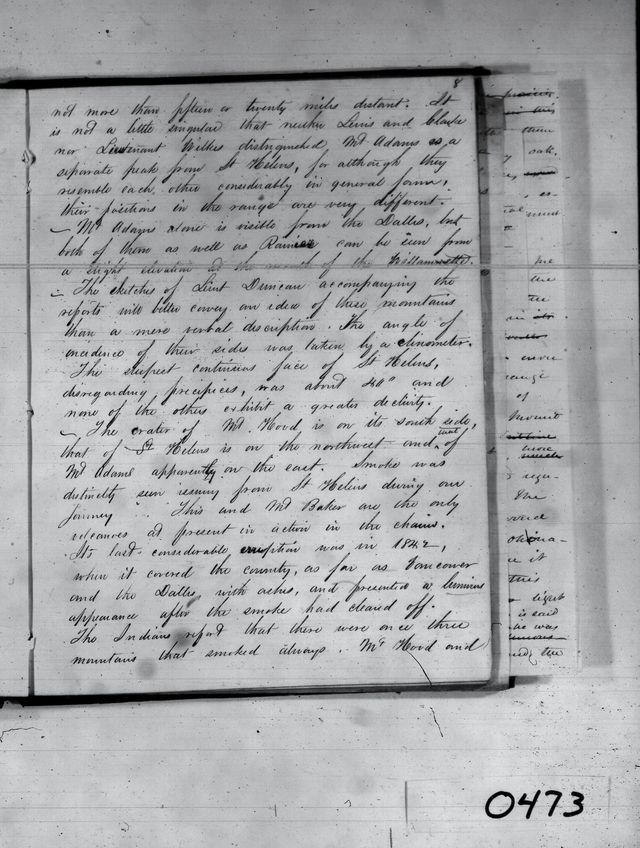
Preserved transcription
Transcription matched to this Wisconsin microfilm frame. Preserved from the supplied frame transcription; compare uncertain readings with the scan.
[page number: 8]
not more than fifteen or twenty miles distant. It
is not a little singular that neither Lewis and Clarke
nor Lieutenant Wilkes distinguished Mt Adams as a
separate peak from St Helens, for although they
resemble each other considerably in general form,
their positions in the range are very different.
Mt Adams alone is visible from the Dalles, but
both of them as well as Rainier can be seen from
a slight elevation at the mouth of the Willamette.
The sketches of Lieut Duncan accompanying the
reports will better convey an idea of these mountains
than a mere verbal description. The angle of
incidence of their sides was taken by a clinometer.
The steepest continuous face of St Helens,
disregarding precipices, was about 40° and
none of the others exhibit a greater declivity.
The crater of Mt Hood is on its south side,
that of St Helens is on the northwest and [inserted: that] of
Mt Adams apparently on the east. Smoke was
distinctly seen issuing from St Helens during our
journey. This and Mt Baker are the only
volcanoes at present in action in the chain.
Its last considerable eruption was in 1842,
when it covered the country, as far as Vancouver
and the Dalles with ashes, and presented a luminous
appearance after the smoke had cleared off.
The Indians report that there were once three
mountains that smoked always. Mt Hood and
Wisconsin Historical Society · WHS-R2-1539 · Letter from George to Capt. G. B. McClellan, 1854-05-01
Open the complete archive frame record →