
Read the original · Check the transcription
Gibbs Family Papers, Reel 2, frame 1173 (reading copy)
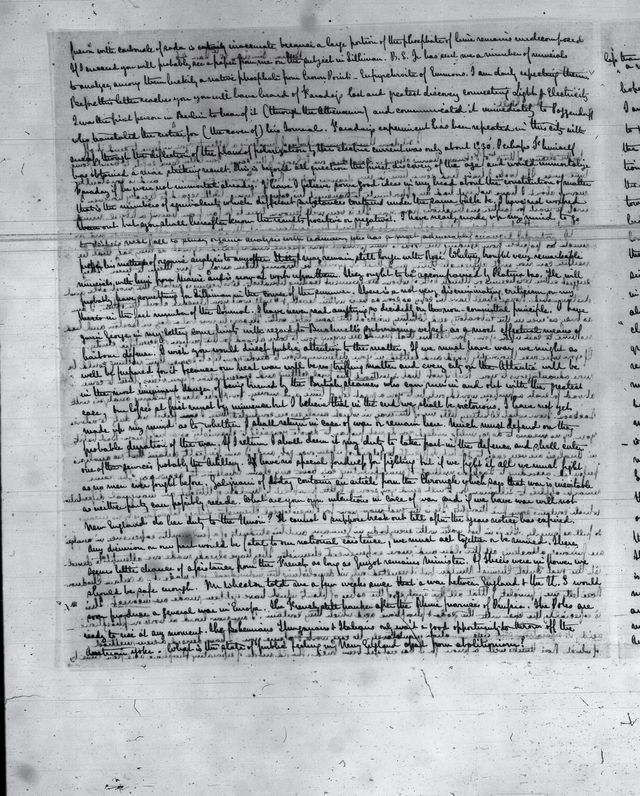
Preserved transcription
Transcription matched to this Wisconsin microfilm frame. Preserved from the supplied frame transcription; compare uncertain readings with the scan.
fusion with carbonate of soda is entirely inaccurate because a large portion of the phosphate of lime remains undecomposed
If I succeed you will probably see a paper from me on the subject in Silliman. B. S. Jr has sent me a number of minerals
to analyze, among them luckily a native phosphate from Crown Point - Eupyrchroite[?] of Emmons. I am daily expecting them.
Before this letter reaches you you will have heard of Faraday's last and greatest discovery connecting Light & Electricity
I was the first person in Berlin to hear of it (through the Athenaeum) and communicated it immediately to Poggendorff
who translated the notice for (the cover of) his Journal. Faraday's experiment has been repeated in this city with
success, though the deflection of the plane of polarization by the electric current was only about 1°.30'. Perhaps F. himself
has obtained a more striking result. This is beyond all question the finest discovery of the age and would immortalize
Faraday if he were not immortal already. I have I believe some good ideas in my head about the constitution of matter
that is the numbers of equivalents which different substances contain under the same bulk &c. I have not worked
them out but you shall hereafter know the results positive or negative. I have nearly made up my mind to go
to Giessen[?] next fall to pursue[?] organic analysis with Liebig, who has a most admirable [illegible, ~3 words]
prefer his method of organic analysis to any other. Still I may remain still longer with Rose. Whitney brought very remarkable
minerals with him from Maine and is now at work upon them. They ought to be accompanied by Platina[?] too. He will
probably have something for Silliman in the course of the summer. There is a not very discriminating criticism on my
theses in the last number of the Journal. I have never read anything so decidedly on the non-committal principle. I have
given George in my letter some hints with regard to Bushnell's submarine vessel as a most effectual means of
harbour defence. I wish you would direct public attention to the matter. If we must have war, we might as
well be prepared for it because our next war will be no trifling matter and every city on the Atlantic will be
in the most imminent danger of being burned by the British steamers who can run in and out with the greatest
ease. Our losses at first must be immense but I believe that in the end we shall be victorious. I have not yet
made up my mind as to whether I shall return in case of war or remain here. Much must depend on the
probable duration of the war. If I return I shall deem it my duty to take part in the defence and shall enter
one of the services probably the Artillery. I have no special fondness for fighting but if we fight at all we must fight
as no men ever fought before. Galignani of today contains an article from the Chronicle which says that war is inevitable
as neither party can possibly recede. What are your own intentions in case of war and if we have war will not
New England do her duty to the Union? It cannot I suppose break out till after the years notice has expired.
Any division on our part would be fatal to our national existence, we must act together or be ruined. There
seems little chance of assistance from the French as long as Guizot remains minister. If Thiers were in power we
should be safe enough. Mr Wheaton told me a few weeks since that a war between England & the U. S would
soon produce a general war in Europe. The French still hanker after the Rhine provinces of Prussia. The Poles are
ready to rise at any moment. The Bohemians Hungarians & Italians only wait a good opportunity to throw off the
Austrian yoke. What is the state of public feeling in New England apart from abolitionism?
Wisconsin Historical Society · WHS-R2-1173 · Letter from Wolcott to "Call"? (chemist friend), 25 Jan 1846
Open the complete archive frame record →