
Read the original · Check the transcription
Gibbs Family Papers, Reel 2, frame 1005 (reading copy)
Preserved transcription
Transcription matched to this Wisconsin microfilm frame. Preserved from the supplied frame transcription; compare uncertain readings with the scan.
Gibbs-Reg.-4
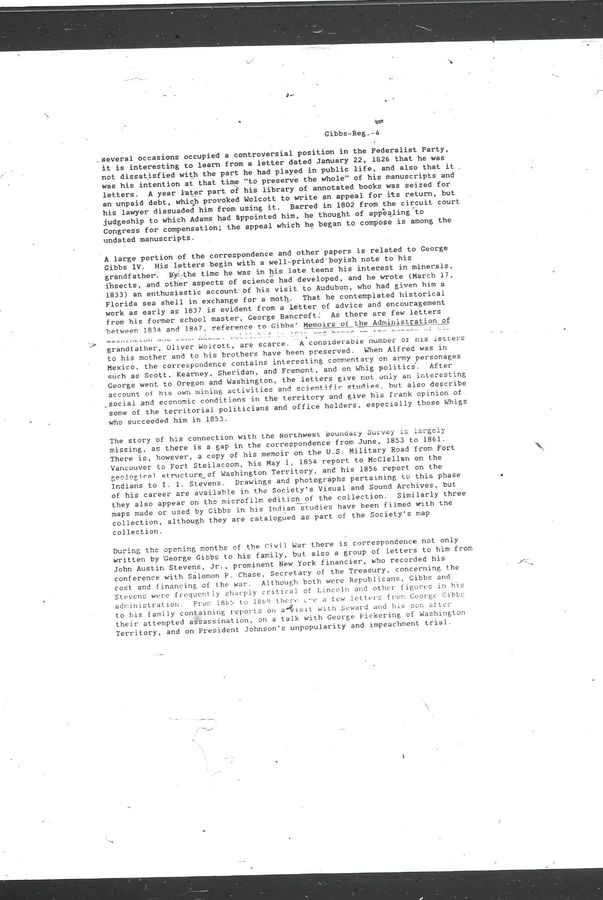
several occasions occupied a controversial position in the Federalist Party,
it is interesting to learn from a letter dated January 22, 1826 that he was
not dissatisfied with the part he had played in public life, and also that it
was his intention at that time "to preserve the whole" of his manuscripts and
letters. A year later part of his library of annotated books was seized for
an unpaid debt, which provoked Wolcott to write an appeal for its return, but
his lawyer dissuaded him from using it. Barred in 1802 from the circuit court
judgeship to which Adams had appointed him, he thought of appealing to
Congress for compensation; the appeal which he began to compose is among the
undated manuscripts.
A large portion of the correspondence and other papers is related to George
Gibbs IV. His letters begin with a well-printed boyish note to his
grandfather. By the time he was in his late teens his interest in minerals,
insects, and other aspects of science had developed, and he wrote (March 17,
1833) an enthusiastic account of his visit to Audubon, who had given him a
Florida sea shell in exchange for a moth. That he contemplated historical
work as early as 1837 is evident from a letter of advice and encouragement
from his former school master, George Bancroft. As there are few letters
between 1834 and 1847, reference to Gibbs' Memoirs of the Administration of
Washington and John Adams, published in 1846[?] and based on the papers of his
grandfather, Oliver Wolcott, are scarce. A considerable number of his letters
to his mother and to his brothers have been preserved. When Alfred was in
Mexico, the correspondence contains interesting commentary on army personages
such as Scott, Kearney, Sheridan, and Fremont, and on Whig politics. After
George went to Oregon and Washington, the letters give not only an interesting
account of his own mining activities and scientific studies, but also describe
social and economic conditions in the territory and give his frank opinion of
some of the territorial politicians and office holders, especially those Whigs
who succeeded him in 1853.
The story of his connection with the Northwest Boundary Survey is largely
missing, as there is a gap in the correspondence from June, 1853 to 1861.
There is, however, a copy of his memoir on the U.S. Military Road from Fort
Vancouver to Fort Steilacoom, his May 1, 1854 report to McClellan on the
geological structure of Washington Territory, and his 1856 report on the
Indians to I. I. Stevens. Drawings and photographs pertaining to this phase
of his career are available in the Society's Visual and Sound Archives, but
they also appear on the microfilm edition of the collection. Similarly three
maps made or used by Gibbs in his Indian studies have been filmed with the
collection, although they are catalogued as part of the Society's map
collection.
During the opening months of the Civil War there is correspondence not only
written by George Gibbs to his family, but also a group of letters to him from
John Austin Stevens, Jr., prominent New York financier, who recorded his
conference with Salomon P. Chase, Secretary of the Treasury, concerning the
cost and financing of the war. Although both were Republicans, Gibbs and
Stevens were frequently sharply critical of Lincoln and other figures in his
administration. From 1865 to 1869 there are a few letters from George Gibbs
to his family containing reports on a visit with Seward and his son after
their attempted assassination, on a talk with George Pickering of Washington
Territory, and on President Johnson's unpopularity and impeachment trial.
Wisconsin Historical Society · WHS-R2-1005 · Registrar's inventory (typescript) (document), 1948+
Open the complete archive frame record →