
Read the original · Check the transcription
Gibbs Family Papers, Reel 2, frame 3964 (thumbnail)
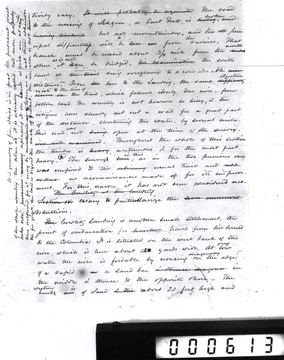
Preserved transcription
Transcription matched to this Wisconsin microfilm frame. Preserved from the supplied frame transcription; compare uncertain readings with the scan.
9
tively easy. [struck: It will probably be requisite] The road
to the crossing of Sehqun[?], or East Fork, is [struck: hilly] [inserted: broken] [struck: and]
[struck: heavily timbered]. but not mountainous, and the [struck: st] prin
cipal difficulty will be [struck: the] [struck: su] from [inserted: the] ravines. That
branch must be crossed about 3/4 mile from the [inserted: mouth] [struck: [illegible]]
where [inserted: as is said] it can be bridged, [struck: but examination] the south
bank at [struck: the trail] [inserted: [illegible]] being overflowed to a considerable [struck: man]
distance. From [struck: the] line to the Landing, the same [struck: difficulty] [inserted: objection]
[struck: occurs on] [inserted: exists to the line of] the trail, which follows closely the river, from
bottom land. The country is not however so hilly, & the
citizens have already cut out a road for a great part
of the distance, shortening the route, by several miles.
This road, not [struck: being] [inserted: was] open at the time of the survey.
[struck: was not examined]. Throughout the whole of this section
the timber is [struck: heavy] continuous & for the most part
heavy. ⊕ The survey [struck: here] [inserted: in this], as in the two previous ones
was confined to the [struck: ordinary] usual trail and [struck: not]
[struck: extensive] no reconnaissances made [struck: of] for its improve-
ment. For this reason it has not been considered nec-
[struck: The Cowlitz at the landing]
[struck: Section IV.] essary to particularize the [struck: [illegible, ~2 words]]
obstructions.
[struck: The] Cowlitz Landing is another small settlement, the
point of embarcation for [struck: travellers] travel from the Sound
to the Columbia It is situated on the west bank of the
river, which is here about 120[?] yards wide. At [inserted: very] low
water the river is fordable by crossing [inserted: diagonally] on the edge
of a rapid to [struck: an] a sand bar [struck: & thence diagonal] in
the middle & thence to the opposite shore— The
[inserted: western] banks [struck: are] [inserted: is] of sand [struck: & the] about 20 feet high and
[Left margin, written vertically, keyed to ⊕:]
It is generally of fir, which is in fact the prevalent forest
of the whole country, the cedar as it is usually called but more properly
arbor vitae, [struck: [illegible]] replacing it on [illegible] which are at any
time overflowed, for it may be [struck: mentioned as a] taken as a rule[?] that wherever
the fir grows, the land is beyond the reach of freshet. The converse is not [struck: true]
Wisconsin Historical Society · WHS-R2-3964 · George Gibbs IV (manuscript volume, ms p. 9), 1856 (Olympia) and later additions
Open the complete archive frame record →