
Read the original · Check the transcription
Gibbs Family Papers, Reel 2, frame 3874 (thumbnail)
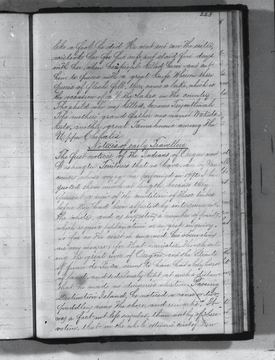
Preserved transcription
Transcription matched to this Wisconsin microfilm frame. Preserved from the supplied frame transcription; compare uncertain readings with the scan.
[page number, top right: 223]
like a fool he did. He went and saw the sister,
mistook her for his wife and staid five days
with her, when his people killed him and cut
him to pieces with a great knife Whereon these
pieces of flesh fell, there came a lake, which is
the occasion of all the lakes in the country.
The child who was killed, became Teyoutlmah[?]
The mothers grand father was named Wakute-
kute, another great Tamahnous among the
Upper Chihalis.
Notices of early Travellers
The first notices of the Indians of Oregon and
Washington Territories that we have, are by Van-
couvers whose voyage was performed in 1792. I have
quoted them much at length, because they
present a view of the condition of these tribes
before they had been affected by intercourse with
the whites, and as suggesting a number of points
which require explanation, or suggest inquiry.
So far as the coast is concerned, his observations
are very meagre; for that navigator, though seek-
ing the great river of Oregon, and the Straits
of Juan de Fuca, seems to have had a holy horror
of land, and sedulously kept at such a distance
that he made no discoveries whatever. Passing
Destruction Island, he noticed a canoe or two,
paddling near the shore, and remarks," It "
was a fact not less singular, than worthy of obser-
vation, that on the whole extensive coast of New
Wisconsin Historical Society · WHS-R2-3874 · George Gibbs IV (manuscript volume, ms p. 223), 1856 (Olympia) and later additions
Open the complete archive frame record →