
Read the original · Check the transcription
Gibbs Family Papers, Reel 2, frame 3858 (thumbnail)
Preserved transcription
Transcription matched to this Wisconsin microfilm frame. Preserved from the supplied frame transcription; compare uncertain readings with the scan.
[page number, top right: 215[?]]
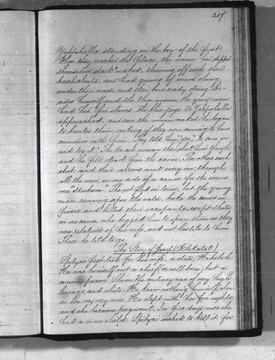
Yahpohalla standing in the bow of the first
When they reached the place, the women had stripped
themselves stark naked, throwing off each their
breech clouts, and had quivers of arrows slung
under their arms, and their bows ready strung. Be-
sides himself and the three women, the young man
had his five slaves, the blue jays. As Yahpohalla
approached, and saw the women naked, he began
to banter them, asking if they were coming to have
connexion with him. They told him "yes," to come on
and try it." The Ar-aih[?] woman then shot him through
and he fell dead from the canoe. The others each
shot, and their arrows went every one, through
all the men, on one side of a canoe. for the arrows
were "Skookoom." The rest fled in terror, but the young
man, running upon the water, broke the canoes in
pieces and killed their occupants, except those
in one canoe who begged him to spare them as they
were relatives of his wife, and not hostile to him.
These he told to go.
The Story of Josup[?] (Klikatat)
Spilyai first took for his wife, a star, (Haheloh[?])
He was himself not a chief (or well born) but a
common person. She on the contrary was of very high
lineage, and white. He knew nothing himself, where-
as she was very wise. He slept with her five nights
and she became pregnant. In five days more she
had a man child. Spilyai wished to kill it. for
Wisconsin Historical Society · WHS-R2-3858 · George Gibbs IV (manuscript volume, ms p. 207), 1856 (Olympia) and later additions
Open the complete archive frame record →