
Read the original · Check the transcription
Gibbs Family Papers, Reel 2, frame 3761 (thumbnail)
Preserved transcription
Transcription matched to this Wisconsin microfilm frame. Preserved from the supplied frame transcription; compare uncertain readings with the scan.
[page number: 118]
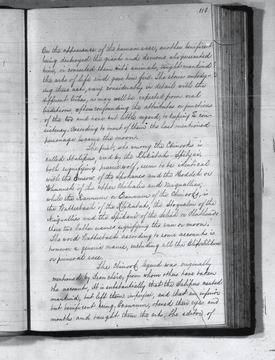
On the appearance of the human race, another benificent
being destroyed the giants and demons who persecuted
him, or converted them into animals, taught mankind
the arts of life and gave him fire. The stories embody-
ing these acts, vary considerably in detail with the
different tribes, as may well be expected from oral
traditions[?] often confounding the attributes or functions
of the two and have but little regard, to keeping [inserted: or] con-
sistency. According to most of them the last mentioned
personage became the moon.
The first, who among the Chinooks is
called Italipus[?], and by the Klikatats[?] - Spilyai[?],
both signifying prairie wolf, seems to be identical
with the Smeow[?] of the Spokanes and the Hoddeh[?] or
Whunnek[?] of the upper Chihalis and Nisquallies;
while the Kannum[?] or Ecannum of the Chinooks, is
the Watteebash[?] of the Klikatats[?], the Stoqualm[?] of the
Nisquallies and the Spikani[?] of the Selish or Flatheads
these two latter names signifying the sun or moon.
The word Watteebash[?] according to some accounts is
however a generic name, including all the Elip Tilikum[?]
or primeval race.
The Chinook legend was originally
mentioned by Franchere[?], from whom others have taken
the account, It is substantially that the Talipus[?] created
mankind, but left them imperfect, and that an inferior
but benificent being, Ecannum, opened their eyes and
mouths and taught them the arts. The editor of
Wisconsin Historical Society · WHS-R2-3761 · George Gibbs IV (manuscript volume, ms p. 118), 1856 (Olympia) and later additions
Open the complete archive frame record →