
Read the original · Check the transcription
Gibbs Family Papers, Reel 2, frame 1734 (thumbnail)
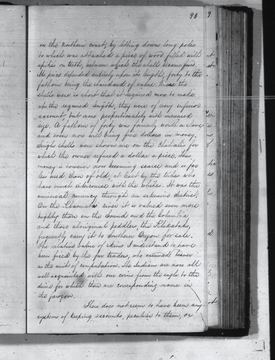
Preserved transcription
Transcription matched to this Wisconsin microfilm frame. Preserved from the supplied frame transcription; compare uncertain readings with the scan.
[page number, top right:] 93
on the Northern coast, by letting down long poles
to which was attached a piece of wood filled with
spikes or teeth, between which the shell became fixed.
Its price depended entirely upon its length, forty to the
fathom being the standard of value. Where the
shells were so short that it required more to make
up the required length, they were of very inferior
account, but rose proportionately with increased
size. A fathom of forty was formerly worth a slave,
and even now will bring five dollars in money.
Single shells were shown me on the Chihalis for
which the owner refused a dollar a piece. This
money is however now becoming scarce and is far
less used than of old, at least by the tribes who
have much intercourse with the whites. It was the
universal currency through an extensive district,
On the Klamath river it is valued even more
highly than on the Sound and the Columbia,
and those aboriginal peddlers, the Klikatats,
frequently carry it to Southern Oregon for sale.
The relative value of skins I understand to have
been fixed by the fur traders, who assumed beaver
as the unit of computation. The Indians are now all
well acquainted with our coins from the eagle to the
dime for which there are corresponding names in
the jargon.
There does not seem to have been any
system of keeping accounts, peculiar to them, or
Wisconsin Historical Society · WHS-R2-1734 · George Gibbs ms. draft on Washington Territory Indians (notebook p.61) (document), n.d. (c.1854-57?)
Open the complete archive frame record →