
Read the original · Check the transcription
Gibbs Family Papers, Reel 2, frame 1714 (thumbnail)
Preserved transcription
Transcription matched to this Wisconsin microfilm frame. Preserved from the supplied frame transcription; compare uncertain readings with the scan.
[page number: 75.]
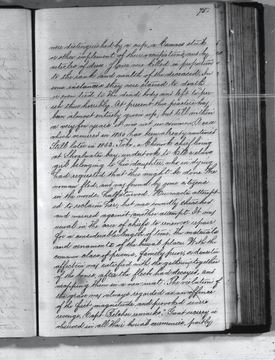
were distinguished by a cup, a Camass stick
or other implement of their occupations, and by
articles of dress. Slaves were killed in proportion
to the rank and wealth of the deceased. In
some instances they were starved to death
or even tied to the dead body and left to per-
ish thus horribly. At present this practice has
been almost entirely given up; but till within
a very few years it was not uncommon. A case
which occurred in 1850 has been already mentioned
Still later in 1853. Toke, a Chinook chief living
at Shoalwater bay, undertook to kill a slave
girl belonging to his daughter, who in dying
had requested that this might be done. The
woman fled, and was found by some citizens
in the woods, half starved. Her master attempt-
ed to reclaim her; but was soundly thrashed
and warned against another attempt. It was
usual in the case of chiefs to renew or repair
for a considerable length of time, the materials
and ornaments of the burial place. With the
common class of persons, family pride, or domestic
affection was satisfied with the gathering together
of the bones, after the flesh had decayed, and
wrapping them in a new mat. The violation of
the grave was always regarded as an offence
of the first magnitude, and provoked severe
revenge. Capt. Belcher remarks, "Great secrecy is
observed in all their burial ceremonies, partly
Wisconsin Historical Society · WHS-R2-1714 · George Gibbs ms. draft on Washington Territory Indians (notebook p.61) (document), n.d. (c.1854-57?)
Open the complete archive frame record →