
Read the original · Check the transcription
Gibbs Family Papers, Reel 2, frame 1712 (thumbnail)
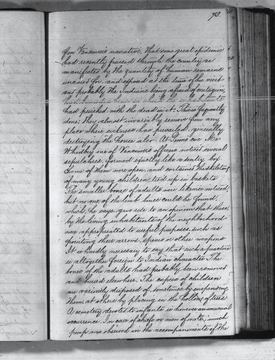
Preserved transcription
Transcription matched to this Wisconsin microfilm frame. Preserved from the supplied frame transcription; compare uncertain readings with the scan.
[page number, top right:] 73.
from Vancouvers narrative, that some great epidemic
had recently passed through the country as
manifested by the quantity of human remains
uncared for, and exposed at the time of his visit
and probably the Indians being afraid of contagion,
had burned a house in which the inhabitants
had perished, with the dead in it. This is frequently
done: they almost invariably remove from any
place where sickness has prevailed, generally
destroying the house also. At Penn's cove Mr
Whidby one of Vancouver's officers noticed several
sepulchres, formed exactly like a sentry box.
Some of them were open, and contained the skeletons
of many young children, tied up in baskets
The smaller bones of adults were likewise noticed,
but no one of the limb bones could be found,
which, he says, gave rise to an opinion that these,
by the living inhabitants of the neighborhood-
were appropriated to useful purposes, such as
pointing their arrows, spears or other weapons.
It is hardly necessary to say that such a practice
is altogether foreign to Indian character. The
bones of the adults had probably been removed
and buried elsewhere. The corpses of children
are variously disposed of, sometimes by suspending
them, at others by placing in the hollows of trees.
A cemetery devoted to infants is however an unusual
occurrence. In case of chiefs or men of note, much
pomp was observed in the accompaniments of the
Wisconsin Historical Society · WHS-R2-1712 · George Gibbs ms. draft on Washington Territory Indians (notebook p.61) (document), n.d. (c.1854-57?)
Open the complete archive frame record →