
Read the original · Check the transcription
Gibbs Family Papers, Reel 2, frame 1707 (thumbnail)
Preserved transcription
Transcription matched to this Wisconsin microfilm frame. Preserved from the supplied frame transcription; compare uncertain readings with the scan.
[printed: page number in ink, top right:] 68.
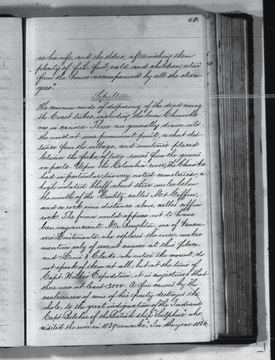
as his wife, and the elders, after wishing them
plenty of fish, fruit, roots, and children, retire
from the house accompanied by all the stran-
gers."
Sepulture.
The common mode of disposing of the dead among
the Coast tribes, including the lower Chinooks
was in canoes. These are generally drawn into
the woods at some prominent point, a short dis-
tance from the village, and sometimes placed
between the forks of trees, raised from the ground
on posts. Upon the Columbia river, the Chinooks
had in particular, two very noted cemeteries, a
high isolated bluff about three miles below
the mouth of the Cowlitz, called Mt. Coffin,
and a rock some distance above, called coffin
rock. The former would appear not to have
been very ancient. Mr. Broughton, one of Vancou-
vers Lieutenants, who explored the river, makes
mention only of several canoes at this place,
and Lewis & Clarke, who notice the mount, do
not speak of them at all; but at the time of
Capt. Wilkes Expedition, it is conjectured that
there were at least 3000. A fire caused by the
carelessness of some of his party destroyed the
whole, to the great indignation of the Indians.
Capt. Belcher of the British ship "Sulphur" who
visited the river in 1839 remarks; "In the year 1836.
Wisconsin Historical Society · WHS-R2-1707 · George Gibbs ms. draft on Washington Territory Indians (notebook p.61) (document), n.d. (c.1854-57?)
Open the complete archive frame record →