
Read the original · Check the transcription
Gibbs Family Papers, Reel 2, frame 1684 (thumbnail)
Preserved transcription
Transcription matched to this Wisconsin microfilm frame. Preserved from the supplied frame transcription; compare uncertain readings with the scan.
[page number, top right: 46]
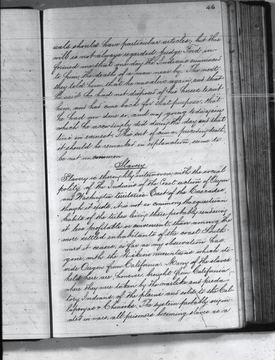
uals should have particular articles; but this
will is not always regarded. Judge Ford in-
formed me that one day the Indians announced
to him, the death of a man near by. The next
they told him, that he was alive again, and that
he said he had not disposed of his horses to suit
him, and had come back for that purpose, that
he had now done so, and was going to die again
which he accordingly did during the day and that
time in earnest. This sort of coma, preceding death,
it should be remarked in explanation, seems to
be not uncommon.
Slavery.
Slavery is thoroughly interwoven, with the social
polity of the Indians of the Coast section of Oregon
and Washington territories. East of the Cascades,
though it exists, it is not so common, the equestrian
habits of the tribes living there probably rendering
it less profitable or convenient, than among the
more settled inhabitants of the coast. South-
ward it ceases, so far as my observation has
gone, with the Hikiou[?] mountains which di-
vide Oregon from California. Many of the slaves
held here are, however, brought from California,
where they were taken by the warlike and preda-
tory Indians, of the plains and sold to the Cal-
lapooyas & Chinooks. The system probably origin-
ated in wars, all prisoners becoming slaves as a
Wisconsin Historical Society · WHS-R2-1684 · Manuscript (George Gibbs ethnography)
Open the complete archive frame record →