
Read the original · Check the transcription
Gibbs Family Papers, Reel 2, frame 1656 (thumbnail)
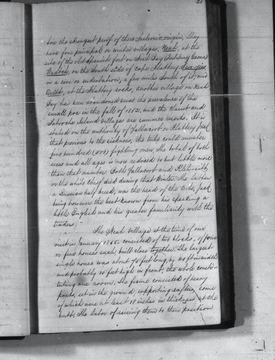
Preserved transcription
Transcription matched to this Wisconsin microfilm frame. Preserved from the supplied frame transcription; compare uncertain readings with the scan.
[page number, top right: 21]
bore the strongest proof of their Scalvonic origin. They
have four principal or winter villages. Neah, at the
site of the old Spanish fort on Neah Bay (Port Nunez Gaona)
Waatch, on the South side of cape Flattery. Tsoo-yess,
in a cove or indentation, a few miles South of it; and
Osett[?], at the Flattery rocks, another village on Neah
Bay has been abandoned since the prevalence of the
small pox in the fall of 1852, and the Classet and
Tatooche Island villages are summer resorts. It is
stated on the authority of Yallacoot[?] or Flattery Jack
that previous to the sickness, the tribe could muster
five hundred (500) fighting men. The total of both
sexes and all ages is now reduced to but little more
than that number. Both Yallacoot[?] and Kleh-sitt[?]
or the white Chief died during that Winter. The latter
a Russian half breed, was the head of the tribe, Jack
being however the best known from his speaking a
little English and his greater familiarity with the
traders."
The Neah village at the time of our
visit in January 1855. consisted of two blocks, of four
or five houses each, built close together. The largest
single house was about 75 feet long, by 40 ft in width
and probably 15 feet high in front, the whole consti-
tuting one room. The frame consisted of heavy
posts, set in the ground, supporting rafters, some
of which were at least 18 inches in thickness at the
butt. The labor of raising them to their position
Wisconsin Historical Society · WHS-R2-1656 · George Gibbs IV ethnographic ms., notebook p.13 (document), c.1856
Open the complete archive frame record →