
Read the original · Check the transcription
Gibbs Family Papers, Reel 2, frame 1572 (thumbnail)
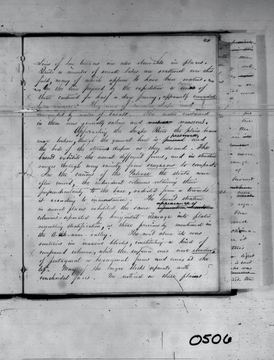
Preserved transcription
Transcription matched to this Wisconsin microfilm frame. Preserved from the supplied frame transcription; compare uncertain readings with the scan.
40
Lines of low terraces are also observable in places.
Quite a number of small lakes are scattered over this
field, many of which appear to have been craters. ⌐
⌐ On the line pursued by the expedition a [struck: [illegible]] [inserted: series] of
these continued for half a days journey, apparently connected
by a ravine[?]. They were of circular shape and
surrounded by walls of basalt. The water contained
in them was generally saline and [struck: nauseat[?]] nauseous.
Approaching the Snake River the plains become
more broken, though the general level is [struck: pursued[?]] [inserted: preserved,] and
the beds of the streams deepen as they descend - The
basalt exhibits the usual different forms, and in structure
ranges through every variety from scoriaceous[?] to compact.
In the cañons of the Palouse the strata were
often curved, the individual columns retaining their
perpendicularity to the base, radiated from or towards
it according to circumstance. The lowest stratum
in several places exhibited the same [struck: separation into] [inserted: appearance of]
columns - separated by horizontal cleavage into plates
resembling stratification, as those previously mentioned in
the A-[struck: tah[?]]-nam-valley. The next above it was
sometimes in massive blocks, constituting a kind of
compound column, while the superior ones were slender,
of pentagonal or hexagonal forms and convex at the
top. Many of the larger blocks separate with
conchoidal faces. We noticed on these plains
[stamp: 0506]
Wisconsin Historical Society · WHS-R2-1572 · George Gibbs draft report (geology, upper Columbia) (document), n.d. [c.1853-54]
Open the complete archive frame record →