
Read the original · Check the transcription
Gibbs Family Papers, Reel 2, frame 1536 (thumbnail)
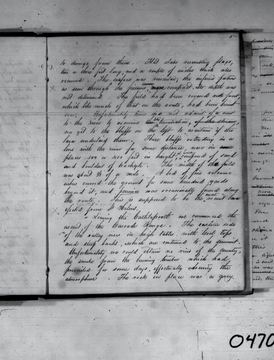
Preserved transcription
Transcription matched to this Wisconsin microfilm frame. Preserved from the supplied frame transcription; compare uncertain readings with the scan.
[page number, top right:] 5
to diverge from them. Flat slabs resembling flags,
two or three feet long, and a couple of inches thick also
occurred. The surface was vesicular; the inferior portions
as seen through the fissures, [inserted: was] [struck: more] compact. Its depth was
not determined. The field [inserted: [illegible]] had been covered with forest,
which like much of that on the route, had been burnt
over. Unfortunately time did not admit of a visit
to the river to examine [struck: the] [inserted: its] termination, [struck: of the stream],
nor yet to the bluffs on the [inserted: [illegible]] left to ascertain if the
lava underlaid them. These bluffs extending in a
line with the river for some distance, were in [struck: some]
places 300 or 400 feet in height, [inserted: & were] composed of sand
and boulders of trachyte. The width of the field
was about 1/3 of a mile. A bed of fine volcanic
ashes covered the ground for some hundred yards
beyond it, and pumice was occasionally found along
the route. This is supposed to be the [inserted: most] recent lava
[pencil, above the line: ejected or effected[?]] ejected from St Helens.
Leaving the Cathlapootl[?] we commenced the
ascent of the Cascade Range. The eastern side
of the valley rises in high tables, with level tops
and steep banks, which are continued to the summit.
Unfortunately we could obtain no view of the country,
the smoke from the burning timber which had
prevailed for some days, effectually obscuring the
atmosphere. The rock in place was a grey
[stamp: 0470]
Wisconsin Historical Society · WHS-R2-1536 · Letter from George to Capt. G. B. McClellan, 1854-05-01
Open the complete archive frame record →