
Read the original · Check the transcription
Gibbs Family Papers, Reel 2, frame 3965
Preserved transcription
Transcription matched to this Wisconsin microfilm frame. Preserved from the supplied frame transcription; compare uncertain readings with the scan.
[Left margin, written vertically, reading bottom to top, running beside lines 1–17 of the main text. The line order and many words are uncertain; see Reading notes:]
of the whole country. It is generally of fir, which is in front[?] the luxuriant forest
alder [illegible]. the cedar [illegible] as it is usually called, but more properly
time overflowed, for it may be [illegible] [struck: [illegible]] upplacing[?] it on lands[?] it [illegible] are at any
the fir [illegible], the land is beyond the fir [illegible] and the [illegible] of fir[?] is a feet[?] [illegible] thick[?]. The course[?] is not [struck: [illegible]]
[At the head of the margin: 9]
[Main text:]
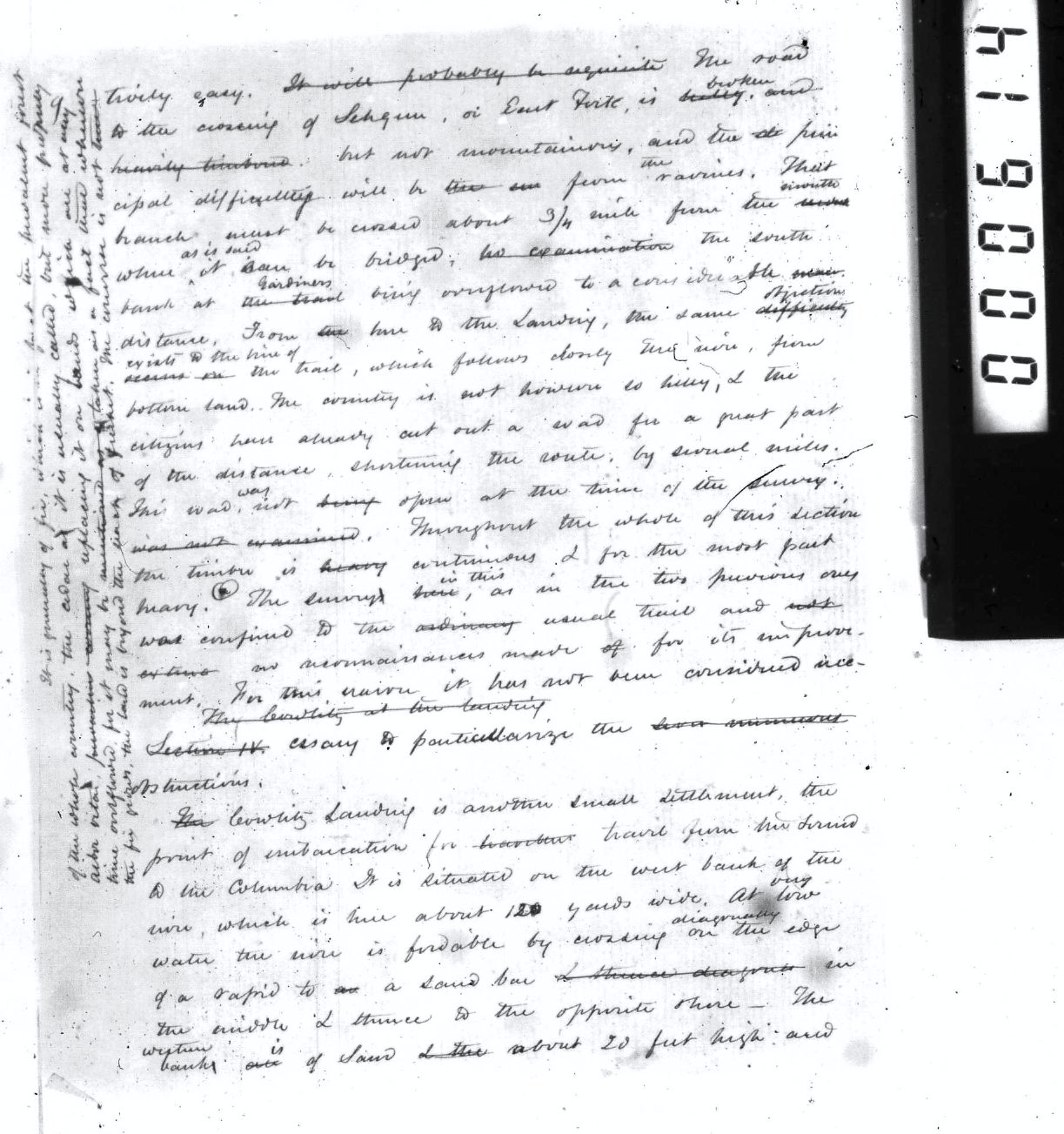
tively easy. [struck: It will probably be requisite] The road
to the crossing of Lehgum[?], or East Fork, is [struck: hilly,] [inserted: broken] [struck: and]
[struck: heavily timbered]. but not mountainous, and the [struck: dc] prin-
cipal difficulty will be [struck: the ess] from [inserted: the] ravines. That
branch must be crossed about 3/4 mile from the [inserted: mouth] [struck: road]
where [inserted: as is said] it can be bridged, [struck: by examination] the south
bank at [struck: the trail] [inserted: Gardiners] being overflowed to a considerable [struck: mi]
distance. From [struck: the] here to the Landing, the same [struck: difficulty] [inserted: objection]
[struck: seems on] [inserted: exists to the line of] the trail, which follows closely the river, from
bottom land. The country is not however so hilly, & the
citizens have already cut out a road for a great part
of the distance, shortening the route by several miles.
This road, not [struck: being] [inserted: way] open at the time of the survey.
[struck: was not examined]. Throughout the whole of this section
the timber is [struck: heavy] continuous & for the most part
heavy. ⊕ The survey [struck: here] [inserted: in this], as in the two previous ones
was confined to the [struck: ordinary] usual trail and [struck: not]
[struck: extens] no reconnaissances made of for its improve-
ment. For this reason it has not been considered nec-
[struck: The Cowlitz at the Landing]
[struck: Section IV.] essary to particularize the [struck: [illegible, ~2 words]]
obstructions.
[struck: The] Cowlitz Landing is another small settlement, the
point of embarcation for [struck: travellers] travel from the Sound
to the Columbia. It is situated on the west bank of the
river, which is here about 120 yards wide. At [inserted: very] low
water the river is fordable by crossing [inserted: diagonally] on the edge
of a rapid to [struck: an] a sand bar [struck: & thence diagonally] in
the middle & thence to the opposite shore. The
[inserted: western] bank [struck: are] [inserted: is] of sand [struck: & the] about 20 feet high and
[stamp: frame number, rotated vertically at right edge; digits not securely legible]
Wisconsin Historical Society · WHS-R2-3965 · George Gibbs IV (manuscript volume, ms p. 9), 1856 (Olympia) and later additions
Open the complete archive frame record →