
Read the original · Check the transcription
Gibbs Family Papers, Reel 2, frame 3923
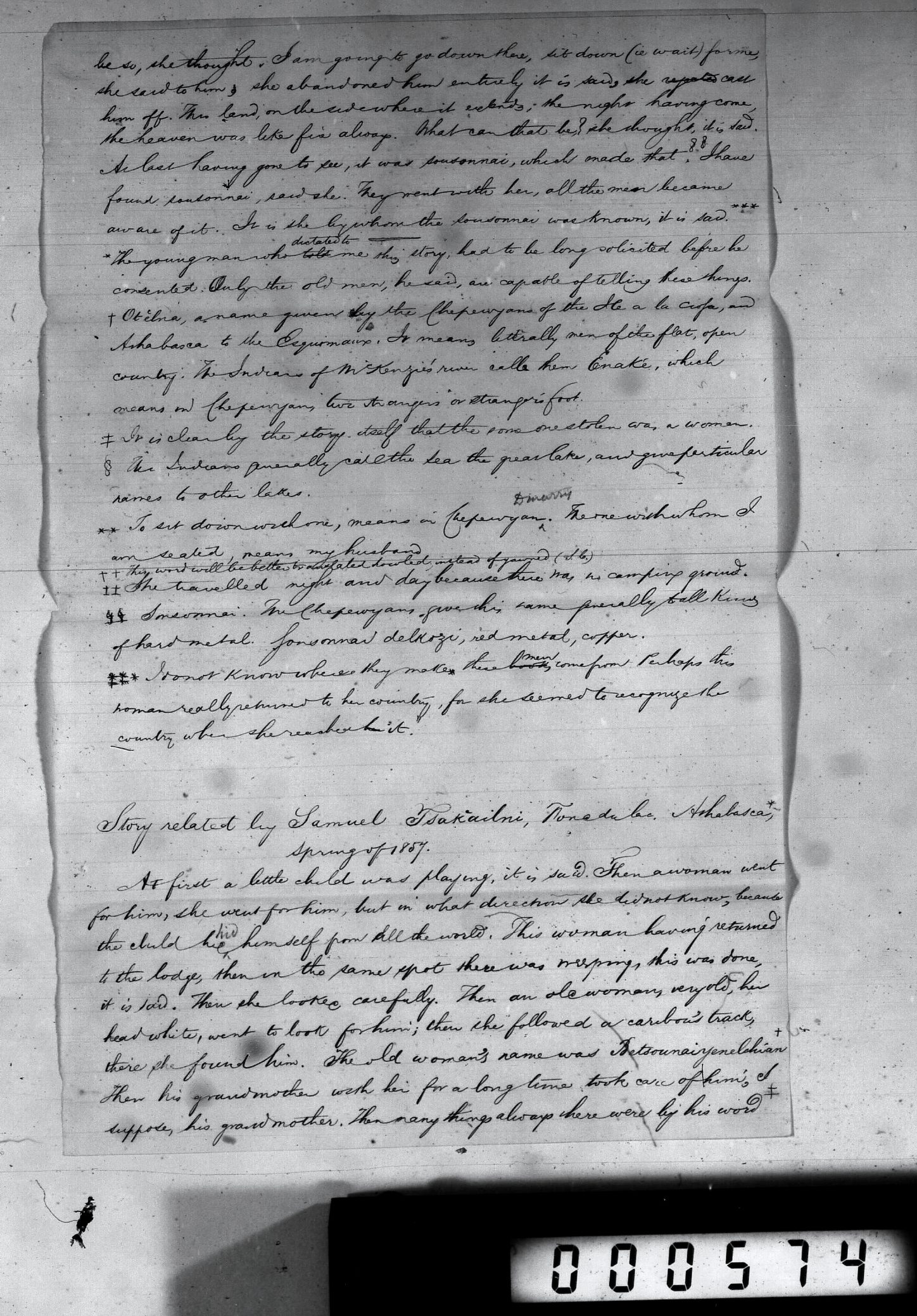
Preserved transcription
Transcription matched to this Wisconsin microfilm frame. Preserved from the supplied frame transcription; compare uncertain readings with the scan.
be so, she thought. I am going to go down there, sit down (ie wait) for me,
she said to him; she abandoned him entirely it is said, she [struck: repeated[?]] call
him off. This land, on the side where it extends, the night having come,
the heaven was like fire alway. What can that be? she thought, it is said.
At last having gone to see, it was sousonnai, which made that. §§ I have
found sousonnai, said she. They went with her, all the men became
aware of it. It is she by whom the sousonnai was known, it is said.***
*The young man who [struck: told] [inserted: dictated to] me this story, had to be long solicited before he
consented. Only the old men, he said, are capable of telling these things.
† Otélna, a name given by the Chepewyans of the Ile a la Crosse, and
Athabasca to the Esquimaux. It means literally men of the flat, open
country. The Indians of McKenzie's river call them Enaké, which
means in Chepewyan, two[?] strangers or strangers foot.
‡ It is clear by the story itself that the some one stolen was a women.
§ The Indians generally call the sea the great lake, and give particular
names to other lakes.
** To sit down with one, means in Chepewyan [inserted: to marry]. The one with whom I
am seated, means my husband.
†† this word will be better translated travelled, instead of gained ([illegible])
‡‡ She travelled night and day because there was no camping ground.
§§ Sonsonnai[?]. The Chepewyans give this name generally to all kind
of hard metal. Sonsonnai delkozi, red metal, copper.
*** I do not know where they make these [struck: [illegible]] [inserted: men] come from. Perhaps this
woman really returned to her country, for she seemed to recognize the
country when she reached [struck: h] it.
Story related by Samuel Tsakailni, Fond du lac. Athabasca,*
Spring of 1867.
At first a little child was playing, it is said. Then a woman went
for him, she went for him, but in what direction she did not know, because
the child hi[illegible] [inserted: hid] himself from all the world. This woman having returned
to the lodge, then on the same spot there was weeping, this was done,
it is said. Then she looked carefully. Then an old woman, very old, her
head white, went to look for him; then she followed a cariboo's track,
there she found him. The old woman's name was Betsounaiyenelchian[?]†
Then his grandmother with her for a long time took care of him, I
suppose, his grandmother. Then many things always there were by his word‡
Wisconsin Historical Society · WHS-R2-3923 · George Gibbs IV (manuscript volume, n.p.), 1856 (Olympia) and later additions
Open the complete archive frame record →