
Read the original · Check the transcription
Gibbs Family Papers, Reel 2, frame 3896
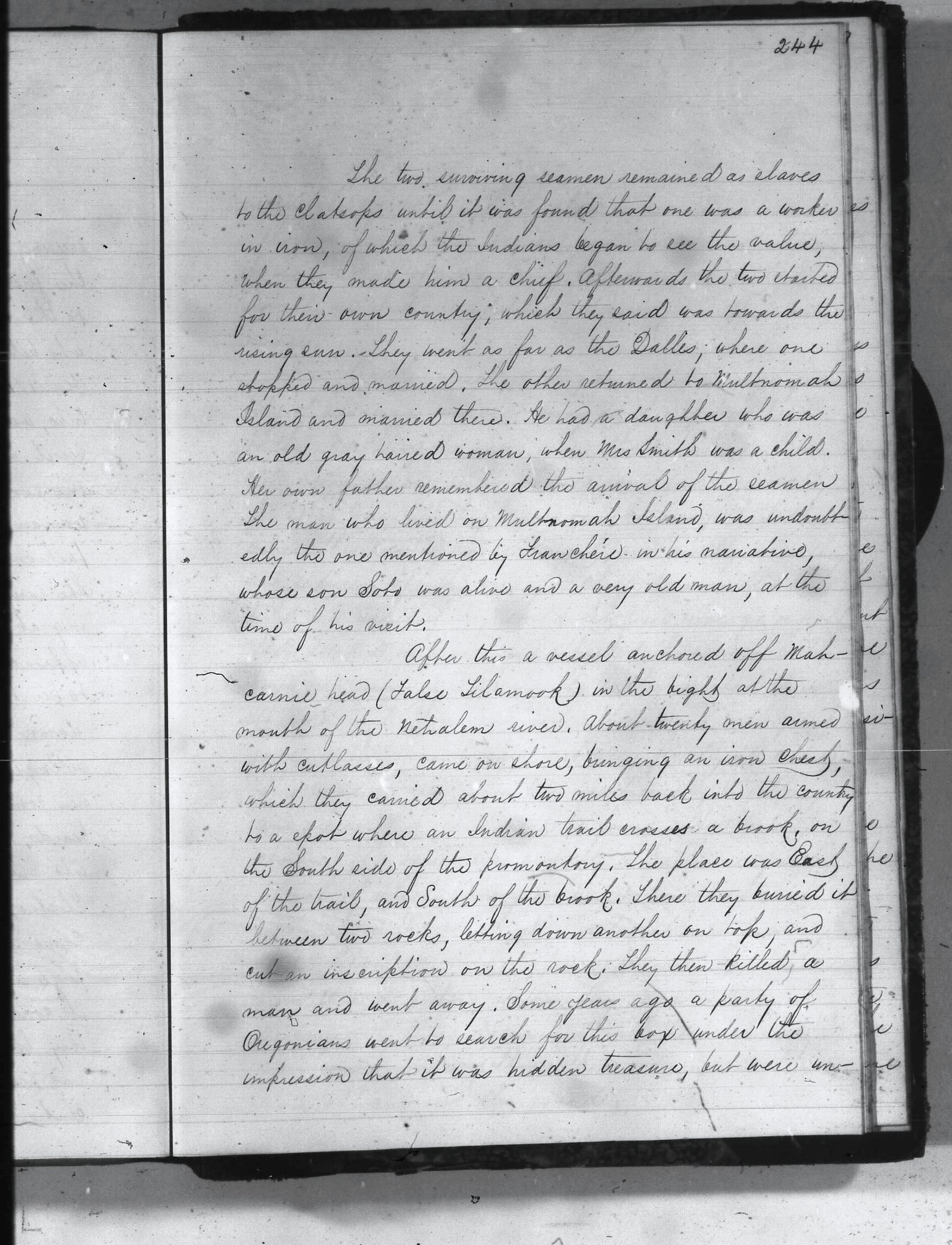
Preserved transcription
Transcription matched to this Wisconsin microfilm frame. Preserved from the supplied frame transcription; compare uncertain readings with the scan.
[page number, top right:] 244
The two surviving seamen remained as slaves
to the Clatsops until it was found that one was a worker
in iron, of which the Indians began to see the value,
when they made him a chief. Afterwards the two started
for their own country; which they said was towards the
rising sun. They went as far as the Dalles, where one
stopped and married. The other returned to Multnomah
Island and married there. He had a daughter who was
an old gray haired woman, when Mrs Smith was a child.
Her own father remembered the arrival of the seamen
The man who lived on Multnomah Island, was undoubt-
edly the one mentioned by Franchére[?] in his narrative,
whose son Soto[?] was alive and a very old man, at the
time of his visit.
After this a vessel anchored off Mah-
carnie head (False Tilamook) in the bight at the
mouth of the Nehalem river. About twenty men armed
with cutlasses, came on shore, bringing an iron chest,
which they carried about two miles back into the country
to a spot where an Indian trail crosses a brook, on
the South side of the promontory. The place was East
of the trail, and South of the brook. There they buried it
between two rocks, letting down another on top, and
cut an inscription on the rock. They then killed, a
man and went away. Some years ago a party of
Oregonians went to search for this box under the
impression that it was hidden treasure, but were un-
Wisconsin Historical Society · WHS-R2-3896 · George Gibbs IV (manuscript volume, ms p. 244), 1856 (Olympia) and later additions
Open the complete archive frame record →